
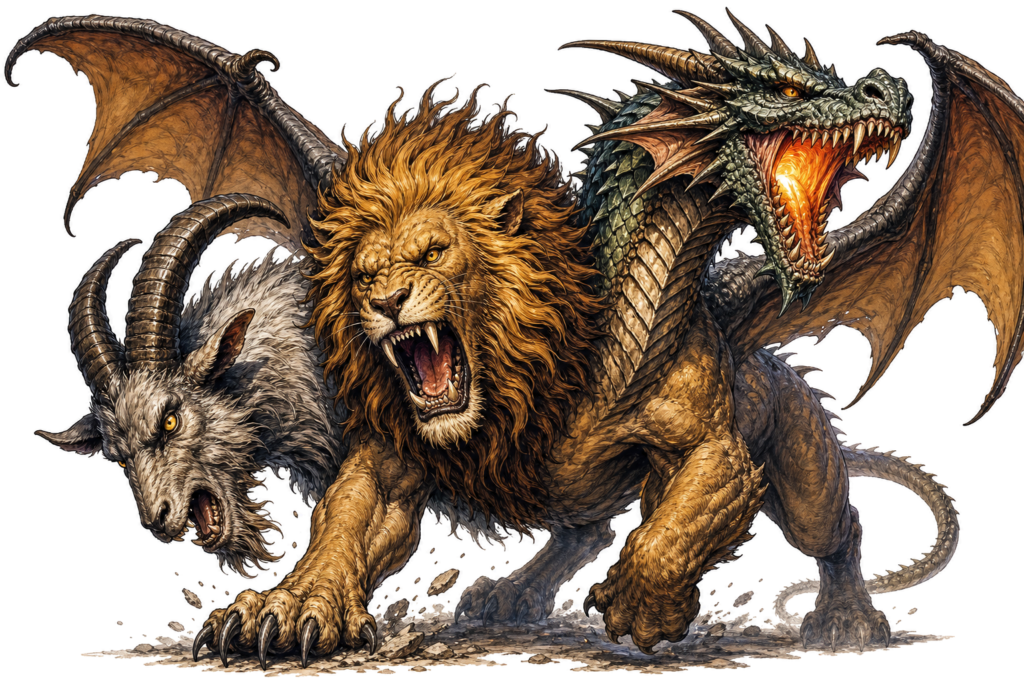
Three heads, five attacks, and fire. The goat head is already butting while the lion bites and the dragon head swings toward you with its mouth opening. You have one round before the breath.
Core Statistics #
| Stat | Value |
|---|---|
| Hit Dice | 9d8** (avg 41 HP) |
| AC | 16 |
| AV | 3 (melee) / 2 (missile) |
| HR | +7 |
| FR | +6 |
| FD | 18 |
| Move | 120 ft (40 ft encounter) ground / 180 ft (60 ft encounter) flying |
| Attacks | 2 claws (1d3/1d3) + 3 heads (2d4 goat butt / 1d10 lion bite / 3d4 dragon bite) + fire breath (3d6, 50 ft cone, 10 ft wide) |
| No. Appearing | 1d2 (1d4) |
| Save As | Fighter 9 |
| Morale | 9 |
| Treasure | Type F |
| Alignment | Chaotic |
| CR | 11 |
| Size | Large |
| Intelligence | Low (INT 6) |
| XP | 2,300 |
| Load | 4,500 cn full speed / 9,000 cn half speed |
| Barding Multiplier | ×3 |
AC/AV Reasoning #
RC original is AC 4 (descending) = Ascending AC 16. The chimera’s protection comes from its mixed anatomy — lion hide on the forebody, goat hide with thick horns on the hindquarters, dragon-scale patches on the wings and tail.
- AC 16 — The chimera’s three-anatomy body creates an unpredictable attack profile. Its five separate attack surfaces (two front claws, three heads) mean it is never still — something is always moving in a different direction. The dragon-scale patches on the lateral body and wings deflect many glancing strikes
- AV 3 (melee) — The mixed hide/scale body averages to chain-mail equivalent absorption. The dragon-scale patches are dense enough to partially deflect weapons; the lion-hide forebody and goat-hide rear are tough but not exceptional. AV 3 represents this uneven but substantial natural armor
- AV 2 (missile) — Arrows find the softer lion-hide sections reliably, reducing average absorption
- FD 18 — Large four-legged creature with significant mass. Formula: 10 + STR mod (+6, implied by 1d10 lion bite and overall size) + Size (+2) + hide/scale armor (+1) = 19 — reduced to 18 to reflect that the chimera is not optimally stable (three heads and mismatched hindquarters create a slightly unstable posture)
Skill Slots #
(9 total — 9 HD = 4 base + 5 at 9 HD; ** = 2 special ability slots)
Standard 9 HD budget: 4 base + 5 at 9 HD = 9 slots + 2 asterisk slots = 11 total. Low intelligence (INT 6) limits social and cognitive skill development. This entry uses 9 substantive slots.
| Slot | Skill / Ability | Notes |
|---|---|---|
| 1 | HR Investment (Skilled) | HR +7; five separate attack surfaces require the DM to track each independently — the chimera is genuinely multi-weapon capable |
| 2 | FR Investment (Basic) | FR +6; the chimera can Shove and pin with its lion-forebody mass — it may press a fallen opponent with its forepaws while all three heads continue attacking |
| 3 | Fire Breath (innate, special) | 3 uses per day, 50% chance per round when available. 3d6 fire damage, cone 50 ft long × 10 ft wide at the end. First asterisk |
| 4 | Rogue Behavior (innate, special) | The campaign-level threat mode. Full mechanics below. Second asterisk |
| 5 | Flight (innate) | 180 ft (60 ft encounter) with full combat capability. The chimera fights equally well in the air and on the ground. Wings are dragon-derived and functional |
| 6 | Alertness (Basic) | Cannot be surprised; three independent sensory systems (lion eyes forward, goat eyes lateral with near-360-degree field, dragon heat sense) provide exceptional situational awareness |
| 7 | Territorial Instinct (innate) | The chimera marks and defends a territory of approximately 10-mile radius. Any intrusion within this territory is known to the chimera within 1d6 hours (through regular patrol or territorial marking disturbance). It responds with aggression regardless of the intruder’s apparent strength |
| 8 | Intimidation (Basic) | Three heads simultaneously making noise — a lion roar, a goat shriek, and a dragon hiss from three different directions overwhelms the prey’s threat-assessment instincts. Creatures of 4 HD or fewer seeing the chimera for the first time must make a Morale check at –2 |
| 9 | Survival (Basic) | The chimera’s Low intelligence supports basic territory management — it knows its hunting grounds, the location of prey concentrations, and navigates reliably between its lair and hunting range |
Martial Style #
Style: Hard (Skilled rank) — Maximum output, all five attacks, every round Secondary: Proactive — the dragon head’s breath preference (50% use each round creates an opening-round pressure that the Hard attacks follow up) Rank: Skilled
The chimera fights without tactical sophistication — it is Chaotic and Low intelligence — but it fights with relentless ferocity. Five attacks per round with the constant breath threat is not a strategy, it is a blender. The Hard Skilled rank reflects that the chimera has practiced nothing and simply attacks everything in reach from every available attack surface simultaneously.
Combat Breath (CB): Base CB = 9 (Fighter-class 9 HD) + CON modifier (+2, robust constitution) = 11 CB. The chimera’s three-head attack coordination actually burns slightly less CB per round than a single-weapon fighter of equivalent HD because many attacks are instinctive rather than deliberately executed. The chimera Winds only in extremely extended combats.
The Five-Attack System #
The chimera makes five melee attacks per round plus the potential fire breath. Understanding how these distribute is essential for running the encounter correctly.
Attack Allocation #
| Attack | Damage | Notes |
|---|---|---|
| Left claw | 1d3 | Front lion-forebody; targets whatever is in front-left |
| Right claw | 1d3 | Front lion-forebody; targets whatever is in front-right |
| Goat head butt | 2d4 | From the hindquarters area — the goat neck extends from the rear/side of the body; targets rear or side threats |
| Lion head bite | 1d10 | Primary front attack from the main lion-head; highest single-bite damage |
| Dragon head bite | 3d4 | Alternative to breath — the dragon head bites if breath is not used |
Distribution against a party: The chimera cannot concentrate all five attacks on one target — the goat head faces rearward/lateral, the claws are front, and the two biting heads are both forward. Against a spread party:
- Characters in front: claws (2×1d3) + lion bite (1d10) + dragon bite or breath
- Characters at the flank or rear: goat head butt (2d4) as they try to attack from the side
Against a single target (solo encounter or a party that has foolishly clustered):
- All five attacks concentrate — potential 1d3+1d3+2d4+1d10+3d4 in one round = avg 23 damage, plus breath
The Claw Hug #
If both claw attacks hit the same target: the chimera grips with both forepaws, dealing an additional 1d8 raking damage as the lion instinct takes over and the rear paws rake. AV applies.
Fire Breath — Complete Mechanics #
Specifications #
- Cone dimensions: 50 ft long, 10 ft wide at the end (standard dragon-breath cone geometry — 0 ft at the mouth, widening to 10 ft at 50 ft range)
- Damage: 3d6 (avg 10.5)
- Save: Save vs. Dragon Breath for half damage
- Uses per day: 3 maximum
- Usage probability: 50% chance each round when uses remain
Usage Procedure #
Each round, before the chimera’s attacks resolve, the DM secretly determines breath use:
- Does the chimera have breath uses remaining? (Track 0/1/2/3 uses)
- If yes: roll d6. On 4–6 (50% = roughly d6 4+): the dragon head breathes this round. On 1–3: the dragon head bites instead (3d4 damage, standard attack)
- If the dragon head breathes: resolve cone damage vs. all targets in the 50×10 ft cone, then resolve remaining four melee attacks
Why 50% and not guaranteed: The RC’s 50% reflects that the chimera’s dragon head is not fully obedient to the chimera’s overall combat intent — the three heads have independent instincts and the dragon head does not always choose to breathe. This also prevents the chimera from being a guaranteed 3d6 area attacker every round, which would make it substantially more dangerous.
Tracking uses: The chimera uses all three breath attacks in 3–6 rounds on average (50% per round means roughly 2 rounds per use). After the third use “it will use only its other attacks” — the DM transitions the dragon head to bite-only for the rest of the combat.
Positioning the cone: The chimera aims the breath at the largest cluster of opponents. In a spread party, the 10 ft wide end of the cone may catch 1–2 targets. Against a clustered party, potentially all 4. The DM should honestly assess the cone geometry each round the chimera breathes.
Rogue Chimera — The Campaign Threat #
“Occasionally, a chimera — ill-tempered and dangerous to begin with — will turn rogue.”
This is the chimera’s most important campaign feature and distinguishes it from being merely a territorial monster to being a regional catastrophe.
What Triggers Rogue Status #
The RC does not specify triggers — the rogue state is treated as random or personality-based. Possible triggers:
- Loss of a mate (the 1d4 lair group includes mated pairs — a widowed chimera has elevated chance of going rogue)
- Territorial defeat by a stronger creature forcing displacement
- An unusual alignment of its three-headed instincts toward destruction rather than territorial defense
- DM decision as a campaign event
DM guidance: Treat rogue status as a campaign-level decision, not a random encounter roll. A rogue chimera is an adventure hook, not a wandering monster.
Rogue Behavior #
“A rogue chimera flies to some distant place (usually a hill or mountain near a human community) and begins to terrorize the area, trying to drive out or kill every living thing in that region.”
Mechanical profile:
- Selects a location near a human settlement (instinctive preference — the prey concentration and the destruction potential both appeal)
- Attacks every living creature it finds in a 10-mile radius systematically
- Does not flee. Does not negotiate. Does not respond to deterrents. Morale becomes 12 — absolute commitment
- Continues until everything in the region is dead/fled OR the chimera is killed
Timeline: A rogue chimera left alone will depopulate a 10-mile-radius area within 1d4 weeks. It kills livestock first (easiest prey), then attacks the settlement directly, then hunts survivors. Within a month, the region is empty.
Why it cannot be negotiated with: The rogue state is not territorial aggression (which can be satisfied by leaving) — it is a drive to destruction that has no satisfaction condition except complete depopulation. Even a party that offers tribute or leaves the territory finds the chimera follows them out of the area and continues elsewhere.
The adventure hook: A town reports that something has been killing livestock, then villagers, for three weeks. The attacks come from the air. Nothing deters it. The party must track the rogue chimera to its current lair on the nearby mountain and kill it — there is no other resolution.
As a Mount — Statistics and Feasibility #
The RC provides Load statistics suggesting the chimera can be ridden. The reality is that a chimera mount is a campaign-defining achievement, not a standard option.
Load capacity:
- 4,500 cn at full speed (approximately 450 lbs with equipment)
- 9,000 cn at half speed (60 ft ground / 90 ft flying)
- Barding Multiplier ×3 — chimera barding is extremely expensive, custom-made for a three-anatomy body
Flight as mount: A chimera flying at 180 ft (60 ft encounter) with a rider at full load — faster than any standard flying mount except the pegasus and hippogriff at maximum speed. The chimera brings its own combat capability, making this the most dangerous riding mount available.
The training problem: Taming a chimera requires:
- Animal Training at Grand Master rank (the highest available — Low INT 6 is sufficient for training in principle but the Chaotic alignment and rogue-potential make this extraordinarily difficult)
- Starting with a chimera young (a non-adult from a 1d4 lair encounter with 2–4 HD equivalent)
- 3d6 months of intensive training (the competing instincts of three heads must each be independently conditioned)
- The trained chimera retains its rogue potential — a chimera mount that is stressed, injured, or exposed to strong territorial conflict has a 5% chance per encounter of going rogue, attacking everything including its rider
Who rides a chimera: This is a villain’s mount. A powerful Chaotic NPC — a warlord, a dark lord, a renegade wizard — who has invested years into training a chimera and accepts the rogue risk as the price of the most terrifying mount available. The party defeating such a villain and then deciding what to do with the trained chimera is a genuine campaign moment.
Habitat & Ecology #
Primary habitat: Hills and mountains; occasionally ruins and deep caverns. The chimera selects high ground with good sightlines — it patrols its territory from altitude, spots prey or intruders, and descends to attack. A mountain stronghold or ruined hillfort is the chimera’s ideal lair.
Social structure: Solitary or mated pairs (1d2 encountered, 1d4 in lair with young). The young fight as reduced-statistics versions — the DM may treat chimera young as 4–5 HD creatures with proportionally reduced attacks and no breath weapon until maturity (approximately 1 year in BECMI timescale).
Treasure Type F: Significant accumulated wealth from territorial defense and opportunistic predation on travelers. Type F includes: 20% chance of 1d3 × 1,000 sp, 30% chance 1d3 × 1,000 gp, 35% chance 1d6 gems, 25% chance 1d3 jewelry, 15% chance 1 magic item. A chimera that has held territory for years accumulates consistently — adventurers, merchants, and military patrols who entered its territory left their equipment behind.
Encounter Notes #
The aerial approach: A chimera that detects the party from altitude has a significant tactical advantage — it can position for a diving breath attack (cone angled at maximum coverage) before landing for melee. The diving breath on the first round followed by five melee attacks on the second round is CR 11 realistically expressed.
Counter to the breath: The cone (50 ft long, 10 ft wide) is narrow relative to total party spread. A party that maintains 15+ ft spacing makes it physically impossible to catch all four members in one breath. The cost is that spread positioning also makes it easier for the chimera to isolate one party member from help.
The three-head targeting problem: The goat head faces rearward — a party member who circles behind the chimera to attack its rear finds themselves the goat head’s primary target. There is no safe angle on a chimera in melee — front faces claws and lion/dragon bites, flanks face the goat head.
Killing the chimera vs. the rogue: A non-rogue chimera with Morale 9 may disengage when seriously damaged (below one-quarter HP) and fly away. It remembers the encounter and its territory now includes the party as a known threat — it may attack again with tactical information (knows what magic they used, knows their positioning tendencies). A rogue chimera with Morale 12 does not disengage — it fights to the death.
CR 11 justification:
- 9** HD = CR 11 base (9 HD + 2 asterisks)
- Five attacks per round + breath = full action economy that exceeds single-monster CR 9
- Rogue behavior makes the CR irrelevant for social resolution
- Against a party that cannot spread effectively: treat as CR 12
- Against a party with fire resistance: treat as CR 9 (removing the breath threat drops the CR significantly)


