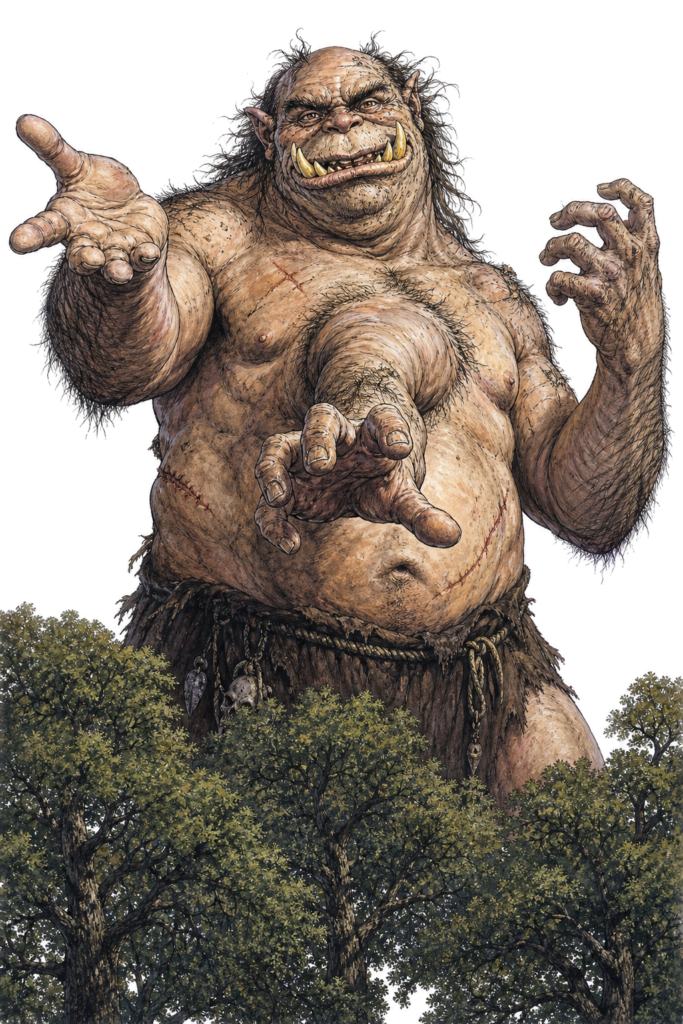
Eighteen feet of malformed spite — two arms where you expect them, a third punching out of the center of its chest, and a mouth full of poison tusks grinning at you from above the tree line. It would accept your jewelry. It would also accept your bones.
Core Statistics #
| Stat | Value |
|---|---|
| Hit Dice | 14d8* (avg 63 HP) |
| AC | 17 |
| AV | 5 (melee) / 3 (missile) |
| HR | +7 |
| FR | +9 |
| FD | 24 |
| Move | 180 ft (60 ft encounter) |
| Attacks | 4 total: 3 bashes (2d12/2d12/2d12) + 1 bite (2d10 + poison) |
| Save As | Fighter 14 |
| Morale | 7 |
| Treasure | Type I (lair — gems and jewelry preferred) |
| Alignment | Chaotic |
| CR | 13 |
| Size | Large |
| Intelligence | Low (INT 8) |
| XP | 2,500 |
AC/AV Reasoning #
RC original is AC 0 (descending) — equivalent to the finest magical plate. In ascending terms this is AC 20 equivalent. The Athach has no manufactured armor — its protection is the combination of its immense body mass, thick hide, and the sheer difficulty of landing a meaningful strike on an 18-foot creature.
- AC 17 — The Athach is Large, moves at 180 ft, and swings three arms with unpredictable geometry. Targeting a vital area on a creature this size requires fighting through constant arm interference — the third chest-arm in particular creates an unusual forward defense zone that disrupts conventional attack patterns. AC 17 reflects this genuine difficulty without overstating the creature’s evasiveness. It is not nimble — it is large, awkward, and hard to hurt precisely.
- AV 5 — This is where the RC’s AC 0 primarily lives. The Athach has extraordinarily thick, dense hide over massive muscle mass — equivalent to banded armor for absorption purposes. A sword that connects deals most of its damage to hide and muscle before reaching anything vital. AV 5 means a typical 1d8+STR hit is reduced to nearly nothing — the guaranteed penetration point plus whatever clears the threshold.
- AV 3 (missile) — Arrows and bolts reach vulnerable areas through gaps in the hide more readily than melee weapons deflected off the curved body mass. Still significant — the Athach is not easy to harm at range either.
- FD 24 — Enormous. 14 HD = +7 base FR, with Large size (+2) plus the anchor weight of an 18-foot giant (+5 from sheer mass). Formula: 10 + STR modifier (+7, implied by 2d12 bash damage) + Size (+2) + Armor FD (+4, banded equivalent) = 23, rounded up to 24 to reflect the third arm’s disruptive effect on any attempt to off-balance the creature.
- HR +7 vs. FR +9 — The Athach’s bashing attacks are strong but not refined — HR 7 reflects power without technique. Its FR is higher because the Athach’s real grapple threat comes from its three-arm advantage: it can bash two targets while the chest-arm grabs a third, or bash once and grab with two arms simultaneously. Three arms make it an exceptional grappler despite low intelligence.
Skill Slots #
(9 total — 14 HD = 8 base slots + 5 at 9 HD + 5 for HD 10–14; adjusted to 9 for Low intelligence cap on useful slots, with asterisk providing 1 special ability slot)
At 14 HD the full budget is 4 base + 5 at 9 HD + 5 (HD 10–14) = 14 slots. However INT 8 (Low) caps meaningful skill investment — most slots go to instinctive physical capabilities. This entry uses 9 substantive slots; the remaining 5 are unfilled representing the Athach’s failure to develop its potential through sheer stupidity and bad temper.
| Slot | Skill / Ability | Notes |
|---|---|---|
| 1 | HR Investment (Basic) | HR +7; the bashing attacks are powerful but crude — the Athach relies on raw accuracy from size advantage rather than technique |
| 2 | FR Investment (Skilled) | FR +9; the three-arm grapple is the Athach’s genuine tactical advantage — it wrestles with all three limbs and is exceptionally difficult to escape from once it has hold |
| 3 | Poison Bite (innate, special) | The tusks produce a contact venom — any victim bitten must Save vs. Poison at –4 or be helpless for 1d6 turns. Helpless means the victim cannot move, attack, or cast spells — they are conscious but physically incapacitated by the venom’s neurotoxic effect. The Athach does not need to choose between biting and bashing — the bite is a fourth independent attack from its head, separate from all three arms. This is the asterisk special ability |
| 4 | Intimidation (Skilled) | A creature 18 feet tall carrying a tree stump and grinning with poison tusks produces a powerful intimidation response. Creatures of 4 HD or fewer seeing an Athach for the first time must Save vs. Spells or suffer –2 HR and –2 to all saves for 1d4 rounds from sheer terror. The Athach knows it is frightening and uses this — it will roar, beat its chest with the third arm, and snap its tusks before committing to violence if it thinks intimidation will get it what it wants faster |
| 5 | Muscle (Expert) | The Athach’s raw physical strength is exceptional even for a giant. Expert Muscle means it can perform feats of strength that exceed what its combat stats alone suggest — tearing off a door, hurling a boulder 200 ft, breaking chains, or lifting a siege engine. In combat this manifests as the ability to throw a grabbed target up to 30 ft (Shove variant — see Combat Maneuvers) |
| 6 | Alertness (Basic) | Cannot be surprised in its home territory (hill, mountain, woods). Detects approaching creatures through ground vibration — the same mass that makes the Athach terrifying also means it feels footsteps through the ground at up to 60 ft range |
| 7 | Bargaining (Basic) | The RC explicitly states the Athach will accept gems and jewelry in lieu of attacking. INT 8 is sufficient to conduct basic transactions — it understands value, it knows what it wants, and it can count roughly. A Basic Bargaining skill reflects this limited but genuine economic rationality. It will not be cheated twice (memory is enough to recognize a previous bad deal) but is not sophisticated enough to detect subtle deception in a first transaction |
| 8 | Survival (Basic) | Cave-dwelling, terrain-ranging predator. Knows its local territory within approximately 5 miles — water sources, prey trails, rival predator territories, and safe cave systems. Does not get lost in its home region. |
| 9 | Endurance (Basic) | Can sustain combat at full capacity for an entire encounter. Can travel continuously for 2d4 days without rest when pursuing prey or fleeing threat, though it becomes visibly fatigued and –2 to all rolls after the first day |
Martial Style #
Primary Style: Hard (Basic rank) — applied to the bashing weapons Secondary Style: Control (Basic rank) — applied to the three-arm grapple Rank: Basic (both)
The Athach fights with the tactical sophistication of a creature that has three arms and knows it. Its Hard Basic bashing is exactly what it looks like — maximum damage output with zero defensive consideration. The Control Basic on the grapple reflects its instinctive exploitation of the third arm advantage — it does not think about its three-arm grapple, it simply does it, because doing so is obviously effective.
The third arm: The chest arm is shorter than the side arms but thicker and positioned perfectly for grappling — it punches forward into a target already being bashed by the outer arms, establishing a grip while the target is off-balance. This is not trained technique; it is evolved anatomy.
Hard Basic Benefits (bash):
- 2d12 damage per bash hit — three of these per round
- No AC bonus, no defensive positioning — the Athach does not care about being hit, it cares about hitting
- The tree stump or stone is not a crafted weapon — it is an improvised weapon that happens to deal 2d12 because the Athach is 18 feet tall and has the Strength of a small giant. Any similar large object does the same damage
Control Basic Benefits (grapple):
- Three-arm Grapple on successful FR roll forces Save vs. Paralysis at –2 (Basic rank save penalty) or target is Grappled
- Grappled targets take 1d8 crushing damage per round (three arms provide more grip surface than two)
- At Basic rank the Athach can access any maneuver from the Success by 0 tier automatically — its three arms make even a marginal grapple attempt effective
Combat Breath (CB): Base CB = 8 (Fighter-class equivalent HD) + CON modifier (+3 for a resilient giant) = 11 CB. The Athach spends 1 CB per round of peak combat (full four-attack sequence). It will reach Winded after approximately 8–9 rounds — longer than most combat encounters. In typical fights this is irrelevant; in a prolonged cave-defense scenario it matters.
Combat Maneuvers #
The Four-Attack Sequence #
The Athach’s signature is four simultaneous attacks per round — three bashes and one bite. This is the product of three arms plus an independent head attack, not multiple attacks earned through level.
Attack resolution order each round:
- Left arm bash (HR +7): 2d12 damage on hit
- Right arm bash (HR +7): 2d12 damage on hit — may target the same creature as the left arm or a different creature within reach (10 ft melee range for a Large creature)
- Chest arm bash (HR +7): 2d12 damage on hit — has shorter reach (8 ft) but perfect forward positioning; OR this arm initiates a Grapple instead of bashing (FR +9 vs. FD)
- Bite (HR +7): 2d10 + poison on hit
Multi-target capability: The Athach may split its attacks across up to three different targets in the same round — one per arm, with the bite going to whichever target is closest to its face. This is genuinely frightening for a party spread in melee: three party members can each be bashed simultaneously, then the one closest to the face gets bitten.
Chest arm flexibility: In any given round the Athach chooses whether the chest arm bashes or grapples. This decision is made before the attack roll. A creature that is already Grappled by the chest arm takes automatic 1d8 crushing per round instead of the bash attack — the bash is replaced by maintaining the grip.
Three-Arm Grapple #
When the Athach decides to grapple rather than bash with the chest arm:
Step 1 — Clear the target (bash): The Athach uses the two side arms to bash the target first (HR +7, 2d12 each). The bash attacks are intended to stagger the target before the grapple.
Step 2 — Chest arm grip (FR +9 vs. FD): On a successful FR check, the chest arm wraps around the target. The target saves vs. Paralysis at –2 (Control Basic penalty) or is Grappled.
Grappled by three arms simultaneously: If the Athach chooses to grapple with all three arms (giving up all three bash attacks for the round), FR check at +4 bonus (three-limb advantage) and the save penalty increases to –4. A target Grappled by all three arms takes 2d8 crushing damage per round and has –6 to escape FR checks — the three-arm grip is essentially inescapable for Medium creatures without exceptional strength.
Escape: Standard FR vs. FD (24). The FD 24 makes escape extremely difficult for most Medium characters. Additionally, the Athach’s Expert Muscle means it can apply additional force as a reaction to a near-successful escape attempt — the DM may have the Athach make a FR +9 check to re-establish grip as a free action if the escape roll succeeds by 3 or less.
Throw (Muscle Expert) #
A Grappled target that the Athach has held for one complete round may be hurled as a free action at the start of the Athach’s next round. The throw is a Shove variant:
Throw distance: FR +9, Shove die d8 (Large attacker size), with Expert Muscle adding +1 die step = d10. Standard Shove results determine throw distance — toward/into obstacles is the Athach’s preferred throw direction.
Throw damage: When the target lands, they take falling damage based on throw distance:
- 5 ft throw: 1d6 impact damage
- 10 ft throw: 2d6 impact damage
- 15–20 ft throw: 3d6 impact damage
- Into a wall/obstacle: Add 1d6 per 5 ft of throw distance that could not be completed (wall impact)
Throw + Bite: In the round the Athach throws a Grappled target, it may still use its bite attack against any creature in melee range — the throw is a free action, not its standard attack action.
Shove (FR +9, d8 die) #
Against Medium creatures the Athach’s Shove is devastating. Shove die starts at d8 (Large) and increases two steps from FR +9 to 2d6. A Crushing Shove (4× Resist) pushes the target 20 ft and deals impact damage — combined with mountain/cliff terrain, the Athach that shoves a character off a ledge is potentially lethal without ever dealing weapon damage.
Terrain exploitation: The Athach’s Alertness in its home territory means it knows where cliffs, ravines, and drop-offs are. It will deliberately position itself to Shove or Throw targets into these hazards. INT 8 is sufficient for this level of tactical terrain awareness — it is not sophisticated, it is simply what 18-foot giants do when they fight near cliffs.
Special Attacks #
Poison Bite — Tusk Venom #
Attack: HR +7 vs. AC (independent of arm attacks — the head moves freely) Damage: 2d10 on hit Poison effect: Bitten creature saves vs. Poison at –4 penalty
Save result:
- Failed save: Creature is helpless for 1d6 turns — conscious but physically incapacitated. Cannot move, attack, cast spells, or take any physical action. Can speak (feebly) and observe. The venom does not cause pain — it causes complete motor paralysis while leaving the mind intact. A paralyzed character is aware of everything happening to them, including being picked up and eaten.
- Successful save: No additional effect beyond the 2d10 bite damage
Helpless target mechanics: A helpless target is the Athach’s preferred state for its prey. It will:
- Set the helpless target aside (carry them to a safe location)
- Continue fighting the rest of the party
- Return to collect the helpless target when combat is resolved
- Eat them at leisure
This makes the poison bite tactically distinct from simply dealing more damage — the Athach is not trying to kill with the bite, it is trying to preserve the prey in a convenient state for later consumption.
Venom properties: The venom is contact-toxic through the tusk tip — it does not splash or affect creatures who touch the Athach’s mouth without being bitten. A character attempting to pry open the Athach’s jaw is not at risk of venom unless the tusks actually puncture skin (DM adjudication).
Antidote: Neutralize Poison removes the helpless effect immediately. Cure Disease has no effect on the venom. The 1d6 turn duration means most victims recover before any long-term threat — the danger is what happens to them during those 1d6 turns while the Athach is still alive.
The Gem and Jewelry Negotiation #
The RC establishes that the Athach will accept gems and jewelry in lieu of attacking “if an offer is good enough.” This is one of the more interesting low-intelligence negotiation mechanics in the RC and deserves full mechanical treatment.
What “good enough” means: The Athach is not sophisticated but it is consistent. It has a rough sense of value based on visual appeal and previous acquisitions. “Good enough” means:
| Offering | Outcome |
|---|---|
| Less than 100 gp value in gems/jewelry | Athach is insulted — attacks with +1 to Initiative from anger |
| 100–299 gp value | Athach considers it (1d6 rounds of indecision, then attacks anyway on 1–4, leaves on 5–6) |
| 300–599 gp value | Athach takes the offering and allows the party to pass. Will not attack unless provoked during transit |
| 600+ gp value | Athach is delighted — allows passage and may follow the party at a distance for 1d6 hours hoping for more |
What it does with gems and jewelry: The Athach’s Treasure Type I (significant wealth — gems and jewelry) is partially explained by this behavior. It collects tribute over time. The cave lair contains accumulated offerings from travelers smart enough to pay, mixed with plunder from those who were not. A Treasure Type I lair represents years of tribute and combat loot in roughly equal measure.
Negotiation mechanics:
- Bargaining (Basic): The party member conducting the negotiation makes a Bargaining check (CHA-based). On a success, reduce the “good enough” threshold by one tier — 300 gp worth of gems might satisfy an Athach that would normally require 600 gp with a skilled negotiator.
- Intimidation against negotiation: Attempting to intimidate an Athach during negotiation backfires — it interprets displays of threat as a challenge and attacks with Morale 9 rather than 7 for the first two rounds.
- Language: INT 8 means the Athach speaks a crude form of Giant. It cannot conduct nuanced verbal negotiation but understands simple Lawful-language phrases related to “give,” “go away,” “shiny,” and “food.” A character with Language (Giant) can facilitate cleaner communication.
Repeat encounters: The Athach remembers faces (INT 8 is sufficient for face recognition). A party that paid tribute once and then returns will be recognized — the Athach expects tribute again. A party that refused tribute and fought the Athach will be attacked on sight with no negotiation offer. A party that cheated the Athach (offered fake gems, for example) will be attacked at +2 HR for the duration of the encounter out of genuine rage.
Family Structure and Social Behavior #
Family groups: 1d3 encountered (1d6 in lair). The RC states they live in “small families” and “beat on one another when not hunting.” This is the most honest description of Athach society possible.
Internal violence: Athach families maintain hierarchy through continuous low-level combat. The dominant Athach (highest HP, typically the largest male) is challenged regularly by subordinates. These “dominance bouts” deal real damage — 1d6 per bout, no armor (they fight naked against each other) — and are considered completely normal behavior. An Athach that is currently injured from a family dominance bout has –2 HP per HD compared to its maximum.
DM tool: When encountering a group, roll 1d6 for each non-dominant Athach: on a 1–2 that individual has been recently injured in a dominance bout (reduce HP by 1d6 × HD). This makes some group members more vulnerable without changing the encounter’s overall threat profile.
Young Athachs: The RC does not address young. If the DM wishes to include them: young Athachs (2 HD) deal 1d8/1d8/1d8/1d4+poison with the same attack structure but at child scale. They are not present in combat encounters by default — they remain in the deepest cave chamber. A party that reaches the family’s inner cave finds them.
Athach family coordination: INT 8 means they can coordinate simple tactics — “you take those two, I’ll grab this one.” They do not use sign language or complex signaling but basic verbal coordination (“get the small one!”) is within their capability. In combat a group of Athachs naturally distributes targets — two of them will not usually bash the same party member when there are multiple targets available.
Habitat & Ecology #
Primary Habitat: Hills, mountains, and woods — specifically areas with cave systems large enough for an 18-foot creature to shelter in. They prefer elevated terrain with multiple approaches, allowing them to see prey coming.
Lair: A cave large enough for 1–6 eighteen-foot creatures — a substantial cave complex rather than a simple hole. The lair will have:
- A dominant chamber where the family sleeps (on bare rock — they do not build furniture)
- A food storage area (carcasses, including incomplete humanoid remains)
- A “treasure” area — loose gems and jewelry piled like a magpie nest, no organization, no containers
Territorial range: Approximately 10 miles from the lair. The Athach family patrols this range for prey, checking known trails, watering holes, and settlements within range. They are not stealthy (18-foot creatures crashing through woods are audible from considerable distance) but they are persistent — they will follow prey trails for days.
Hunting behavior: The RC states they “hunt for meat” and “consider humans to be meat.” In practice:
- They prefer to ambush from elevated positions (hill/mountain advantage)
- They set crude traps — a tree stump placed in a trail that will alert them to movement (Survival Basic — not a skilled trap, just a noise-maker)
- They identify livestock and grain stores as secondary prey when humanoid targets are unavailable
Relationship with other giants: Athachs occupy the lower end of giant society in terms of intelligence and organization. Hill Giants (INT 7) treat them as rough equals or minor nuisances. Stone Giants (INT 10) find them tedious. Giants of higher intelligence actively look down on them. Athachs do not have consistent relationships with other giant types — they react to each encounter individually based on whether the other giant seems like a threat or a source of food.
Relationship with humanoid settlements: Settlements within an Athach family’s territorial range pay a regular toll in gems, jewelry, or food to avoid being raided. This is not organized protection — it is simply the settlement learning the Athach’s tribute threshold and meeting it. A settlement that stops paying finds its outlying farms raided within 1d6 weeks.
Encounter Notes #
Wilderness approach: The party hears the Athach before they see it — an 18-foot creature moving through woods or hills produces unmistakable sound (Alertness check to identify the sound source before visual contact, no penalty). The Athach may similarly hear the party (its own Alertness — ground vibration sense within 60 ft).
Initial contact and negotiation opportunity: The RC does not specify when the negotiation offer is made — the DM should give it before combat initiative is rolled. The Athach steps out of cover (or descends from the hillside), fixes the party with small unfriendly eyes, and either:
- Demands tribute (if it has successfully extracted tribute before and recognizes this as a productive behavior)
- Simply attacks (if it does not see the party as a negotiation partner — low Morale 7 suggests it is not especially aggressive before combat begins)
A party that immediately presents gems and jewelry without being asked has a significantly better negotiation outcome — the Athach interprets this as social savvy and responds positively.
Combat: The Athach’s primary threat is the four-attack sequence — three bashes dealing 2d12 each plus the poison bite. Against a party of four, it distributes one bash per party member and reserves the fourth attack (bite) for whoever looks most dangerous (usually the Fighter in the front). The bite target is chosen for maximum tactical disruption — paralyzing the party’s primary damage dealer for 1d6 turns changes the combat entirely.
The poison bite priority target: The Athach should preferentially bite spellcasters and healers — not because it understands magic, but because it has learned through experience that the small ones who wave their hands and make things happen are dangerous. INT 8 is sufficient to recognize this pattern.
Morale 7 behavior: The Athach is not heroic. When reduced to half HP it checks Morale. On a failed check it disengages — it uses the Throw maneuver to create distance (hurling the nearest Grappled character into the party to disrupt pursuit) and retreats at full 180 ft move speed. It will not return to the same site that same day; the DM should consider whether it returns to warn its family group or simply retreats to lick its wounds.
The paralyzed party member problem: A party that has one or more members helpless from the bite venom faces a genuine prioritization crisis: rescue the paralyzed party member from being carried off, or finish the Athach before it can do more damage? The Athach deliberately exploits this by setting aside paralyzed prey and continuing to fight — it has solved the “preserve food” problem and can now focus entirely on combat. A party that splits attention between rescue and combat is at serious disadvantage.
CR 13 justification:
- 14* HD = CR 14 base + 1 for special ability (poison) = CR 15 theoretical
- Reduced to CR 13 for: Morale 7 (will flee at half HP, limiting maximum threat duration), Low intelligence (exploitable through negotiation, cannot coordinate complex tactics), and the Chaotic alignment meaning it is never encountered as an organized force
- Against a party that cannot afford Neutralize Poison, treat as CR 14 — the paralysis threat is substantially more dangerous without a counter


