
Rooster head. Snake tail. Wings. And if it touches you — not bites, touches — you stop being flesh and start being stone. It weighs twelve pounds and it will end your career.
Two Modes — Prime Plane and Plane of Earth #
| Mode | HD | Size | Damage | CR | Notes |
|---|---|---|---|---|---|
| Standard (Prime Plane) | 5** | Small | 1d6 + petrification | 7 | Petrification on bite or touch, no save modifier |
| Plane of Earth variant | 1+1 | Tiny (1 ft) | 1 point + petrification | 2 | Earth-body creature; only petrifies non-earth creatures |
Standard Cockatrice (Prime Plane) #
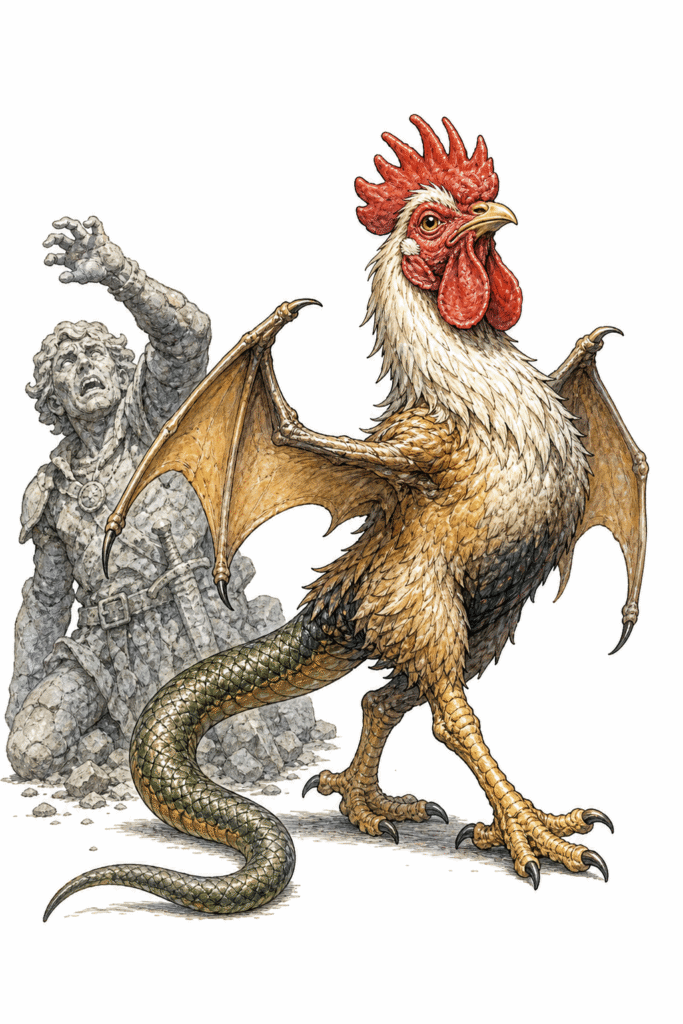
Core Statistics #
| Stat | Value |
|---|---|
| Hit Dice | 5d8** (avg 23 HP) |
| AC | 14 |
| AV | 0 |
| HR | +4 |
| FR | +3 |
| FD | 12 |
| Move | 90 ft (30 ft encounter) ground / 180 ft (60 ft encounter) flying |
| Attacks | 1 beak: 1d6 + petrification |
| No. Appearing | 1d4 (2d4) |
| Save As | Fighter 5 |
| Morale | 7 |
| Treasure | Type D |
| Alignment | Neutral |
| CR | 7 |
| Size | Small |
| Intelligence | Animal (INT 2) |
| XP | 425 |
AC/AV Reasoning #
RC original is AC 6 (descending) = Ascending AC 14. The cockatrice is a Small flying creature — the combination of size and flight makes it a genuinely difficult target.
- AC 14 — A Small creature in active flight, swooping and turning with rooster-agility, presents a very difficult target. The wings create unpredictable movement patterns. AC 14 for a flying Small creature is correct — it is hard to hit, not because it is armored but because it is fast, small, and airborne
- AV 0 — Feathers and light bird-bone structure. The cockatrice has no meaningful impact absorption. When hit it takes full damage — its defense is entirely AC and the petrification threat that makes attackers reluctant to engage
- FD 12 — A Small flying creature. Shoving it is trivially easy if it is grounded; irrelevant if it is airborne (normal Shove mechanics do not apply to flying creatures unless they are forced to land)
Skill Slots (5 total — 5** HD = 4 base + 2 asterisk slots; used 5 of 6) #
| Slot | Skill / Ability | Notes |
|---|---|---|
| 1 | HR Investment (Basic) | HR +4; the beak strike is fast and precise — the cockatrice dives from flight to striking range and back |
| 2 | Petrification Touch (innate, special) | Any creature bitten OR touched by a cockatrice must Save vs. Turn to Stone. Full mechanics below. First asterisk |
| 3 | Flight (innate, special) | 180 ft (60 ft encounter) flying at full combat capability. The cockatrice is more agile in air than on ground — uses flight for both attack approach and escape. Second asterisk |
| 4 | Alertness (Basic) | Cannot be surprised in open terrain or airspace; detects movement at 120 ft through bird-sharp visual acuity |
| 5 | Evasion (Basic) | The cockatrice’s Small size and flight combine for natural evasive capability. Ranged attacks against a flying cockatrice suffer –2 HR (small, fast-moving, airborne target) |
Petrification Mechanic — The Critical Rule #
Trigger: Bite OR Touch #
The RC states: “Any creature bitten or touched by a cockatrice must make a saving throw or be turned to stone.”
This is not limited to the beak attack. Any physical contact with the cockatrice triggers the save. This includes:
- A successful beak attack (the standard trigger)
- A character grabbing the cockatrice with bare hands
- A character catching it barehanded
- A character falling onto it
- The cockatrice brushing against a character during flight
- Wrestling or grappling the cockatrice
The critical implication: A character who attacks the cockatrice with a melee weapon and misses, but makes contact with the creature’s body during the swing (DM adjudication — treat as a 1-in-6 chance on a near-miss, or require the character to Save if they declared contact intent), may still trigger the petrification save.
Practical interpretation: The touch trigger means the correct answer to a cockatrice is ranged attacks. Melee combat with a cockatrice is dangerous not because it bites well (1d6 is modest damage) but because any contact triggers a petrification save.
Petrification Save #
Save vs. Turn to Stone — standard, no modifier.
Failed save: The character (and all their equipment, clothing, and carried items) is immediately turned to stone. They are a statue. They have no awareness, cannot act, cannot be harmed by standard attacks (they are stone now), and can be Restored by Stone to Flesh.
Successful save: No effect from this contact. The character must save again for each subsequent contact.
Petrification is not death — but it might as well be without a Cleric:
- The statue remains indefinitely until Stone to Flesh is applied
- The party must carry or leave the statue — a Medium statue weighs approximately 600–800 lbs (the character’s weight converted to stone density, roughly ×8)
- A party without Stone to Flesh or access to a 6th-level Cleric has a petrified party member and must find magical restoration to recover them
- A shattered statue cannot be restored — a petrified character who is struck hard by a weapon (any hit dealing 10+ damage to the statue) may crack or shatter. DM adjudication. A safe rule: the petrified statue has the character’s original HP as its structural integrity, and damage carries over when restored
What Petrifies and What Doesn’t #
Petrified: All living creatures, regardless of size or HD.
Not petrified: Undead, constructs, elementals of Earth (the Plane of Earth variant specifically cannot petrify earth creatures), and anything already made of stone or inorganic matter. Creatures immune to petrification effects (some high-level undead, certain magical constructs).
The cockatrice vs. its own reflection: A classic question — does a cockatrice petrify itself by seeing its reflection? The RC does not address this. DM adjudication: yes (the touch/gaze effect is consistent), for use as a potential encounter solution with a mirror.
Tactical Profile #
How the Cockatrice Fights #
The cockatrice does not have complex tactics (INT 2 — Animal). It attacks anything it perceives as threatening and uses its flight to maintain positional advantage.
Standard attack pattern:
- Circling at 10–30 ft altitude, out of normal melee reach
- Dives to melee range (5 ft), beak strike
- Immediately returns to altitude after the strike
- Repeats
This pattern makes the cockatrice effectively immune to melee counter-attack unless the character readies an action specifically to strike during the dive. The cockatrice is only at melee range for the instant of the beak strike — a character who wants to counter-attack must act in the same instant.
Against multiple targets: The cockatrice prioritizes whoever is closest or most threatening (INt 2 — simple threat assessment). Against a party it will typically single-target the nearest character each round.
Countering the Cockatrice #
Correct approach — ranged with –2 HR penalty: A character with a bow or sling attacks from distance. The –2 HR for the small/airborne target applies but the character is never at risk of contact. If the archer hits, full damage is dealt. The cockatrice’s Morale 7 means it may flee when injured.
Mirror counter: A mirror held to reflect the cockatrice’s gaze (if the DM uses gaze rules) or an angled mirror that the cockatrice dive-attacks into (physical contact with the mirror forces a save… by the cockatrice). DM adjudication — a clever party that brings a large mirror to a cockatrice encounter deserves the solution.
Magical attacks: Fireball, Sleep, Hold Monster — standard area or targeted spells work normally. The cockatrice has no spell immunity. Sleep vs. INT 2 creature is highly effective if the cockatrice is within range.
Physical protection: Thick gloves and full armor coverage eliminates the “touch” component for melee fighters — if no skin is exposed, no touch trigger applies. A Fighter in full plate with gauntlets, visor down, is completely protected from the touch trigger. Only the beak attack matters in this case.
Morale 7 — The Escape Pattern #
The cockatrice at Morale 7 is not committed. When seriously wounded (below half HP):
- Makes Morale check
- On failure: flies away at full speed (180 ft — faster than any running character)
- On success: continues attacking but flight instinct activates on the next failure
A fleeing cockatrice cannot be caught by ground characters. The party should pursue ranged damage to kill it before it escapes — a cockatrice that escapes and returns is just as dangerous the second time.
Plane of Earth Variant #
Ecological Note #
On the Plane of Earth, the cockatrice exists as a small earth-bodied creature — fundamentally different from the Prime Plane version in biology but retaining the defining petrification touch.
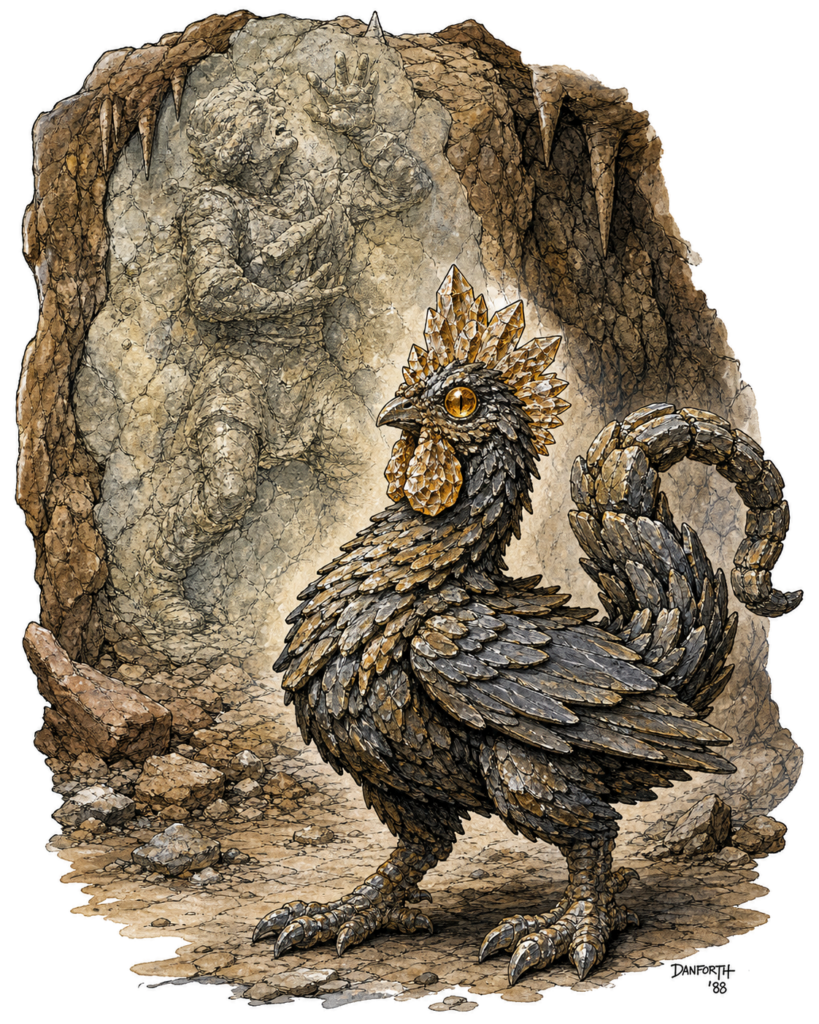
Stat Block #
| Stat | Value |
|---|---|
| Hit Dice | 1d8+1 (avg 6 HP) |
| AC | 14 |
| AV | 0 |
| HR | +1 |
| FR | +1 |
| FD | 8 |
| Move | 240 ft (80 ft encounter) |
| Attacks | 1 beak: 1 point + petrification |
| No. Appearing | 1d20 (2d40) |
| Save As | Fighter 1 |
| Morale | 7 |
| Treasure | Special (see below) |
| Alignment | Neutral |
| CR | 2 |
| Size | Tiny (1 ft) |
| Intelligence | Animal (INT 2) |
| XP | 15 |
Plane of Earth Skill Slots (2 total — 1+1 HD, low investment) #
| Slot | Skill | Notes |
|---|---|---|
| 1 | Petrification Touch (innate) | Same save mechanic as the Prime Plane version but restricted — only affects non-earth creatures. A character made primarily of flesh is at risk. A creature of elemental earth, a rock golem, or a stone construct is immune |
| 2 | Speed (innate) | 240 ft (80 ft encounter) — the earth-body variant moves faster than the Prime Plane version, compensating for its significantly reduced damage (1 point). The speed is the threat on this plane — 1d20 to 2d40 tiny fast earth-cockatrices swarming through stone corridors at 80 ft encounter speed |
Plane of Earth Notes #
“Nearly harmless”: The RC’s characterization is accurate for the damage (1 point). The petrification is not harmless — it is the same save, the same stone result. A party of planar travelers that encounters 2d40 earth-cockatrices (avg 41) all with petrification touch is in severe danger despite each individual doing only 1 point of damage.
The swarm threat: 1d20 appearing in the wild, 2d40 in their lair on the Plane of Earth. A group of 20+ earth-cockatrices at 80 ft encounter speed generates potentially 20+ petrification saves per round against a party. Even with good saves (50% success rate), a party of four will have petrified members within 2–3 rounds of contact.
“They breed normally on their own plane”: The implication is that the Prime Plane cockatrices do not breed normally — they are planar visitors or were created by magical accident. The Plane of Earth variety is the original form; Prime Plane cockatrices are a derived/displaced population.
Treasure Type Special: On the Plane of Earth, the earth-cockatrice lair contains earth-plane treasure — unusual mineral wealth, crystalline formations, and gem concentrations rather than standard coin-and-magic-item hoards. DM determination: 2d6 uncut gems per lair, possibly 1d4 earth-plane mineral curiosities worth 50–500 gp each to collectors on the Prime Plane.
Shared Ecology Notes #
Any Terrain: The Prime Plane cockatrice is encountered anywhere — the RC’s “Terrain: Any” reflects its magical origin making it habitat-independent. It is found in dungeons, open plains, forests, mountains, and coastal cliffs equally.
Treasure Type D: In the cockatrice’s lair, accumulated from past victims. Type D: 25% chance 1d3 × 1,000 sp, 20% chance 1d3 × 1,000 gp, 20% chance 1d6 gems, 10% chance 1 piece jewelry, 15% chance 1 magic item. The magic item probability reflects that the cockatrice’s territory sees adventurers regularly — the creature’s legendary status means treasure-hunters seek cockatrice encounters for the petrification counter-challenge, and they do not always survive.
Lore value of the cockatrice: Beyond the standard encounter, several cockatrice-derived materials have in-world value:
- Feathers: Used in magical scroll preparation and certain spellcasting focuses — 1d4 × 10 gp per feather to an alchemist or magical-item crafter
- Beak fragment: The petrification capability concentrates in the beak — a carefully preserved fragment can be used as a material component for Stone to Flesh reversal (the opposing material). Value: 50–100 gp
- Blood: Cockatrice blood is an ingredient in some petrification-related potions. Value: 1d4 vials per cockatrice, 25 gp per vial
Encounter Notes #
The “any terrain” problem: The cockatrice has no habitat constraint, which means it appears anywhere the DM places it. This makes it a potential surprise in otherwise-safe environments — a dungeon room, an alpine meadow, a merchant road. The DM should deploy it deliberately rather than as a wandering monster in heavily-trafficked areas.
Party preparation for a known cockatrice: A party that knows they are entering cockatrice territory can prepare:
- Full armor coverage (no touch trigger for covered fighters)
- Ranged weapons prioritized
- Stone to Flesh prepared (have the Cleric memorize it)
- A mirror (for the reflection counter if the DM allows)
- Sleep memorized (immediately effective against INT 2 if in range)
Party without preparation: The petrification save on any contact punishes the Fighter who naturally closes to melee range. A Fighter in plate mail who wins initiative and attacks the cockatrice successfully takes 1d6 damage and triggers the petrification save from the beak contact. A Fighter in plate mail with gauntlets and visor down does not trigger the touch save — only the beak attack matters.
The statue recovery problem: A petrified party member in a dungeon is a logistical catastrophe. 600–800 lbs of stone to carry or leave behind. The party either:
- Leaves the statue and marks the location (risk: enemies find and damage it)
- Carries it (logistical nightmare — four people needed, half speed for the carriers)
- Finds a Cleric with Stone to Flesh immediately (requires returning to civilization)
The petrification is not combat-lethal but it may be expedition-ending. A party without healing resources may need to abandon a dungeon expedition to find restoration magic for a petrified member.


