
A four-foot sphere of armored flesh drifts toward you, trailing ten eye-stalks that swivel independently like a nest of snakes, each one already aiming at someone different. The large central eye looks at nothing and erases everything it sees.
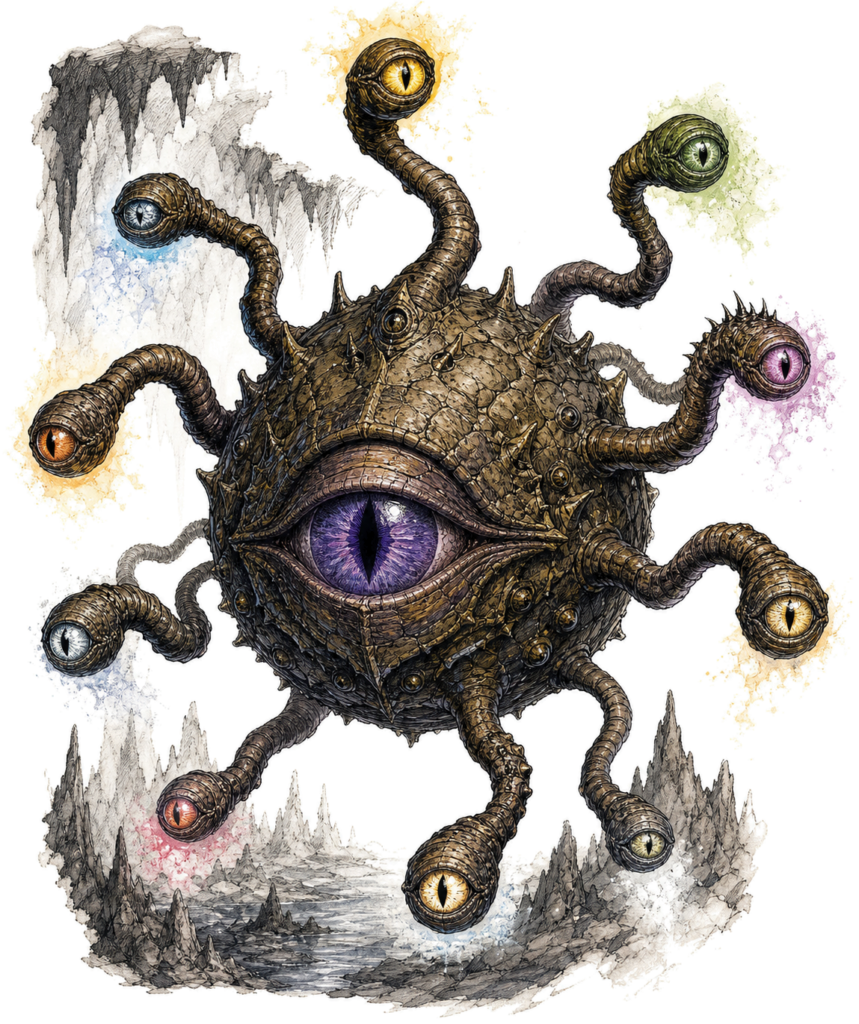
The Targeting System — Read This First #
The Beholder has three separate targets, each with different AC and HP. Attacking a Beholder requires declaring which target you are striking before rolling. This is the most important mechanical fact about the creature.
| Target | AC (ascending) | HP | Notes |
|---|---|---|---|
| Body | 25 | 50 HP | Killing the body kills the Beholder |
| Front Eye | 23 | 20 HP | Destroying the front eye eliminates the anti-magic ray permanently |
| Eye Stalk (any) | 17 | 12 HP each | Destroying a stalk removes that eye’s power; does NOT count toward body HP total |
Why this matters: Damage to eye stalks is completely separate from body damage. A party that hacks off all 10 eye stalks has done zero progress toward killing the creature — the body still has all 50 HP. Eye stalk destruction is purely about neutralizing specific eye powers, not winning the fight.
Damage tracking: The DM should maintain three separate HP pools:
- Body HP (50, reduce toward 0 to kill)
- Front Eye HP (20, once at 0 the anti-magic ray is gone)
- Ten individual stalk HP pools (12 each, tracked independently)
Core Statistics #
| Stat | Value |
|---|---|
| Hit Dice | 11d8* (Body: 50 HP fixed; see below) |
| AC | 25 (body) / 23 (front eye) / 17 (eye stalk) |
| AV | 3 (all targets — the armored skin covers the entire body) |
| HR | +6 |
| FR | +4 |
| FD | 18 |
| Move | 30 ft (10 ft encounter) — magical levitation |
| Fly | 30 ft (10 ft encounter) — same speed, no altitude limit |
| Attacks | 1 bite (2d8) + up to 4 eye ray attacks (special) per round |
| Save As | Magic-User 11 |
| Morale | 12 |
| Treasure | Type L, N, O |
| Alignment | Chaotic |
| CR | 18 |
| Size | Medium (4 ft diameter sphere) |
| Intelligence | Exceptional (INT 16) |
| XP | 5,100 |
HP — Special Rule #
The RC states “hp special” rather than a dice roll. Fixed HP values:
- Body: 50 HP (fixed, not rolled)
- Front eye: 20 HP (fixed)
- Each eye stalk: 12 HP (fixed, each)
- Total stalk HP if all intact: 120 HP (irrelevant to body survivability)
Young Beholder HP: 1/10 normal = Body 5 HP, Front eye 2 HP, each stalk 1–2 HP.
AC/AV Reasoning #
RC original uses AC 0 / 2 / 7 (descending) — three separate values for the three target zones.
Ascending conversions:
- AC 0 (descending) = AC 25 for the body — the armored carapace is exceptional natural protection
- AC 2 (descending) = AC 23 for the front eye — slightly easier to strike than the body but still heavily protected
- AC 7 (descending) = AC 17 for eye stalks — the stalks are the weakest target, thin and exposed
AV 3 across all targets: The armored skin covers the entire creature including the stalks (they emerge through armored sheaths). AV 3 applies to all physical attacks regardless of target zone — even a successful stalk hit is partially absorbed by the chitinous sheath.
Flight is magical but dispel-proof: The RC specifies the beholder’s slow flight “cannot be dispelled.” This is not a spell effect — it is the creature’s innate biology. Dispel Magic, Anti-Magic effects, and the beholder’s own anti-magic ray do not affect its flight. Even inside its own anti-magic cone the beholder floats normally.
Skill Slots #
(18 total — 11 HD = 8 base + 5 at 9 HD + 2 for HD 10–11; * = 5 special ability slots)
Skill budget: 4 base (1–8 HD) + 5 at 9 HD + 2 (HD 10–11) = 11 standard slots + 5 special ability slots from five asterisks = 16 slots minimum. The Beholder’s Exceptional intelligence (INT 16) and the depth of its abilities justifies the full 18-slot allocation — 11 HD + 5 asterisk + 2 bonus for exceptional intelligence investment.
| Slot | Skill / Ability | Notes |
|---|---|---|
| 1 | HR Investment (Expert) | HR +6; the bite is precise and the eye-ray targeting is exceptional — an 11 HD creature with INT 16 fights with practiced lethality |
| 2 | FR Investment (Basic) | FR +4; the Beholder can use telekinesis (Eye 4) as a FR-equivalent force effect — FR investment represents the general physical manipulation capability |
| 3 | Anti-Magic Ray — Front Eye (innate, special) | The central eye projects a permanent, always-active anti-magic cone. Full mechanics in Anti-Magic Ray section. First asterisk |
| 4 | Eye Rays 1–5 (innate, special) | Charm Person, Charm Monster, Sleep, Telekinesis, Flesh to Stone. Second asterisk |
| 5 | Eye Rays 6–10 (innate, special) | Disintegrate, Cause Fear, Slow, Cause Serious Wounds, Death Spell. Third asterisk |
| 6 | Stalk Regeneration (innate, special) | Lost eye stalks grow back in 2d4 days. Partial stalk damage regenerates at 1 HP per day. Fourth asterisk |
| 7 | Tactical Intelligence (innate, special) | INT 16 Beholder tactical decision-making — see Tactics section. Fifth asterisk |
| 8 | Alertness (Master) | Cannot be surprised. 360-degree sensory coverage through ten independently-rotating eye stalks. There is no blind angle above the body (the stalks reach in all directions) — only directly below the body is a true blind spot. +4 to Initiative in all environments |
| 9 | Intimidation (Grand Master equivalent) | A floating armored sphere with ten eye stalks and a mouth full of 2d8 teeth is terrifying. Creatures of 5 HD or fewer seeing a Beholder for the first time must Save vs. Spells or be affected as per Cause Fear for 1d4 rounds — this is the Beholder’s presence alone, not an eye ray |
| 10 | Knowledge — Planar (Master) | The Beholder speaks most languages and has spent its existence in caverns and ruins accumulating information. It knows dungeon layouts, the capabilities of creatures it has encountered, the locations of magic items it has seen or heard of, and the weaknesses of specific opponent types. It weaponizes this knowledge tactically |
| 11 | Knowledge — Magic (Master) | Exceptional understanding of spells, spell effects, and magical items. The Beholder knows what every spell in its eye-ray arsenal does to different creature types and optimizes accordingly. It recognizes spellcasters by their components and focuses the front eye on them immediately |
| 12 | Language (Master — all languages) | Speaks most languages per RC. In game terms: speaks all languages spoken by creatures it has encountered. Communicates in multiple languages simultaneously if the situation warrants it |
| 13 | Deception (Expert) | The Beholder negotiates, bargains, and lies with practiced facility. It is greedy — it will trade information, passage, and even its treasure if the alternative is a fight it calculates it might lose. Every word it speaks should be treated as potentially a deception |
| 14 | Detect Deception (Expert) | The converse of its own Deception — the Beholder’s INT 16 and multiple sensory inputs make lying to it very difficult. It reads micro-expressions, scent changes, vocal stress, and tactical body positioning simultaneously through ten independent eyes |
| 15 | Bargaining (Expert) | The Beholder is greedy (RC explicit). It accumulates Treasure Types L, N, O — significant magic item and gem hoards. It bargains as well as it fights, sometimes preferring profit to combat |
| 16 | Military Tactics (Grand Master equivalent) | See Tactics section — this represents the Beholder’s extraordinary combat planning capability applied to its specific weapon loadout |
| 17 | Danger Sense (Expert) | The Beholder senses attacks targeting its stalks and front eye specifically. On a round where a character declares a targeted attack at an eye stalk or front eye, the Beholder senses the declared targeting 1 round in advance (the DM may telegraph specific threat postures). This represents the Beholder tracking the geometric positions of all party members relative to its vulnerable zones |
| 18 | Mysticism (Expert) | The Beholder has deep insight into the metaphysics of magic, anti-magic, and the interplay between them. It understands the limitations of its own anti-magic ray and exploits them. It has studied magical theory to the extent that it can identify spells being cast by visual cue alone |
The Anti-Magic Ray — Complete Mechanics #
This is the most important mechanic in the encounter. The entire battle is structured around it.
Geometry #
The front eye projects an anti-magic cone directly in front of the Beholder to a range of 60 ft. The cone:
- Extends straight out in front of the body
- Cannot be aimed above or below the creature — only straight forward (horizontal)
- Has width roughly equivalent to the Beholder’s body diameter — approximately 4–6 ft wide at the origin, spreading to approximately 10–15 ft wide at 60 ft
- The DM should draw or describe the cone clearly — a flat horizontal plane extending 60 ft in front of the Beholder
What the Ray Does #
Within the cone’s area of effect:
- All magic is temporarily turned off. Not dispelled — suspended.
- Spells cast within the area are instantly ruined — the spell fails at the moment of casting
- Spells cast from outside the area are ruined when their effects reach the area — a Fireball cast from outside the cone that would pass through it detonates before entering (at the boundary), or simply fails if targeted at a point within the cone
- Magical weapons are treated as non-magical — a +3 sword swings as a non-magical sword. The magic is suppressed, not removed.
- Magic items in the area cease functioning
- Spells and items resume normal function when removed from the cone — the effect is suspension, not cancellation. A magic sword carried through the cone comes out the other side working again. A Haste spell in effect on a character passing through the cone is suspended during transit and resumes afterward.
The Self-Interaction Rule #
The anti-magic ray also affects the Beholder’s own small eyes if they are used on targets within the cone. The RC is explicit: “the small eyes cannot be used on targets within the anti-magic ray.” This is critical:
The Beholder must choose: Face the party with the front eye (anti-magic cone, protected from spells, but the small eyes cannot target anything in the cone’s area) OR rotate to use small eyes (the party can cast spells in the front direction, but the eye rays can reach them).
The Beholder solves this by using the three-dimensional space:
- Front eye facing the spellcasters (anti-magic cone suppresses their magic)
- Small eyes rotating to target melee fighters approaching from the sides and behind
- Bite targeting whoever is within melee range (below and beside the body)
Tactical Implications for the Party #
From the front: Any character approaching within 60 ft of the beholder’s front face is in the anti-magic cone. Their spells fail. Their magic items don’t work. Their magic weapons hit as normal weapons. They are as vulnerable as a mundane human. Approach from the front = no magic, but also no eye ray attacks.
From the sides/rear: Outside the cone. Magic items and spells work normally. But the small eyes can target anyone outside the cone. The eye rays are more immediately lethal than the anti-magic suppression.
The geometry exploit: The anti-magic ray is fixed horizontally — it cannot angle up or down. A character flying above the beholder is outside the cone even while directly “in front” of the beholder geometrically. A character in a pit below the beholder is safe from the cone. Elevation changes the encounter fundamentally.
The cone direction changes: The Beholder can rotate to face a different direction — changing which area the cone covers. This takes no action (free rotation as part of movement). The Beholder with INT 16 will constantly rotate the cone to cover whoever is casting spells, forcing the party to reposition continuously.
Eye Rays — Complete Mechanics #
How Eye Rays Work #
Each of the ten small eye stalks can fire one ray per round. However:
- Maximum 4 small eyes can aim in one direction simultaneously — the stalks cannot all overlap perfectly
- Small eyes cannot see directly below the body — this is the Beholder’s only true blind spot for eye rays (the anti-magic ray also cannot angle down)
- Small eyes cannot target anything within the front eye’s anti-magic cone — the cone suppresses the rays
Practical eye ray output per round: The Beholder can typically fire 4 eye rays toward the main party concentration, while potentially firing different rays at isolated targets in other directions. Against a spread-out party it fires 4 eyes in the most concentrated direction and distributes remaining eyes toward isolated targets.
The Ten Eyes — Individual Mechanics #
All eye rays are once per round for the individual eye. Range is as listed. All saves at the standard Cleric 11 / Magic-User 11 difficulty (Save As M11 means very favorable save targets for high-level characters, but devastating for mid-level parties).
Eye 1 — Charm Person Range: 120 ft Effect: As the Magic-User spell Charm Person Save: Save vs. Spells On failed save: Target is charmed — treats the Beholder as a trusted friend. Will not attack it, will follow suggestions, may be directed to attack party members. The Beholder uses charmed characters as shields between itself and the remaining party. Tactical note: The Beholder prioritizes charming the party’s strongest fighter to turn them against the spellcasters.
Eye 2 — Charm Monster Range: 120 ft Effect: As the Magic-User spell Charm Monster — works on any creature, not just humanoids Save: Save vs. Spells On failed save: Same as Charm Person but applicable to any creature type including summoned monsters, animal companions, and non-humanoid party members. Tactical note: Used against any creature in the party that Eye 1 cannot affect (non-humanoids, charmed animal companions).
Eye 3 — Sleep Range: 240 ft Effect: As the Magic-User spell Sleep — affects creatures of up to 4+1 HD Save: None (Sleep has no save in standard BECMI) Tactical note: The longest-range eye ray. The Beholder fires this at the party before they close to melee range, eliminating the lowest-HD members without a save. Against a mixed party it sleeps the Guildsmen and Clerics before they can act. Sleep has no effect on creatures above 4+1 HD (Fighters of 5th level, etc.) but devastates low-HD party members and hirelings.
Eye 4 — Telekinesis Range: 120 ft — up to 5,000 cn weight Effect: As the Magic-User spell Telekinesis — moves objects or creatures weighing up to 5,000 cn Save: Save vs. Spells to resist being moved (for creatures) Tactical note: The Beholder uses this to reposition party members — specifically to move them:
- Into the anti-magic cone (negating their magic)
- Away from the Beholder’s blind spot (directly below)
- Into hazardous positions (pits, off ledges, into other eye ray angles)
- To grab and throw items — disarming fighters of magical weapons, retrieving items from treasure rooms 5,000 cn = approximately 500 lbs — this covers most Medium humanoids with full equipment.
Eye 5 — Flesh to Stone (reversed) Range: 120 ft Effect: As reversed Stone to Flesh (i.e., Flesh to Stone) Save: Save vs. Turn to Stone On failed save: Target is petrified along with all equipment Tactical note: Petrified party members are removed from combat indefinitely. The Beholder then uses Telekinesis to position petrified statues as cover between itself and the remaining party.
Eye 6 — Disintegrate Range: 60 ft Effect: As the Magic-User spell Disintegrate Save: Save vs. Death Ray On failed save: Target is completely destroyed — reduced to fine powder. No Raise Dead possible. Tactical note: The shortest range of the eye rays and the most lethal. The Beholder fires this at the most powerful Fighter who has closed to melee range. The Disintegrate eye prioritizes creatures that have gotten past the anti-magic cone and reached the body.
Eye 7 — Cause Fear (reversed) Range: 120 ft Effect: As reversed Remove Fear (i.e., Cause Fear) Save: Save vs. Spells On failed save: Target flees in terror for 2d6 rounds Tactical note: Used to break up party formations — a terrified Fighter running away from combat exposes the party’s flanks. The Beholder coordinates this with Charm effects to create maximum confusion.
Eye 8 — Slow (reversed) Range: 240 ft Effect: As reversed Haste (i.e., Slow) Save: Save vs. Spells On failed save: Target is Slowed — half movement, –2 to AC, –2 to attack rolls Duration: 3 turns Tactical note: The second longest-range ray. Fired early to reduce the party’s ability to close the distance quickly. A Slowed Fighter closing at half speed through Disintegrate range gives the Beholder significantly more rounds of eye-ray attacks before melee begins.
Eye 9 — Cause Serious Wounds (reversed) Range: 60 ft Effect: As reversed Cure Serious Wounds — deals 2d6+2 damage (no attack roll needed if within range) Save: Save vs. Death Ray for half Tactical note: Short range but reliable damage at the moment of melee engagement. Used against the Fighter who has pushed past the outer defenses and is closing for melee contact.
Eye 10 — Death Spell Range: 240 ft Effect: As the Magic-User spell Death Spell — slays up to 4d8 HD of creatures with 8 or fewer HD Save: None (Death Spell has no save) Tactical note: The most devastating area effect. The Beholder fires this at the party’s earliest opportunity if there are multiple low-HD members clustered together. Against a party with hirelings and followers this can eliminate multiple NPCs simultaneously. Against a party of four 9th-level characters it is ineffective (all above the 8 HD limit) — a tactical note the Beholder understands from its INT 16.
Bite Attack #
HR +6 vs. AC, 2d8 damage
The bite is the Beholder’s melee attack, used when opponents are within 5 ft of its body. The mouth is positioned below the front eye — creatures approaching from directly below (the eye-ray blind spot) still face the bite.
Bite and eye rays in the same round: The Beholder can bite and fire up to 4 eye rays in the same round — the bite is a separate attack action from the eye stalks. In a round where a Fighter is within melee range and the party’s spellcasters are at distance, the Beholder bites the Fighter while using stalks to target the spellcasters.
Eye Stalk Targeting and Destruction #
Targeting a specific stalk: When a character declares they are targeting an eye stalk, the DM rolls randomly to determine which stalk is actually struck (the stalks move constantly). Roll 1d10: the result indicates which numbered eye is affected.
What “destroyed” means: A stalk reduced to 0 HP is severed — the eye is gone. The eye cannot function. But this damage does not count toward the body’s 50 HP.
Partial damage: A stalk hit but not destroyed continues to function normally — even taking 11 HP of its 12 HP does not reduce the eye’s effectiveness. It is either fully functional or gone.
Regeneration:
- Severed stalk: Grows back in 2d4 days — the stalk and eye fully regenerate
- Partial stalk damage: Regenerates at 1 HP per day
- This means eye stalk destruction is a temporary tactical advantage, not a permanent win condition. Against a Beholder the party encounters repeatedly (its lair), stalk destruction strategies are less valuable than they first appear.
Priority targets for stalk destruction: In order of tactical impact:
- Eye 10 (Death Spell, 240 ft, no save) — removing this dramatically reduces the Beholder’s no-save kill capability
- Eye 3 (Sleep, 240 ft, no save) — removing this protects low-HD party members
- Eye 6 (Disintegrate, 60 ft) — removing this eliminates the permanent-kill threat
- Eye 4 (Telekinesis) — removing this prevents the Beholder from repositioning party members
The anti-magic ray front eye: If the party chooses to target the front eye (AC 23, 20 HP), destroying it permanently removes the anti-magic cone. This fundamentally changes the encounter — magic becomes fully effective against the Beholder. This is often the correct strategic priority despite the difficulty (AC 23 means only skilled fighters can reliably hit it).
Tactics — INT 16 Combat Planning #
The Beholder is not a static encounter — it is an intelligent, experienced combatant that has survived long enough to develop a comprehensive combat doctrine. Morale 12 means it never runs; its INT 16 means it fights better than any comparable-CR unintelligent creature.
Opening Position (Before Contact) #
The Beholder prepares before the party enters its chamber:
- Positions itself at the far end of the room with the front eye facing the entry point
- Raises itself to 8–10 ft altitude — above typical party movement, exploiting the eye-ray blind spot directly below while maintaining full front-arc anti-magic coverage
- Has eye stalks pre-rotated to cover the sides and entry point
Round 1 Priority #
With INT 16, the Beholder has already assessed the party’s composition through its Knowledge (Magic) and Detect Deception skills during any pre-combat observation. Its Round 1 decisions:
- Front eye on spellcasters — whoever is casting, the cone faces them
- Eye 10 (Death Spell) on hirelings, henchmen, or low-HD party members if clustered
- Eye 3 (Sleep) on remaining low-HD targets not covered by Death Spell
- Eye 8 (Slow) on the fastest-moving Fighter — delay melee engagement
- Eye 1 (Charm Person) on the most capable Fighter — turn them against the party
Sustained Combat #
The Beholder rotates continuously — the front eye tracks the current greatest magical threat, the small eyes distribute across all visible targets. Against a party that spreads out:
- Fighters approaching from multiple angles face different eye rays
- The Beholder cannot cover all angles with the anti-magic cone, so it prioritizes the spellcasters over the fighters in terms of front-eye facing
- The bite handles whoever is in melee range (5 ft)
When the Front Eye is Destroyed #
If the front eye is reduced to 0 HP, the anti-magic cone is gone. The Beholder loses its most powerful defensive tool. Its tactical response:
- Immediately reassesses — now it is vulnerable to magic from any angle
- Prioritizes Eye 1/2 (Charm) and Eye 6 (Disintegrate) against the Magic-User who just became its greatest threat
- Considers retreat (but Morale 12 means it rarely actually retreats — it fights harder instead)
- Uses Telekinesis to reposition party members, disrupting their spellcasting through physical interference instead of anti-magic
The Blind Spot Exploit #
Directly below the body is the Beholder’s true blind spot — no eye rays can fire downward, and the anti-magic cone is horizontal only. A party member in a pit directly below the Beholder, or a party using a Fly spell to position a Fighter directly below and striking upward, bypasses both the cone and all ten eye rays. The Beholder knows this. It will use Telekinesis to move characters out of the blind spot if they exploit it. It will never voluntarily position itself where its blind spot is occupied by a threat.
The Anti-Magic Ray vs. Magical Weapons — Clarification #
This is the most frequently misunderstood element of the Beholder encounter:
Within the cone: A magic sword swings as a normal sword (+0, 1d8 for a longsword). The magic is suspended, not removed. After leaving the cone: The magic works normally again immediately. A fighter charges through the cone to reach the body: Their magic sword works normally once they are past the cone and within melee range — they have exited the cone by stepping past the Beholder’s face. Only the 60 ft area in front of the front eye is suppressed; once within 5 ft of the body (melee range) the character may be behind the cone’s origin point.
The practical fighting position: A fighter who closes through the cone (enduring suppressed magic and potential eye rays from the sides) and reaches the body is now at melee range. They may be past the cone’s origin, restoring magic weapon function. They are also within bite range and within range of Eye 6 (Disintegrate, 60 ft) and Eye 9 (Cause Serious Wounds, 60 ft) fired from stalks on the sides of the body.
Young Beholders (5% chance) #
The RC states: 5% chance of encountering with 1d6 young beholders.
Young Beholder statistics:
- Body HP: 5 (1/10 of 50)
- Front eye HP: 2 (1/10 of 20)
- Each stalk HP: 1–2 (1/10 of 12, round down/up per DM)
- Bite: 1d4 damage (not 2d8)
- Eye ray range: 1/10 of listed range — Charm Person becomes 12 ft, Death Spell becomes 24 ft
- Eye ray effects: Full spell effects, just very short range
- AC: Same as adult (25/23/17)
- AV: Same (3)
- CR: 3 each
Young beholder tactical note: Young beholders with their very short eye ray ranges must be essentially adjacent to their targets to function. Their front eye still projects an anti-magic cone but at 6 ft range instead of 60 ft — more like a personal shield than a battlefield denial tool. The body’s 5 HP means they die to one solid hit.
The monstrous parental dynamic: An adult Beholder with young is significantly more aggressive than normal — Morale 12 becomes “12 plus irrational” around young. The adult uses the young as a distraction screen, sending them toward the party while it fires through them. Young Beholders are expendable to the adult.
Habitat & Ecology #
Habitat: Caverns and ruins only. The Beholder requires large enclosed spaces — it floats and needs overhead clearance. It cannot operate in narrow tunnels (less than 6 ft wide or high). Its preferred chamber is a large cavern or ruined hall with multiple entry points it can monitor.
Lair construction: The Beholder arranges its lair to maximize the anti-magic cone’s effectiveness:
- Entry points at the far end of the primary axis — visitors enter facing the front eye
- Treasure stored in a side chamber accessible only by passing through the main chamber
- No cover of significant size within the first 60 ft of the entry — the cone’s area should be clear
- Elevated position at the far end — height exploits the eye-ray downward blind spot
Social behavior: Almost entirely solitary. The 5% young exception is seasonal — the Beholder is with young only briefly before driving them off. Two adult Beholders never share territory; they are incapable of the trust required for cooperation and their eye rays would be mutual threats.
Diet: The Beholder eats whatever it can kill — the 2d8 bite and the eye rays make it capable of killing essentially anything. Its INT 16 and Deception skill mean it can lure prey rather than hunting. A Beholder that needs food may spread rumors of treasure in its lair, wait for adventurers to come to it, kill them, eat what it wants, and add the rest to Treasure Types L, N, O.
Treasure Types L, N, O: Very significant hoard — these types include the most valuable magic items and gems in the RC. A Beholder that has occupied a dungeon for years has accumulated magic items from killed adventurers, gems it has collected through Telekinesis, and items traded to it by creatures that found dealings with the Beholder preferable to fighting it. Type L is primarily gems (50% chance of 1d12 gems), Type N is potions (1d4 with 10% chance per type), Type O is scrolls (1d4 with 5% chance per type) — combined these represent a significant magic item haul.
Encounter Notes #
The Beholder as intelligent opponent: Unlike nearly every other RC monster, the Beholder holds a full conversation before or during a fight. It speaks most languages. It may attempt negotiation (Bargaining Expert, Deception Expert) to assess the party’s strength before deciding whether to fight or deal. Information it wants:
- What magic items the party carries (to assess threat level)
- Where the party came from and who sent them (to assess whether more will follow)
- What they want in the lair (to determine if a deal is possible)
A party that provides this information honestly has given the Beholder everything it needs to decide whether to fight or to offer a deal that benefits it more.
The correct tactical approach:
- Identify the Beholder’s type before entering its chamber if possible — the distinctive floating sphere with eye stalks should be recognizable with a Knowledge or Lore check
- Determine the chamber’s geometry — the cone direction and the blind spot below are the key tactical factors
- Assign roles: Fighter(s) close through the cone (accepting anti-magic suppression), Magic-User(s) attack from the sides or rear (bypassing the cone, facing eye rays)
- Prioritize the front eye if the party has reliable high-HR attackers — destroying it transforms the encounter
- Prepare for Sleep and Death Spell casualties among henchmen before they happen — position low-HD party members at maximum distance
CR 18 justification:
- 11 HD base = CR 11
- ×5 asterisks = +5 = CR 16 theoretical base
- +2 for the anti-magic cone (battlefield denial against the party’s primary capabilities)
- +2 for INT 16 tactical coordination of ten independent weapon systems
- –2 for slow movement (30 ft), fixed cone geometry exploits, and Morale 12 not providing adaptive retreat
- Net: CR 18
Against a party without high-level Magic-User support (who can bypass the cone from the sides): treat as CR 20. Against a party with flying capability who exploits the vertical blind spot: treat as CR 15.


