
Nine feet of pale segmented body moving silently across the ceiling, eight two-foot tentacles trailing from the mouth end, each one looking for a surface to touch. It is patient. It has been waiting for fresh meat, and you are fresh.
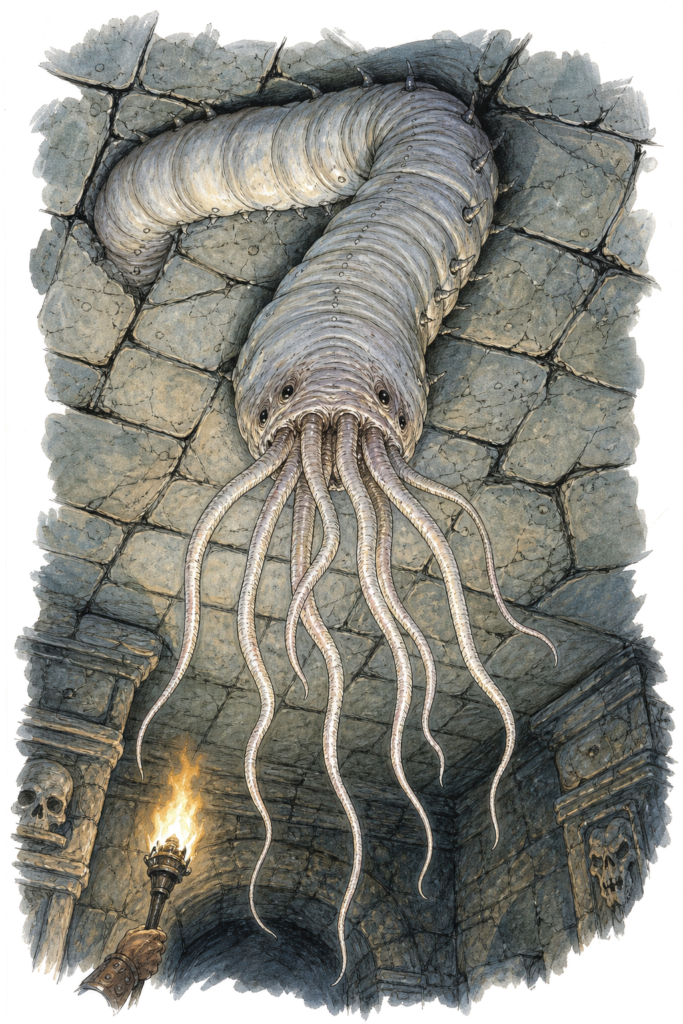
Core Statistics #
| Stat | Value |
|---|---|
| Hit Dice | 3d8+1* (avg 15 HP) |
| AC | 13 |
| AV | 1 (melee) / 0 (missile) |
| HR | +3 |
| FR | +3 |
| FD | 12 |
| Move | 120 ft (40 ft encounter) — floor, wall, or ceiling equally |
| Attacks | 8 tentacles (paralysis, no damage) OR 1 bite (1 point damage) |
| Save As | Fighter 2 |
| Morale | 9 |
| Treasure | Type B |
| Alignment | Neutral |
| CR | 4 |
| Size | Large (9 ft long, 3 ft high) |
| Intelligence | None (INT 0) |
| XP | 75 |
AC/AV Reasoning #
RC original is AC 7 (descending) = Ascending AC 13. The carrion crawler is a segmented worm — it has no armor, but its low-slung body profile and constant movement creates genuine targeting difficulty.
- AC 13 — A nine-foot worm moving across walls and ceilings presents an awkward attack angle. Its body is in constant sinuous motion. AC 13 reflects the genuine difficulty of placing a precise strike on something this shape in motion, not any protective structure
- AV 1 — The rubbery segmented body provides modest impact absorption — equivalent to thick leather. A sword that connects deals slightly reduced damage as the blade does not find sharp edges or gaps to exploit
- AV 0 (missile) — Arrows penetrate the segmented body cleanly
Skill Slots (4 total — 3+1 HD, asterisk = 1 special ability, INT 0) #
| Slot | Skill / Ability | Notes |
|---|---|---|
| 1 | HR Investment (Basic) | HR +3; the tentacles reach and touch with practiced efficiency — all eight can independently track and strike in the same round |
| 2 | Paralytic Tentacles (innate, special) | Eight independent tentacle attacks, each delivering paralysis on contact. Full mechanics below. The asterisk |
| 3 | Surface Travel (innate) | Moves on walls and ceilings at full 120 ft speed. Identical to the Black Pudding’s wall/ceiling movement — the many-legged body maintains contact on any surface. Cannot be flanked by retreating to elevated surfaces |
| 4 | Scavenger Patience (innate) | The carrion crawler is primarily a scavenger — it detects decomposing organic matter at 120 ft and fresh kills at 60 ft through chemical sensing. It is attracted to blood, body odor, and the smell of wounds. A party with injured members (any character not at full HP from a recent wound) is detectable at double normal range (120 ft) |
Martial Style #
Style: Control (Basic rank) — The Warden, applied to mass paralysis Rank: Basic
The carrion crawler’s combat philosophy is entirely about Control — it does not deal damage to kill, it deals paralysis to restrain. Once the party is paralyzed the crawler becomes a feeding machine rather than a combat entity. The Control style’s emphasis on special effects over damage output is exactly correct.
The bite vs. tentacle choice: The RC states “8 tentacles or 1 bite” — these are mutually exclusive attack modes. In any given round the carrion crawler uses all eight tentacles OR one bite, not a mix. The bite deals 1 point of damage (trivial) and is used when the crawler is actually eating an already-paralyzed victim — the tentacles are the combat tool, the bite is the feeding tool.
No Combat Breath: INT 0, pure predatory/scavenging instinct. Does not Winden or Exhaust.
Paralytic Tentacles — Complete Mechanics #
The Eight Attacks #
Each round the carrion crawler makes eight tentacle attacks against targets within reach (10 ft range from the front of its body). These eight attacks can be distributed across multiple targets — the crawler does not need to concentrate all eight on one character.
Attack distribution: The DM determines how the eight attacks are distributed, guided by the crawler’s targeting logic:
- Against a party of 4: distribute as evenly as possible (2 tentacles per character)
- Against a party of 2: 4 tentacles each
- Against a single target: all 8 tentacles
- The crawler prioritizes unparalyzed targets — once a character is paralyzed, the crawler shifts its tentacle attacks to the remaining mobile characters
HR +3 applies to each tentacle attack individually. The DM makes eight HR rolls vs. each target’s AC.
Paralysis Effect #
On a successful tentacle hit:
- The tentacle deals no damage — the hit itself is a touch, not a wound
- The target must Save vs. Paralysis (standard, no modifier)
- Failed save: Target is fully paralyzed
- Successful save: Target is unaffected for this hit (must save again if struck again)
Paralyzed condition:
- Cannot move, attack, cast spells, or take any physical action
- Remains conscious and fully aware — can hear, see, and understand everything happening
- Is a helpless target — attacks against a paralyzed character hit automatically (no HR roll needed) and the character loses DEX bonus to AC
- Lasts 2d4 turns (20–80 minutes) unless magically cured
- Cure Paralysis, Remove Curse, or equivalent Cleric magic cures it immediately
Cumulative saves: Each tentacle that hits requires a separate save. A character struck by 3 tentacles in one round makes 3 separate Saves vs. Paralysis. While any one save blocks the paralysis, multiple saves increase the statistical pressure — against 3 hits, the chance of failing at least one is approximately 50% even with a good save score.
Paralysis Duration and the Three-Turn Eat Timer #
The RC states the carrion crawler “will eat paralyzed victims in three turns unless the carrion crawlers are being attacked.”
The three-turn window:
- Turn 1 (rounds 1–10): Crawler has secured a paralyzed victim, positions it, begins feeding
- Turn 2 (rounds 11–20): Active feeding — the victim is being consumed
- Turn 3 (rounds 21–30): Feeding continues — if undisturbed, the victim is dead by the end of this turn
“Unless being attacked” qualifier: The crawler abandons or pauses feeding when it is under attack. A party that continues fighting the crawler forces it to choose between feeding and defending itself — it returns to tentacle attacks, potentially paralyzing additional party members while the original paralyzed victim lies waiting.
The moral dilemma: A party that has two paralyzed members and two mobile fighters faces a genuine choice:
- Continue attacking the crawler → crawler returns to tentacle mode, original paralyzed members survive longer but the mobile fighters face paralysis risk
- Try to drag paralyzed members away → leaves the crawler free to resume feeding, but removes the victims from danger
- Split the party → one person engages the crawler, one drags victims
Paralysis vs. feeding timer interaction: The 2d4 turns paralysis duration and the 3-turn eat timer overlap — a character who is paralyzed for 4 turns but the crawler eats them in 3 turns is dead regardless of the paralysis wearing off. The paralysis duration is relevant only if the party drives off the crawler before feeding is complete.
Surface Travel — Tactical Implications #
The carrion crawler moves on walls and ceilings at full 120 ft speed. This creates specific tactical problems that distinguish it from ground-only creatures:
Ceiling approach: A crawler on the ceiling descends onto targets directly below — attacks from above against characters who are not watching the ceiling. Standard surprise rules apply (1–2 on d6) unless a party member is specifically watching the ceiling (Alertness check or declared vigilance).
Wall positioning: A crawler on a wall can attack characters at floor level — its 10 ft tentacle reach extends downward from the wall. A character who backs against a wall to protect their rear may find a carrion crawler emerging from that wall.
Retreat blocking: A party that retreats from a ground-level crawler may find the ceiling is occupied. The crawler can follow across any surface — there is no “safe” elevation except open air (it cannot fly, only climb).
Dungeon geometry: A carrion crawler in a standard 10-ft wide dungeon corridor occupies most of the floor width. It can simultaneously hang from the ceiling with its front end while its body trails along the wall — effectively blocking a corridor with its body mass while attacking from an overhead position.
Scavenger Ecology #
Primary behavior: The carrion crawler is a scavenger first — it follows the smell of death, congregates where battles recently occurred, and prefers carrion over the effort of hunting live prey. A dungeon room where a fight recently occurred (within the past day) is likely to attract carrion crawlers within 1d6 hours.
Fresh meat secondary: When carrion is unavailable or the crawler is hungry, it hunts live prey. “Small parties of travelers” — the RC’s specific language — suggests the crawler is an opportunistic ambush predator against manageable prey, not a creature that attacks large groups. A party of 6+ is likely to deter a lone carrion crawler (Morale 9 — it will assess the threat before committing).
Attracted to wounds: The Scavenger Patience skill means a party with injured members attracts carrion crawlers at double range. A party that camps without treating wounds in a dungeon with carrion crawlers is making a navigation error — they are broadcasting their location to every scavenger in 120 ft.
No. Appearing 1d4 (0): Wild/dungeon encounters are groups of 1–4. There is no lair encounter (0 in lair) — carrion crawlers do not maintain fixed lairs. They roam dungeon corridors following the smell of death. This means a cleared dungeon that the party returns to may have new carrion crawler infestation if bodies were left behind.
Treasure Type B: The crawler’s territory is wherever it feeds. The treasure represents accumulated items from previous victims left in the crawler’s feeding areas — it does not carry treasure, it leaves treasure behind (it cannot eat metal or stone). A party that follows the smell of carrion crawler activity through a dungeon may find equipment from previous victims scattered along the crawler’s patrol route.
Encounter Notes #
The ceiling approach (most dangerous opening): The party moves through a dungeon corridor. The carrion crawler is on the ceiling, moving parallel to their direction. Unless someone is watching the ceiling (Alertness check or declared vigilance), the first hint is when tentacles begin reaching down. The first round of contact may paralyze 1–2 party members before initiative is properly established.
Managing the eight attacks: Against a party of 4, the crawler makes 2 tentacle attacks per character per round. At HR +3 vs. typical AC 13–15, each tentacle hits on approximately a 10–12+ = 45–55% per attack. Two attacks per character per round means approximately 70–85% chance of at least one hit per round per character. Each hit requires a Save vs. Paralysis. A party that does not deal damage quickly will have paralyzed members within 2–3 rounds.
The “8 or 1 bite” rule in practice: The crawler uses tentacles until all targets are paralyzed, then switches to biting (1 damage point) for feeding. The transition from “paralyzing prey” to “consuming prey” is the signal that combat has effectively ended — if the party has not killed or driven off the crawler by this point, members are being eaten.
Fire and the carrion crawler: The RC lists no specific fire weakness, but the crawler’s scavenger nature means fire is a deterrent — it will not approach an open flame during feeding assessment. Fire does not automatically drive it off (Morale 9 is relatively high) but a torch waved aggressively may buy a round to drag a paralyzed companion away.
CR 4 justification:
- 3+1* HD = CR 4 base (asterisk = tentacle paralysis)
- Eight independent paralysis attacks per round creates overwhelming save pressure — against a party of 4, approximately 12 saves per round with roughly 50% fail rate = ~6 failed saves per round average
- In practice CR 4 individual; CR 5 for two crawlers coordinating ceiling and floor approaches simultaneously; against a party without Cure Paralysis: treat as CR 5 — the paralysis duration (2d4 turns) means rescue requires finding magical curing, not just surviving the fight


