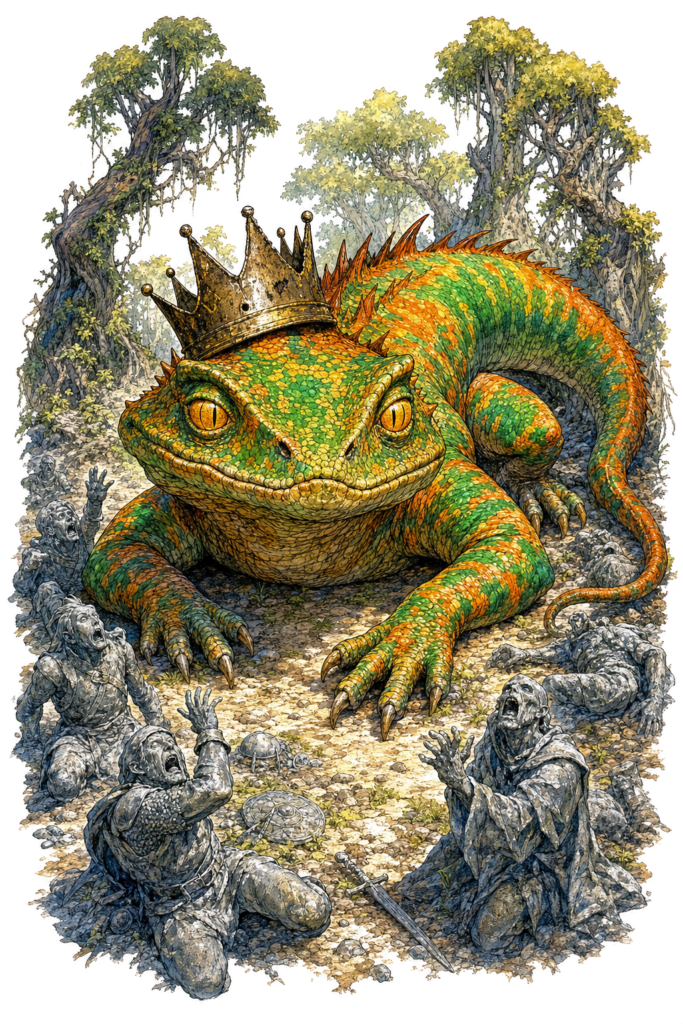
A 10-foot lizard wearing a crown it did not earn — bright-colored, slow-moving, utterly unhurried. It has no reason to hurry. Everything that looks at it dies.
Two Modes — Prime Plane vs. Plane of Earth #
The Basilisk has two distinct profiles depending on where it is encountered. Both share the same base statistics but the Plane of Earth variant has different gaze effects, a burrowing capability, and a fundamentally different behavioral profile. Establish which mode applies before running the encounter.
Mode 1 — Prime Plane Basilisk: Standard petrification gaze, bite petrification, standard ecology in caverns and wild thickets. This is the default encounter.
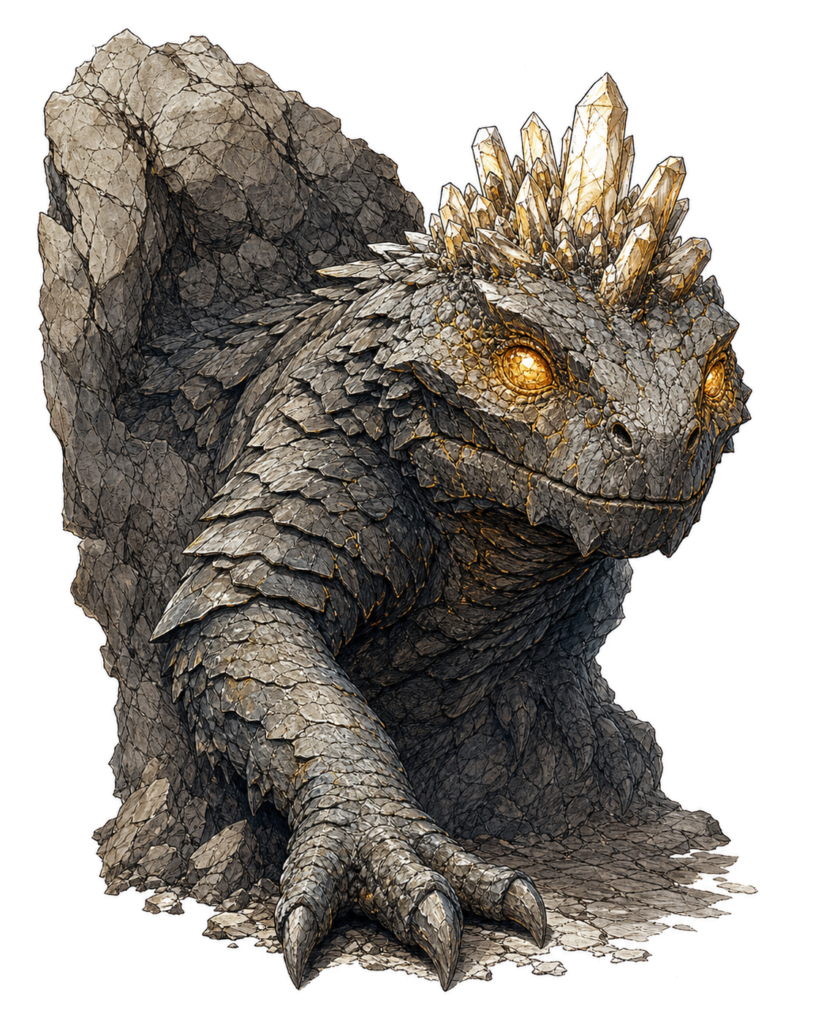
Mode 2 — Plane of Earth Basilisk: Made of rock. Gaze slows earth-creatures (no save), still petrifies non-earth creatures (standard save). Burrows at 180 ft through dense rock. Avoids other life forms by preference. CR reduced by 1 for Prime Plane parties (the slowing gaze against earth-creatures is irrelevant) but increased by 1 for parties heavy on earth-magic (the no-save slow is devastating).
Core Statistics #
| Stat | Value |
|---|---|
| Hit Dice | 6d8+1** (avg 28 HP) |
| AC | 16 |
| AV | 3 (melee) / 2 (missile) |
| HR | +5 |
| FR | +3 |
| FD | 14 |
| Move | 60 ft (20 ft encounter) |
| Attacks | 1 bite (1d10 + petrification) + 1 gaze (petrification, see Gaze System) |
| Save As | Fighter 6 |
| Morale | 9 |
| Treasure | Type F (lair) |
| Alignment | Neutral |
| CR | 8 |
| Size | Large |
| Intelligence | Animal (INT 2) |
| XP | 950 |
AC/AV Reasoning #
RC original is AC 4 (descending) = Ascending AC 16. The Basilisk is a large magical lizard with thick scales over a dense body.
- AC 16 — The Basilisk moves slowly (60 ft / 20 ft encounter) and is not evasive. Its AC 16 comes from thick overlapping scales on a muscular body — not agility but physical resilience. The crown-like head growth and the bright distinctive coloring suggest a creature that has no need to hide — its primary defense is its gaze, not its armor.
- AV 3 (melee) — Dense lizard scales over heavy muscle mass. Equivalent to scale armor for absorption purposes. A weapon strike that connects deals reduced damage — 1 always penetrates, but the remaining damage is substantially cut. AV 3 makes the Basilisk genuinely durable in sustained melee — the challenge of fighting it is not just the petrification risk but the fact that even successful hits deal reduced damage.
- AV 2 (missile) — Arrows and bolts find scale gaps more readily than melee weapons. Still meaningful — ranged combat against a Basilisk is safer from a gaze perspective but only marginally more effective damage-wise.
- HR +5 — The double asterisk (**) marks two special abilities (bite petrification and gaze). The Basilisk’s HR +5 reflects a magical creature of 6+1 HD with innate combat capability — not a trained fighter but a dangerous predator with precision bite targeting. The bite is aimed at exposed flesh that will be petrified, not at armored surfaces.
Skill Slots #
(5 total — 6 HD = 4 base + 1 from 9 HD proximity; ** = 2 special ability slots)
Standard 6 HD budget is 4 base slots (1–8 HD tier). The marks two special abilities. Total: 4 base + 2 special = 6 slots**. This entry uses 5, leaving 1 open for DM customization.
| Slot | Skill / Ability | Notes |
|---|---|---|
| 1 | HR Investment (Basic) | HR +5; the bite is a targeted precision attack — the Basilisk aims for exposed skin, face, or hands where petrification will be most immediately disabling |
| 2 | Gaze Attack — Petrification (innate, special) | The primary special ability. Full mechanic in the Gaze System section. This is the first asterisk |
| 3 | Bite Petrification (innate, special) | Any creature hit by the bite must Save vs. Turn to Stone or be petrified along with all carried equipment. This is separate from and independent of the gaze — the bite can petrify even a creature that is successfully avoiding the gaze. This is the second asterisk |
| 4 | Alertness (Basic) | Cannot be surprised in its home terrain (cavern, dense thicket). Detects movement through vibration and scent — the Basilisk’s eyes are its weapon, but its other senses locate prey first. Its slow movement (60 ft) means it relies on ambush positioning rather than pursuit |
| 5 | Stealth — Ambush Positioning (Basic) | The Basilisk does not chase prey — it positions itself where prey will walk past it. In caverns it sits motionless near water sources and narrow passages. In thickets it sits in dense undergrowth where passing creatures must come within gaze range to navigate. Stationary Basilisks are surprisingly difficult to detect — the bright coloration that identifies them to knowledgeable observers actually disrupts outline recognition in dappled light |
Martial Style #
Style: Reactive (Basic rank) — The Counter-Striker Rank: Basic
The Basilisk is the most purely Reactive creature in the RC. It does not pursue. It does not attack unprovoked prey it cannot reach. It sits, waits, and when prey enters range it bites and gazes. This is not learned behavior — it is evolved ambush predation built around the assumption that prey will come to it.
Reactive Basic Benefits:
- 1 Riposte available per round — any attacker who misses the Basilisk triggers an immediate counter-attack at –2 HR (the Basilisk’s reflexive snap at the overextended limb)
- The Reactive style perfectly models the gaze interaction: the Basilisk’s combat advantage comes entirely from opponents’ mistakes (looking at it, getting within bite range) rather than from the Basilisk’s own offensive initiative
No Combat Breath: Animal intelligence, pure predatory instinct. Does not Winden or Exhaust. Fights until it or the prey stops moving.
The slow movement note: 60 ft (20 ft encounter) is the slowest combat movement of any active predator in the RC. This is not a weakness in the Basilisk’s ecosystem — prey comes to the water source, the narrow passage, the only path through the thicket. The Basilisk does not need speed because its environment does the work of positioning.
The Gaze System — Complete Mechanics #
This is the most mechanically detailed encounter element in the entire Basilisk entry. The RC describes it with unusual precision — three distinct states for the character, each with different attack and defense modifiers. The Skills-Based framework formalizes and extends this.
The Core Problem #
Any character in hand-to-hand (melee) combat with a Basilisk must choose one of three states each round. This choice is declared in Phase 1 (Intentions) before any attack rolls are made and cannot be changed mid-round.
The three states:
State 1 — Avoid the Gaze #
“A character tries to avoid the gaze”
The character fights with eyes averted, focused on the Basilisk’s lower body, using peripheral vision and sound to locate and attack.
Modifiers:
- Character suffers –4 HR on all attacks against the Basilisk
- Basilisk gains +2 HR on all attacks against this character
- Character does not need to Save vs. Turn to Stone this round (the gaze is avoided)
- Character still needs to Save vs. Turn to Stone if the bite hits
Tactical use: Appropriate when the character cannot afford any chance of petrification — when they are already weakened, when no one in the party has Stone to Flesh, or when the character is the party’s only healer/spellcaster. The –4/+2 penalty is severe but the complete elimination of gaze risk makes it viable.
The mirror variant: A character using a mirror to avoid direct gaze while still seeing the Basilisk’s position suffers only –2 HR instead of –4. Full mechanics in the Mirror section below.
State 2 — Meet the Gaze #
“If the character meets the gaze, he attacks and defends normally”
The character fights normally, looking at the Basilisk directly.
Modifiers:
- No attack or defense penalties
- Character must Save vs. Turn to Stone each round (standard save, no modifier)
- Character still saves vs. Turn to Stone on bite hit (independent of gaze save)
Tactical use: Appropriate for characters with high saving throws, characters protected by Protection from Petrification effects, or characters who calculate the risk of a standard save is preferable to the –4/+2 combat penalty. A Fighter with a high level save who fights at Master Weapon Mastery rank loses enormous damage output from the –4 HR penalty in Avoid state — for such a character, meeting the gaze and trusting their save may deal significantly more damage total.
Surprised character automatic gaze: A character surprised by a Basilisk automatically meets the gaze (they looked at it before they knew what it was). They still get the standard saving throw — “surprised” does not mean “no save,” it means the gaze decision was made for them.
State 3 — Mirror Defense #
“A character may use a mirror when confronting a basilisk”
A character with a hand mirror (or polished shield face, highly polished metal object) can use the reflection to fight the Basilisk without direct eye contact.
Requirements:
- The area must be lit — the mirror requires sufficient light to produce a clear reflection. In magical darkness, natural underground darkness without light sources, or heavy shadow, the mirror is ineffective (treat as full Avoid state, –4 HR penalty)
- The character cannot use a shield while using the mirror — one hand holds the mirror, one hand fights
- The shield restriction means the character loses any shield AC bonus for this round
Modifiers:
- Character suffers –2 HR (reduced from –4 for Avoid state)
- Character does not need to Save vs. Turn to Stone from the gaze this round
- Character still saves vs. Turn to Stone if the bite hits
- No basilisk attack bonus against this character (the +2 vs. Avoid state does not apply when using a mirror)
The self-petrification chance: Each round the character uses a mirror, roll 1d6. On a result of 1, the Basilisk sees itself clearly in the mirror and must make its own Save vs. Turn to Stone. If the Basilisk fails, it is petrified — the encounter ends instantly. If the Basilisk succeeds, the mirror attempt for that round produces no self-petrification effect (roll again next round).
Note: The 1-in-6 chance applies per round of mirror use. Over multiple rounds this becomes a reliable eventual outcome — a party member who survives 6 rounds of mirror combat has a 66% chance of having triggered at least one self-petrification attempt.
Mirror availability: A standard adventuring kit does not include a mirror. Characters who carry a silver mirror (20 gp), a polished copper mirror, or any highly reflective surface may use this option. A character without a mirror improvises with a polished breastplate, a shield face they hand to a companion, or a pool of still water (DM adjudication — improvised reflections may trigger a skill check to use effectively).
Gaze Range and Targeting #
Range: The gaze affects any creature that makes eye contact with the Basilisk within its line of sight. There is no stated maximum range in the RC — treat as 30 ft for game purposes (the creature needs to be close enough to see the Basilisk’s eyes distinctly). Beyond 30 ft the gaze risk does not apply.
Missile/spell attacks beyond 30 ft: A character attacking the Basilisk from beyond gaze range (or from behind, or with eyes closed, or in magical darkness) faces no gaze risk but suffers no standard attack penalties either. This is the party’s tactical advantage — a Basilisk can be safely attacked at range if the party identifies it before coming within 30 ft.
Identifying a Basilisk before gaze range: A character with Nature Lore (INT) or Knowledge (Monsters) can identify the distinctive crown-like head growth and bright coloration before entering gaze range. A successful check at difficulty –2 (the Basilisk is distinctive) means the party knows what they are dealing with and can plan accordingly. An Identify effect or a party Bard using Lore (INT+WIS+CHA+Level×2 vs. d100) can also provide this forewarning.
Gaze through obstacles: The gaze requires direct eye contact — it does not pass through solid obstacles, does not affect creatures looking at the Basilisk from the side at greater than 90 degrees, and does not affect creatures with their eyes closed. Blind characters are completely immune to the gaze. A Darkness spell covering the Basilisk (but not the party) eliminates the gaze risk entirely while the party fights in the dark.
Bite Petrification — Independent Threat #
The bite deals 1d10 damage plus forces a Save vs. Turn to Stone, independent of the gaze. This means:
Even in Avoid state (–4 HR, no gaze risk), a successful bite forces a save. Even with the mirror (–2 HR, no gaze risk), a successful bite forces a save. Meeting the gaze means potentially two saves per round — one for the gaze and one if the bite connects.
The bite petrification save has no modifier — it is a standard Save vs. Turn to Stone without the penalties or bonuses that apply to the gaze decision states. The bite and gaze are mechanically independent.
Equipment petrification: All equipment carried by a petrified character is also turned to stone. This has significant implications:
- Magic items in a petrified character’s possession are stone — they cannot be used by others until the character is restored
- Petrified characters cannot be looted — the items are fused to the stone form
- Stone to Flesh (or Flesh to Stone reversed) restores the character and their equipment simultaneously
Tactical Analysis — Party Approaches #
The Ranged Approach (Recommended for unprepared parties) #
Identify the Basilisk from beyond 30 ft. Attack with missile weapons, spells, or thrown weapons from outside gaze range. The Basilisk’s 60 ft move and 20 ft encounter speed means it will close slowly — a party that maintains 30+ ft distance and retreats as it advances can deal significant damage before melee becomes necessary.
Limitation: The Basilisk’s AV 3 reduces missile damage. A shortbow dealing 1d6 damage averages 3.5 — after AV 2 (missile), roughly 2 damage per hit average. Against 28 average HP, the Basilisk requires approximately 14 missile hits to kill at average rolls. This is sustainable at range but takes time.
Spell option: Hold Monster (Magic-User 5th level) paralyzes the Basilisk without requiring eye contact. A paralyzed Basilisk can be safely approached for melee. Flesh to Stone (Magic-User 6th) is ironic but effective. Fireball, Lightning Bolt, and other area spells work normally — the Basilisk has no spell immunity.
The Mirror Approach (Recommended for melee parties) #
Every melee party member should be carrying a mirror. The –2 HR penalty vs. the standard –4 for Avoid state is a significant advantage, and the 1-in-6 self-petrification chance per round provides an escalating probability of instant victory.
Mirror math: A melee Fighter with HR +8 fighting in Mirror state has effective HR +6 vs. the Basilisk’s AC 16. Against a target they need a 10 to hit, they hit on a 10+, which is 55%. Against the same Basilisk in Avoid state (HR +8 –4 = HR +4), they hit on a 12+, which is 45%. The mirror is substantially better — 10% more hits plus no shield loss matters less than the HR improvement.
The self-petrification windfall: A party of three mirror-users against a Basilisk rolls three 1d6 per round. The chance that at least one die shows a 1 per round is approximately 42% — the Basilisk has nearly a coin-flip chance of having to save against itself every round with three mirror users engaged.
The Blind Approach (Specialized) #
A party member who is blind (from a Darkness spell, a blindfold, or the Blind Shooting Guild Art) is completely immune to the gaze. They fight entirely in Avoid state without any of the mechanical downsides — no HR penalty (they already account for fighting blind in their accuracy), no gaze risk. A Guildsman with Expert Blind Shooting can actually perform better than sighted party members against a Basilisk by eliminating the gaze mechanic entirely.
Darkness cast on a party member’s own position (they stand in the darkness, attack out of it) is a legitimate tactic — they cannot be gazed, the Basilisk cannot target them well, and the party fights normally outside the darkness zone.
Special Attacks #
Gaze — Petrification (no attack roll required) #
The gaze is not an attack — it is an environmental effect triggered by eye contact. No HR roll is made for the gaze. The saving throw is the only mechanic:
- Save vs. Turn to Stone: Standard save, no modifier, unless the character is in Avoid state (no save needed) or Mirror state (no save needed)
- Failed save: Character and all carried equipment are instantly petrified — turned to stone in the exact position they were standing in
- Successful save: Character is unaffected this round but must save again next round if still meeting the gaze
Petrified character properties:
- Weight increases dramatically (a 180 lb human becomes approximately 400+ lbs of stone)
- Cannot be moved without significant effort (Muscle skill or equivalent Strength check)
- Persists indefinitely without magical restoration
- Is not dead — can be restored by Stone to Flesh, Wish, or the reverse of Flesh to Stone
- Takes normal damage from physical attacks while petrified (the stone form can be chipped or shattered — a petrified character who takes more than their HP maximum in damage while stone is permanently destroyed)
Bite — 1d10 + Petrification #
Standard HR +5 vs. AC attack. On a hit:
- 1d10 damage (AV applies to the damage component)
- Target saves vs. Turn to Stone (standard save, no modifier regardless of gaze state)
- Equipment is also petrified on a failed save
Treasure Type F #
The Basilisk’s lair contains Type F treasure — significant value including gems, jewelry, and potentially magic items. The source of this treasure is self-explanatory: the Basilisk has been petrifying prey for years. Adventurers, merchants, hunters, and animals that wandered into the lair did not come back. Their petrified forms — and the equipment fused to those forms — are still there.
The disturbing lair: A Basilisk’s lair contains a variable number of petrified former prey. Roll 1d6 for the number of statues present. Each statue:
- Was a living creature at some point — the DM may detail these (a petrified merchant with a pack, a petrified adventurer in armor, a petrified animal)
- Has equipment fused to it — not freely available unless the statue is restored or shattered
- May still be alive in the stone — Stone to Flesh can potentially restore prey that the Basilisk petrified recently (within the last year, DM adjudication of stone-preservation of biological processes)
Finding the treasure: The Type F treasure is loose items that fell from petrified victims over time (coins, jewelry not fused to the body), items cached by the Basilisk through instinct (it has carried shiny objects back to the lair), and equipment from victims that broke off rather than petrifying with them. The bulk of the loot is accessible; the equipment fused to petrified forms requires Stone to Flesh or deliberate damage to the statue to retrieve.
The moral question: A party that shatters the petrified statues to retrieve equipment is destroying potentially living beings. A party that casts Stone to Flesh on statues to restore them is rescuing prisoners who have been in stone sleep for an unknown time. Both options should be present and neither should be made trivially easy.
Plane of Earth Variant #
The Plane of Earth Basilisk is a fundamentally different encounter despite identical base statistics.
Physical composition: Made of rock — its body is dense stone rather than biological tissue. This produces:
- Natural AV increase: AV 5 (melee) / AV 3 (missile) — the stone body absorbs even more physical damage
- Immunity to fire, cold, and lightning (stone does not burn, freeze, or conduct meaningfully at combat scales)
- Vulnerability to earth-type magic is shared with the plane’s other inhabitants — the DM adjudicates
Gaze — modified:
- Against earth-type creatures (Earth Elementals, Stone Giants, Xorn, earth-form spell users): The gaze slows (as reverse Haste) for 1d6 rounds, no saving throw. The stone-to-stone gaze disrupts the elemental cohesion of earth-creatures rather than petrifying them.
- Against non-earth creatures (standard humanoids, fire elementals, etc.): Standard petrification gaze, standard save. The petrification effect functions normally against biological creatures even on the Plane of Earth.
Burrowing: Moves through very dense rock at 180 ft (60 ft encounter). This is faster than its surface movement. On the Plane of Earth the Basilisk burrows rather than walks — surface movement on rock formations is 60 ft as normal, but through solid rock it can move at 3× speed.
Behavioral difference: The Plane of Earth Basilisk “usually avoids other life forms on its own plane.” It is not aggressive on home ground — it will retreat into rock rather than fight when given the option. The petrification risk to a Prime Plane party is incidental rather than predatory. A party that encounters a Plane of Earth Basilisk and does not block its retreat path will usually see it burrow away rather than fight.
Encounter CR on Plane of Earth:
- Against parties without earth-type composition: CR 7 (the no-save slow is irrelevant)
- Against parties with earth elementalists, earth-type creatures, or stone-form magic users: CR 9 (the no-save slow against those party members is extremely disruptive)
- In pursuit mode (party has blocked its retreat): CR 8 standard — it fights when cornered
Habitat & Ecology #
Primary Habitat (Prime Plane): Underground caverns and wild tangled thickets. Both habitats share the characteristic that prey cannot easily see and identify the Basilisk until already within gaze range.
Cavern behavior: The Basilisk positions near water sources, narrow passages, and cave intersections — places where creatures must pass close regardless of caution. Its slow movement means it selects positioning carefully. A cavern Basilisk near the only water source in a dungeon level is a genuine strategic problem.
Thicket behavior: Dense woodland undergrowth provides excellent concealment for a motionless, slow Basilisk. The bright coloration that makes it easy to identify in open terrain actually disrupts visual pattern recognition in dappled light through leaves. Travelers forced to push through thick vegetation cannot maintain the safe 30+ ft distance.
Diet: Anything that gets petrified becomes food when the petrification is eventually… processed. The Basilisk’s biology works on geological time in some respects — it petrifies prey, waits, and the stone form eventually breaks down in ways that provide sustenance. The RC does not detail this; the DM should treat the Basilisk as feeding on whatever it can catch, with petrification as the primary capture mechanism rather than a storage system.
Reproduction: The RC does not detail this. Small groups (1d6 individuals) suggest family units or territorial clustering. Individual Basilisks maintain significant personal territory — multiple Basilisks in proximity suggests either mated pairs or a recently-split family group before territorial distribution.
“King of Snakes” title: The Basilisk is sometimes called this despite being a lizard rather than a snake. The title reflects its reputation — it does not mean the Basilisk leads snake hierarchies or has any relationship with snakes.
Encounter Notes #
Detection before combat: The Basilisk encounter should ideally begin with a knowledge check. A party walking into a Basilisk lair without knowing what they face is gambling on their saving throws. A party that identifies the creature first can plan the mirror strategy, establish firing positions outside gaze range, and prepare Stone to Flesh for potential casualties.
Signs of a Basilisk lair:
- Stone statues of creatures in positions that suggest interrupted movement (not artistic poses — awkward freeze-frame stances)
- Unusual stillness and silence (other cave animals avoid the territory)
- Bright unusual coloring visible from a distance (the Basilisk’s crown and coloration are distinctive)
- A Nature Lore or Knowledge check detects characteristic basilisk tracks — four clawed feet with a dragging belly mark, moving very slowly in a direct line toward the water source
Running the gaze decision each round: The DM should ask each melee party member to declare their state (Avoid/Meet/Mirror) at the start of each round during Intentions Phase. This is the mechanical heart of the encounter — the ongoing decision under pressure is what makes the Basilisk interesting rather than simply a damage-dealing creature with a save-or-die.
The “one petrified party member” scenario: A petrified party member is a campaign-level problem. Stone to Flesh is a 6th-level Cleric spell or a Magic-User scroll — not casually available to most parties. Options:
- Find a Cleric of sufficient level (12th+) in the nearest city
- Locate a Stone to Flesh scroll (high-level dungeon treasure, expensive purchase)
- Return to a temple and pay for the service (typically 1,000+ gp for restoration)
- Leave the petrified party member in the lair and come back (the statue is heavy and difficult to transport)
The cost and effort of restoration is intentionally significant — it makes the Basilisk one of the most dangerous monsters in its CR range despite only 28 average HP.
CR 8 justification:
- 6+1 HD** base = CR 6 + 2 (two asterisks) = CR 8
- The save-or-die petrification on both bite AND gaze simultaneously, the complex three-state gaze mechanic creating guaranteed penalties in melee, and the restoration cost of failure justify the full CR 8 rating
- Against parties without Stone to Flesh access: treat as CR 9 — a failed save is a permanent party member loss, not a resolvable setback


