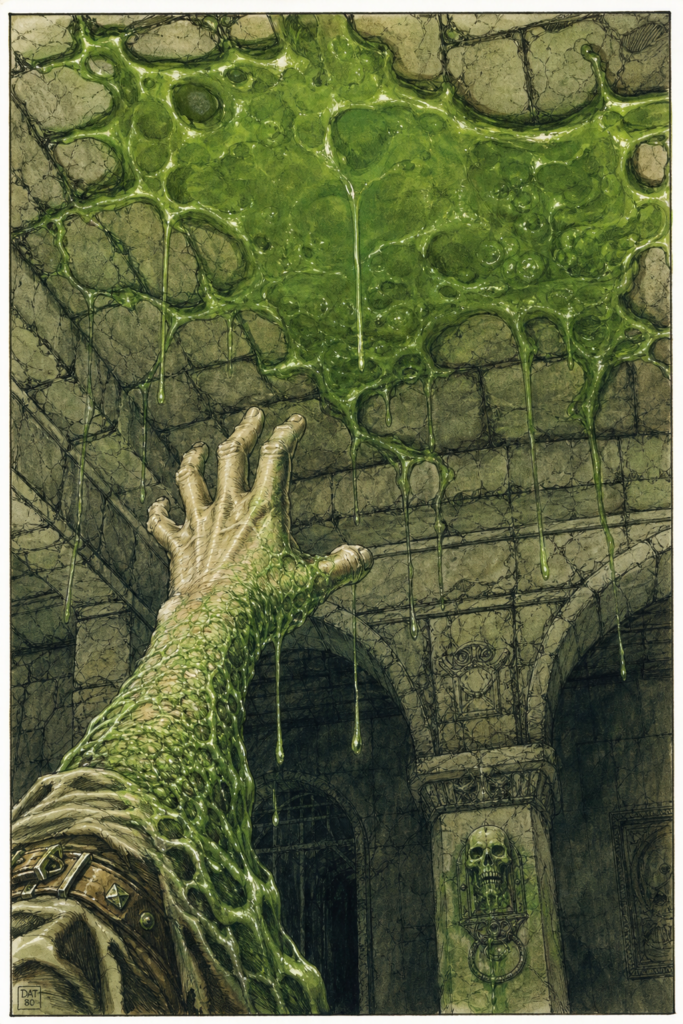
You look up too late. The ceiling was covered in it. Now your arm is covered in it. You have approximately one minute to do something about this.
What Green Slime Is #
Green slime is a biological hazard with no parallel in the RC’s monster roster. It is not fought — it is managed. Its danger is not HP damage but transformation: green slime turns flesh into green slime. A character who fails to remove it within a fixed timeline is permanently lost.
Two asterisks, 2 HD: The statistical anomaly is immediate — a 2 HD creature with two asterisks has CR above its HD. The asterisks represent the transformation ability and the near-total attack immunity. Green slime is the most dangerous 2 HD creature in the RC.
Core Statistics #
| Stat | Value |
|---|---|
| Hit Dice | 2d8** (avg 9 HP) |
| AC | Can always be hit — no roll required |
| AV | 0 |
| HR | Automatic (see contact mechanic) |
| FR | N/A (does not move meaningfully) |
| FD | N/A |
| Move | 3 ft (1 ft encounter) |
| Attacks | 1 (contact: transformation process) |
| No. Appearing | 1 (0) |
| Save As | Fighter 1 |
| Morale | 7 |
| Treasure | (P+S) individual / B lair |
| Alignment | Neutral |
| Intelligence | None (INT 0) |
| XP | 30 |
AC — “Can Always Be Hit” #
Green slime has no AC. It cannot evade. Attacks against it automatically contact the slime — no attack roll required. This unique property means:
- Any weapon strike hits automatically
- Any area attack that covers the slime’s position hits automatically
- The challenge is not hitting green slime — the challenge is that only fire and cold can harm it
Skill Slots (3 total — 2** HD = 2 base + 2 asterisks) #
| Slot | Skill / Ability | Notes |
|---|---|---|
| 1 | Flesh Transformation (innate, special) | Contact begins 6-round dissolution; 1d4 rounds after that = complete transformation. First asterisk |
| 2 | Near-Total Attack Immunity (innate, special) | Only fire and cold deal damage. Second asterisk |
| 3 | Dissolution (innate) | Cloth/leather: instant; wood/metal: 6 rounds; stone: immune |
Attack and Immunity Profile #
What Harms Green Slime #
“Green slime cannot be harmed by any attacks except fire or cold.”
Only two damage sources deal damage to green slime:
- Fire: Torches, flaming oil, Fireball, Burning Hands, Wall of Fire — all deal full damage
- Cold: Cone of Cold, Ice Storm, Frost effects — all deal full damage
Everything else deals zero damage:
- Weapons (swords, axes, hammers, arrows, spears): zero
- Lightning: zero
- Acid: zero
- Poison: zero (no biology to poison)
- Mind-affecting magic: zero (no mind)
- Blunt trauma, crushing, piercing: zero
The implication: A party without fire or cold capability cannot harm green slime at all. A party that expends all fire/cold resources faces a slime problem with no solutions.
What Green Slime Cannot Dissolve #
“Green slime cannot dissolve stone.” Stone floors, stone walls, stone objects — all are immune to the slime’s dissolving chemistry. This is why green slime inhabits caves and ruins — stone provides surfaces it can cling to without being dissolved.
The Transformation Process — Complete Timeline #
Round 0 — Contact #
Green slime makes contact with flesh. Contact is almost always by ceiling drop (see below) or by a character stepping on or reaching into a slime patch. Contact is automatic — the slime does not make an attack roll.
On contact:
- Cloth or leather items in contact: instantly destroyed (same round)
- The flesh-transformation clock begins
Rounds 1–6 — Dissolution Phase (One Minute) #
The slime is dissolving the victim’s armor and beginning to work on flesh. During this phase:
- Wood and metal items in contact with the slime are being dissolved — they will be destroyed after 6 rounds
- The victim takes no HP damage during this phase — the slime is preparing the flesh, not consuming it yet
- Fire may be applied to burn off the slime (see rescue below)
“When green slime drops on a victim (or is stepped on), the victim can usually burn it while it is dissolving armor and clothing.” This 6-round window is the rescue window.
Rounds 7 to 7+1d4 — Transformation Phase #
After the 6-round dissolution period, if the slime has not been removed, transformation begins. “The victim will turn completely into green slime 1d4 rounds after the first 6-round period.”
- The victim begins visibly transforming — skin turning green and slimy
- The victim takes ongoing damage at DM discretion during transformation
- At the end of the 1d4 rounds: the victim is entirely transformed into green slime
- A fully transformed character is permanently dead — there is no restoration, no Raise Dead, no recovery. They are green slime now.
Total timeline from contact to transformation:
- Minimum: 6 rounds + 1 round = 7 rounds (approximately 70 seconds)
- Maximum: 6 rounds + 4 rounds = 10 rounds (approximately 100 seconds)
- Average: 6 rounds + 2.5 rounds = 8–9 rounds
Rescue — Burning Off the Slime #
“It cannot be scraped off, but may be burnt off, or treated with a Cure Disease spell.”
Fire Removal #
“Burning does half damage to the green slime and half damage to the victim.”
This is the most important mechanical constraint in the entry. Fire cannot be precisely targeted at the slime without also burning the character it is on. The fire damages both simultaneously:
- Fire damage roll: split 50%/50% between the slime and the victim
- A torch dealing 1d4+1 fire damage: (1d4+1)÷2 to slime (rounded down), (1d4+1)÷2 to victim (rounded up)
- A Burning Hands dealing 2d4: 1d4 to slime, 1d4 to victim
- A Fireball dealing 6d6: 3d6 to slime, 3d6 to victim
The rescue calculation: The party must deal enough fire damage to kill the slime (9 avg HP) before the transformation completes, accepting that the victim takes half that fire damage simultaneously. The victim who survives the rescue is alive but burned. The victim who is not rescued is green slime.
Self-burning: “The victim can usually burn it while it is dissolving armor and clothing.” The victim can apply a torch to themselves during the 6-round dissolution window — self-burning is the primary rescue method when allies are not positioned to help or do not have fire magic.
Torch damage: A standard torch held to the slime deals 1d4+1 fire damage per round of contact. Split: approximately 2–3 damage to slime, 2–3 damage to victim per round. At 9 avg HP, the slime requires approximately 3–4 rounds of torch application to destroy — during which the victim takes 6–12 fire damage in addition to the transformation clock.
Cure Disease #
“May be treated with a Cure Disease spell.”
Cure Disease (3rd level Cleric spell) instantly removes the green slime without the fire damage cost. It treats the slime as a disease — which it essentially is, a biological transformation agent. No damage to the victim, immediate removal, transformation clock ends.
This is the ideal rescue. The challenge: Cure Disease is a 3rd-level Cleric spell, requiring at minimum a 5th-level Cleric (who has 3rd-level spells). Low-level parties without a high-level Cleric cannot use this option.
Ceiling Drop — The Primary Encounter #
“Green slime often clings to walls and ceilings and drops down in a surprise attack.”
Green slime’s 3 ft movement speed makes it an effective ambush predator despite being nearly immobile. It positions itself on ceilings and walls and waits. When a creature passes beneath it, it drops.
Drop mechanics:
- Surprise: Green slime drops on 1–4 (d6) — the same high surprise rate as creatures that use ambush tactics — because the party is looking forward and down, not upward
- Drop range: The slime must be directly above the target — only targets passing directly under the slime are at risk
- On a successful surprise drop: Contact is automatic. The transformation clock begins immediately.
- On a failed surprise (party detects the slime above): The party can choose to go around rather than under
Detection before the drop:
- Looking up actively (declared action) in a slime-prone environment: avoids surprise
- Alertness check (difficulty –3) to notice the discoloration on the ceiling passively
- Torchlight at ceiling height: slime is visible as a distinct green patch against stone
- Dripping sound: slime occasionally drips fluid — a successful Alertness check (difficulty –4) detects this sound
The dungeon environment logic: Green slime thrives on ceilings because the stone is immune to its dissolution and provides permanent adhesion. A corridor where the floor is oddly clean (the slime has been dissolving organic material that falls) while the ceiling has irregular dark patches is a green slime warning sign.
Material Dissolution — Specific Timeline #
| Material | Dissolution Time |
|---|---|
| Cloth | Instant (same round as contact) |
| Leather | Instant (same round as contact) |
| Wood | 6 rounds (1 minute) |
| Metal (non-magical) | 6 rounds (1 minute) |
| Stone | Immune |
Practical sequence:
- A leather-armored character who is hit by green slime loses their armor the same round — beginning round 2 they have no armor protection
- A plate-armored character has 6 rounds before the metal dissolves — more time to act, but the metal is being dissolved and cannot be saved once the 6 rounds expire
- Magical items use the same degradation rate as gray ooze (DM determination for green slime — the RC does not specify magical item resistance for green slime, unlike gray ooze; reasonable to apply similar 1-turn magical item degradation)
Treasure #
Individual: (P+S) — The parenthetical indicates individually carried treasure: coins (Type P = rare, perhaps 1 electrum coin) and gems (Type S = very small gems). These are items that have survived dissolution — stone-based or mineral objects that the slime cannot destroy.
Lair: B — A larger slime accumulation’s territory may contain Type B treasure. This represents items from dissolved victims that happened to be made of stone or mineral: stone-set jewelry, carved stone objects, gemstones.
The Two Asterisks — XP Justification #
Two asterisks on 2 HD = 30 XP. This is deceptively low for a creature that permanently kills characters. The XP reflects the creature’s HD, not its danger — the RC’s XP system does not fully account for non-HP-damage threats. The CR 5 classification more accurately represents the encounter’s actual danger.
Encounter Notes #
The standard ceiling drop: The party moves through a dungeon corridor. Alertness checks are not being made (they are focused on the goblins they just fought). The ceiling has 1 patch of green slime directly above the party’s path. It drops. Roll surprise (1–4). On a surprise: the victim is in contact before they know what happened. On no surprise: the party sees a green mass dropping and can scatter.
The rescue decision: Character A has green slime on their left arm. They have 6 rounds to burn it off before transformation begins, then another 1d4 rounds before completion. Options:
- Cure Disease (Cleric): Immediate removal, no damage. Best option, may not be available
- Torch applied by ally: 2–3 fire damage to slime + 2–3 fire damage to victim per round. Slime dies in 3–4 rounds. Victim takes 6–12 fire damage total. Transformation clock expires before slime is killed if they delay
- Self-torch: Same as above but the victim does it themselves — possible if they retained a torch
- Fire spell from ally: Half damage to slime, half to victim. A Burning Hands (2d4 avg 5) deals ~2 to slime, ~2 to victim per cast. Faster than a torch
The fatal delay: A party member contracts green slime and the party spends 3 rounds trying to determine what to do (arguing about whether to burn them, looking for the Cleric’s Cure Disease scroll). The 6-round window is now 3 rounds. If they begin burning now, they have 3 rounds of torch application (about 9 fire damage to each) — enough to kill the slime but barely. The tight timeline punishes indecision.
CR 5 justification:
- 2** HD = theoretical CR 4 (2 HD + 2 asterisks)
- Elevated to CR 5: The permanent death consequence (no Raise Dead for a slimed character) is categorically worse than any other 2 HD creature
- Rescue requires specific resources (fire/cold or 3rd-level Cleric spell)
- Near-total attack immunity (only fire/cold effective)
- Ceiling drop produces automatic contact from surprise
- Offset by: Morale 7 (breaks — but what does a slime fleeing look like?), 9 avg HP (fragile once correctly targeted), slow movement (cannot pursue)
Morale 7 note: The RC lists Morale 7 for green slime. A mindless organism with Morale 7 is unusual — it may represent the slime’s tendency to “retreat” (ooze away from fire) when damaged by its only vulnerabilities. When the party uses fire effectively, the slime pulls back from the damage source, which manifests as the slime withdrawing from the area.


