The forest is not safe. The river is not safe. The night air is not safe. These are not monsters from outside nature — they are nature itself, in the aspect that has always been indifferent to whether you survive the encounter.
Design Notes #
These spirits are not evil in the theological sense that undead or demons are evil. They are predatory expressions of natural forces — the danger of deep water, of winter, of marsh fog, of the thing glimpsed at the edge of firelight. They predate, they manipulate, they kill — but as nature kills, not as Chaos kills. Most are Neutral, not Chaotic. This is worse, in a sense. Chaotic evil can be opposed on moral grounds. These simply are.
All entries here are distinct from the Black Hag and Sea Hag (BECMI_Hag.md, RC source), which already exist in the project.
I. Night Hag #
She does not want your body. She wants the part of you that makes your body worth inhabiting. She will take it while you sleep, over several nights, in pieces small enough that you don’t notice until it is too late. By the time you understand what is happening, you have already given most of it away.
What a Night Hag Is #
The Night Hag is not a physical predator — she is a soul-harvester. She enters the dreams of sleeping victims and extracts vital essence across multiple nights, weakening the victim incrementally until she can sever the soul from the body and carry it away. She trades souls to extraplanar buyers — specifically to entities in evil outer planes who have uses for particularly seasoned spirits.
Distinction from the Black and Sea Hag: The RC Hags are physical combatants who control undead and attack directly. The Night Hag operates almost entirely in the dream-space and through incremental attrition. She rarely confronts the party physically until she has already won.
Physical form: An ancient, withered crone with iron-grey skin, black fingernails that leave marks on the skin of sleeping victims, and eyes like polished obsidian. She carries a heartstone — a dark gemstone that allows her to enter the Ethereal and project into dreams. Without the heartstone she cannot perform dream-entry.
Core Statistics #
| Stat | Value |
|---|---|
| Hit Dice | 9d8**** (avg 41 HP) |
| AC | 20 |
| AV | 2 |
| HR | +9 |
| FR | +7 |
| FD | 17 |
| Move | 90 ft (30 ft) ground / 240 ft (80 ft) Ethereal |
| Attacks | 2 claws (1d4/1d4) + 1 bite (1d4 + disease); OR dream assault (see below) |
| No. Appearing | 1 (1d4 in coven) |
| Save As | Fighter 13 |
| Morale | 10 |
| Treasure | Type E + heartstone |
| Intelligence | Exceptional (INT 17) |
| Alignment | Neutral (Evil) |
| XP | 3,000 |
Skill Slots (9 total — 9**** HD = 4 base + 5 at 9 HD + 4 asterisks; Exceptional INT 17) #
| Slot | Skill | Notes |
|---|---|---|
| 1 | HR Investment (Skilled) | HR +9 |
| 2 | Dream Entry — Soul Sap (innate, special) | Via heartstone: enters sleeping victim’s dreams each night; saps 1d4 CON (temporary); victim wakes exhausted. First asterisk |
| 3 | Ethereal Travel (innate, special) | Moves to Ethereal at will; on Ethereal: 240 ft move, immune to physical attacks, can observe material plane. Second asterisk |
| 4 | Heartstone Magic (innate, special) | Can become invisible at will; cast Magic Missile, Ray of Enfeeblement, Sleep (3/day each). Third asterisk |
| 5 | Disease Touch (innate, special) | Bite or extended claw contact: Save vs. Poison or contract Nightmare Fever (see below). Fourth asterisk |
| 6 | Magic Immunity (innate) | Immune to all 1st–3rd level spells; immune to Sleep, Charm, Hold, and fear effects |
| 7 | Weapon Requirement (innate) | +2 or better magical weapons to damage; silver alone is insufficient |
| 8 | Soul Cage (innate) | A victim drained to 0 CON has their soul snagged — trapped in the heartstone. Cannot be raised or resurrected while the heartstone contains the soul |
| 9 | Coven Magic (innate) | With 2 other hags (any type): can jointly cast spells as MU12; each hag contributes once per day to the coven casting |
Dream Entry — The Soul Sap #
Each night the Night Hag visits a sleeping target within 1 mile (she travels via Ethereal): the victim saves vs. Death Magic or loses 1d4 CON. This loss appears as exhaustion — the victim wakes feeling they did not sleep, increasingly haggard, increasingly unable to recover.
The victim does not know what is happening. The dreams leave no clear memory. Companions may notice the victim looking worse each morning. A Kha Shemsu can identify the Sahu disruption pattern after one night; a standard Cleric recognizes the supernatural exhaustion after 3 nights of decline.
CON loss recovery: Recovers at 1 point per night of uninterrupted, hag-free sleep. While the Night Hag continues visiting, recovery is impossible.
At 0 CON: The soul is snagged into the heartstone. The body enters a comatose state — alive but empty. The soul is lost until the heartstone is taken and Dispel Magic (6th level) or Remove Curse is applied to release it.
Nightmare Fever #
A disease specific to Night Hag victims. Symptoms: vivid waking hallucinations of being pursued, inability to sleep (even when exhausted — the body refuses sleep as self-protection), progressive WIS loss (–1 per day, not permanent — recovers 1/day after cure). At WIS 3: the victim cannot distinguish the hallucinations from reality.
Cure: Cure Disease (Cleric 3rd). The hallucinations end immediately.
The Heartstone #
Every Night Hag carries a heartstone — a polished dark gem (worth 1,800 gp as a material object, more as a magical tool). Without it she cannot perform dream entry or Ethereal travel.
As a weapon against her: A character who obtains the heartstone can use Dispel Magic on it to:
- Release any souls currently trapped within
- Destroy the stone (preventing her from performing dream-entry until she obtains a new one — weeks of work)
As a magical tool (for non-hags): The heartstone can be used 3 times by a non-hag before it becomes inert. Each use: one of the heartstone spells (Magic Missile, Ray of Enfeeblement, Sleep) at MU9 equivalent.
II. Annis — The Iron Hag #
She does not trick you. She does not charm you. She is simply very strong and her fingers are iron and she wants to break something today. The other hags use cleverness. The Annis is clever enough to know she doesn’t need to be.
What an Annis Is #
The Annis is the apex physical predator among the hag types — where the Sea Hag uses a horrifying gaze and the Night Hag harvests souls over time, the Annis simply tears things apart. She has iron-hard skin, fingers that function as iron claws, and the combat capability of a giant. She is the hag who appears when you have made it past the charm and the tricks and the curses and finds you anyway.
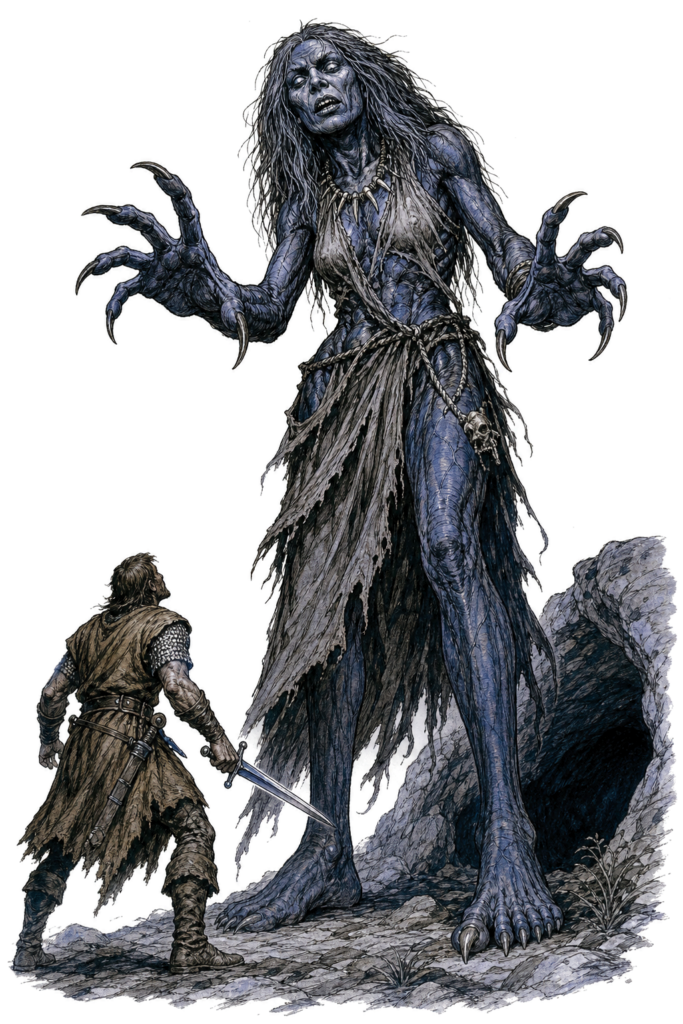
Physical form: Enormously tall for a hag — 8 feet, gaunt but with visible iron-cord musculature. Skin the blue-black of deep bruising. Fingers end in iron nails 4 inches long. Hair matted and grey-black. She smells of iron and cold mud. Her voice is beautiful and she uses it as a lure — she sounds like a gentle old woman until she speaks loudly, at which point it is wrong in a specific way that is hard to articulate but impossible to ignore.
Disposition: Brutal, direct, contemptuous of subtlety. She tolerates Black and Night Hags in covens because coven magic is useful. She finds their methods tedious. She is not stupid — she is just genuinely better at direct violence than at deception and sees no reason to pretend otherwise.
Core Statistics #
| Stat | Value |
|---|---|
| Hit Dice | 7d8** (avg 32 HP) |
| AC | 20 |
| AV | 5 |
| HR | +8 |
| FR | +12 |
| FD | 22 |
| Move | 150 ft (50 ft) |
| Attacks | 2 iron claws (2d6/2d6) + 1 bite (1d6) OR rend (see below) |
| No. Appearing | 1 (1d3 in coven) |
| Save As | Fighter 10 |
| Morale | 11 |
| Treasure | Type D |
| Intelligence | Average (INT 10) |
| Alignment | Chaotic |
| XP | 1,175 |
AV 5: Iron-hard skin. Weapons that hit deal normal damage against the AV but feel like striking plate armor. Her skin actually sparks against edged metal.
Skill Slots (6 total — 7** HD = 4 base + 2 at 6–7 HD + 2 asterisks; Average INT 10) #
| Slot | Skill | Notes |
|---|---|---|
| 1 | HR Investment (Expert) | HR +8 |
| 2 | FR Investment (Expert) | FR +12; the Annis is one of the hardest creatures to move in the system |
| 3 | Iron Rend (innate, special) | Both claws hit same target in one round: automatic rend for 2d6 additional damage + target’s armor (non-magical) is destroyed. First asterisk |
| 4 | Beautiful Voice Lure (innate, special) | Can project a calm, beautiful elderly voice for up to 1 mile; characters hearing it Save vs. Spells –1 or feel compelled to follow it toward her. Second asterisk |
| 5 | Iron Skin (innate) | AV 5; edged weapons that deal 5 or fewer points of damage in a single hit are themselves damaged (non-magical blades: Save vs. Death Ray or the blade chips and deals –1 damage permanently until repaired) |
| 6 | Shapeshifting — Old Woman Form (innate) | Can appear as an ordinary old woman indefinitely; dropped by violent action or if she chooses; smell of iron and cold mud remains regardless |
The Iron Rend #
When both claw attacks hit the same target in a single round:
- Automatic 2d6 additional rending damage
- Any non-magical armor worn by the target is destroyed — ripped apart by iron fingers
- Magical armor saves vs. Death Ray or loses 1 bonus point permanently
The armor destruction is the primary tactical use. The Annis prioritizes rending well-armored targets first — she strips their protection before beginning sustained damage. A Fighter in plate who survives the first round of rend has lost their armor and faces a creature that hits for 2d6/2d6 per round.
III. Bheur Hag — The Winter Crone #
She is winter given will. Not the safe winter of hearth and rest — the winter that kills the old and the weak, that strips the forest bare, that freezes the river solid and leaves the bodies of travelers until spring. She finds this appropriate. She was here before the first fire.
What a Bheur Is #
The Bheur is a winter hag — a predatory nature spirit of cold, storm, and the killing season. She is not Chaotic in the sense of causing random destruction; she is the ordered cruelty of winter, which kills according to rules (cold kills the weak, storms kill the exposed, starvation kills those without reserves) that are internally consistent even if they are not kind. She is Neutral, not Chaotic — she is winter’s will, not malice.
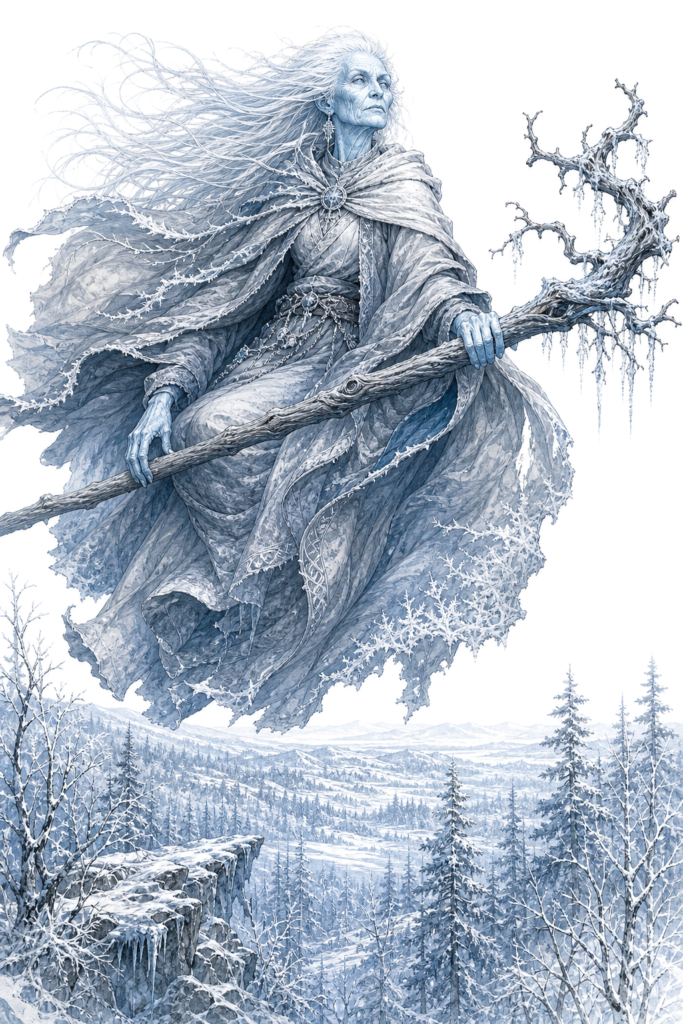
Physical form: Ancient and gaunt, with blue-white skin the color of ice, frost-white hair, and eyes like winter sky. She travels on a great grey staff of ash wood that she rides like a horse through the sky. She wears grey robes that always seem to move in a wind that isn’t present. Everything she touches, she chills.
Disposition: Purposeful, cold, unhurried. She does not hate her victims. She is ending them the way winter ends things — because it is the season for it. She views attempts to prevent her work as misguided rather than heroic.
Core Statistics #
| Stat | Value |
|---|---|
| Hit Dice | 6d8** (avg 27 HP) |
| AC | 16 |
| AV | 1 |
| HR | +5 |
| FR | +5 |
| FD | 15 |
| Move | 120 ft (40 ft) ground / 240 ft (80 ft) flying (on staff) |
| Attacks | 1 staff (1d8 + cold drain) OR winter magic |
| No. Appearing | 1 |
| Save As | Cleric 9 |
| Morale | 10 |
| Treasure | Type E |
| Intelligence | High (INT 14) |
| Alignment | Neutral |
| XP | 875 |
Save As Cleric 9: The Bheur’s powers are divine-adjacent — she is a nature spirit of a specific cosmic function, and her resilience reflects that.
Skill Slots (6 total — 6** HD = 4 base + 1 at 5–6 HD + 2 asterisks; High INT 14) #
| Slot | Skill | Notes |
|---|---|---|
| 1 | HR Investment (Basic) | HR +5 |
| 2 | Cold Drain — Staff Strike (innate, special) | Staff hit: 1d8 + Save vs. Death Ray or lose 1d4 CON from cold drain (temporary; restores 1/day in warmth). First asterisk |
| 3 | Winter Magic Suite (innate, special) | At will: Ice Storm, Wall of Ice, Cone of Cold equivalent (all as MU9). 3/day total uses. Second asterisk |
| 4 | Winter Immunity (innate) | Immune to all cold damage and cold-based effects; operates normally in any temperature |
| 5 | Winter Calling (innate) | Can summon a blizzard (1 mile radius, 1 hour to build, lasts 1d6 hours); within her blizzard, all non-cold-immune creatures save vs. Death Ray each hour or take 1d6 cold damage and lose 1 CON |
| 6 | Ride the Storm (innate) | On her staff at 240 ft flying: immune to ranged attacks from below while airborne in natural precipitation; she is part of the weather |
Winter vs. Summer #
The Bheur is at full power from the autumn equinox to the spring equinox. During this period, her Winter Magic is unlimited rather than 3/day and her blizzard builds in 10 minutes rather than 1 hour.
In summer, she retreats to high mountain glaciers and deep northern forests. She does not die in summer — she is simply diminished, like winter itself.
Encounter timing matters. A Bheur encountered in a January blizzard in the Heldann Freeholds is operating at full power. A Bheur encountered in July in the Five Shires is running at perhaps half effectiveness and extremely irritable about it.
IV. Kelpie — The Drowning Horse #
It was a beautiful horse standing at the river’s edge. The saddle was already on. Travelers rested their hands on its neck and found they could not remove them. The horse walked into the river. The saddle held them in place. The horse swam to the deepest part.
What a Kelpie Is #
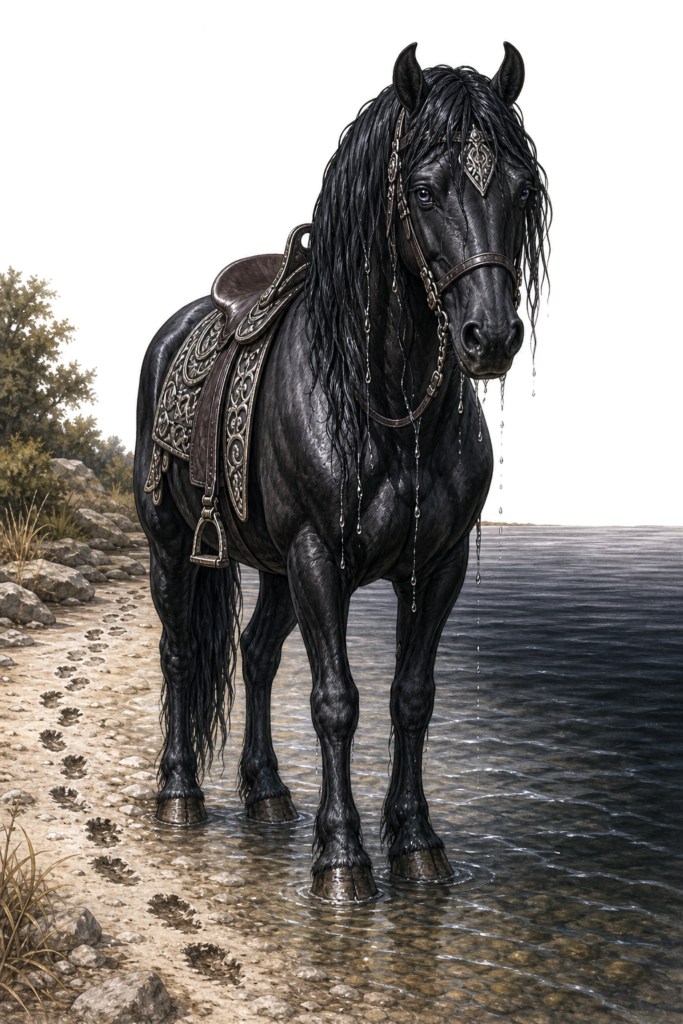
The Kelpie is a shape-shifting water spirit that primarily takes the form of a beautiful horse standing at a river, loch, or ford. Its skin is naturally adhesive — anyone who touches it (or mounts it) finds their hands stuck fast. The Kelpie then carries its victim into deep water and drowns them, feeding on the death. It can also take human form — specifically a beautiful, wet-haired person encountered near water who lures victims close enough to touch.
The anchor: Death by drowning, specifically. The Kelpie is the predatory intelligence of dangerous river crossings and deep lochs — the thing that makes fording a swollen river feel like more than just a physical risk.
Physical tells in horse form: Perfect, beautiful horse — but its mane drips regardless of weather, and the saddle is always already in place. Hoofprints near water run backward (the Kelpie approaches the river walking in reverse of apparent direction). In human form: entirely wet hair that does not dry, the smell of river water, and a subtle wrongness of the ankle region (the hooves do not entirely disappear).
Core Statistics #
| Stat | Value |
|---|---|
| Hit Dice | 5d8** (avg 22 HP) |
| AC | 15 |
| AV | 2 |
| HR | +5 |
| FR | +7 |
| FD | 17 |
| Move | 150 ft (50 ft) ground / 240 ft (80 ft) swimming |
| Attacks | 1 bite (2d6) + adhesive contact (see below) |
| No. Appearing | 1 |
| Save As | Fighter 7 |
| Morale | 9 |
| Treasure | Type C (possessions of drowned victims on the loch floor) |
| Intelligence | Average (INT 9) |
| Alignment | Neutral |
| XP | 550 |
Skill Slots (5 total — 5** HD = 4 base + 1 at 5 HD + 2 asterisks; Average INT 9) #
| Slot | Skill | Notes |
|---|---|---|
| 1 | FR Investment (Skilled) | FR +7; in water, the Kelpie is effectively immovable |
| 2 | Adhesive Hide (innate, special) | Any creature touching the Kelpie: Save vs. Death Ray or stuck fast (cannot voluntarily release contact); the stuck creature is dragged with the Kelpie wherever it moves. First asterisk |
| 3 | Shape-Shift — Horse/Human/True (innate, special) | Three forms: beautiful horse (primary lure), beautiful wet-haired human (secondary lure), true form (large aquatic horse-creature with seal-like tail). Second asterisk |
| 4 | Underwater Supremacy (innate) | In water: full combat capability, breathes water, moves at 240 ft; stuck victims drown at standard drowning rate (1 turn) with no ability to break free without special assistance |
| 5 | River Sense (innate) | Perceives all creatures crossing or entering any body of water within 1 mile; knows the location, size, and apparent capability of any creature at a ford, riverbank, or water’s edge |
Breaking the Adhesion #
A stuck character cannot voluntarily release. Methods that work:
- Cold iron: Touching the adhesion point with iron (not steel — iron) releases the grip. This is why cold iron horseshoes on a real horse are traditionally considered protective.
- Running water separately: Pouring water from a running stream over the adhesion point has 50% chance per application of releasing it.
- Cutting: An ally can cut away the clothing or (at cost) the skin at the adhesion point. The Kelpie takes no damage from this; the victim takes 1d4 damage and is released.
- Killing the Kelpie: On death, all adhesion releases immediately.
The Human Form #
In human form, the Kelpie lures travelers to touch it (offering help, asking for assistance, appearing distressed near water). The adhesion works in human form as well — touching its hand, arm, or hair triggers the save. Once stuck, it walks into the water.
The tell: In human form, if the Kelpie speaks more than three sentences consecutively, it involuntarily makes a sound — a quiet, wet noise, like water in a horse’s nostril. This is the only reliable non-magical identification.
V. Rusalka — The Drowned Maiden #
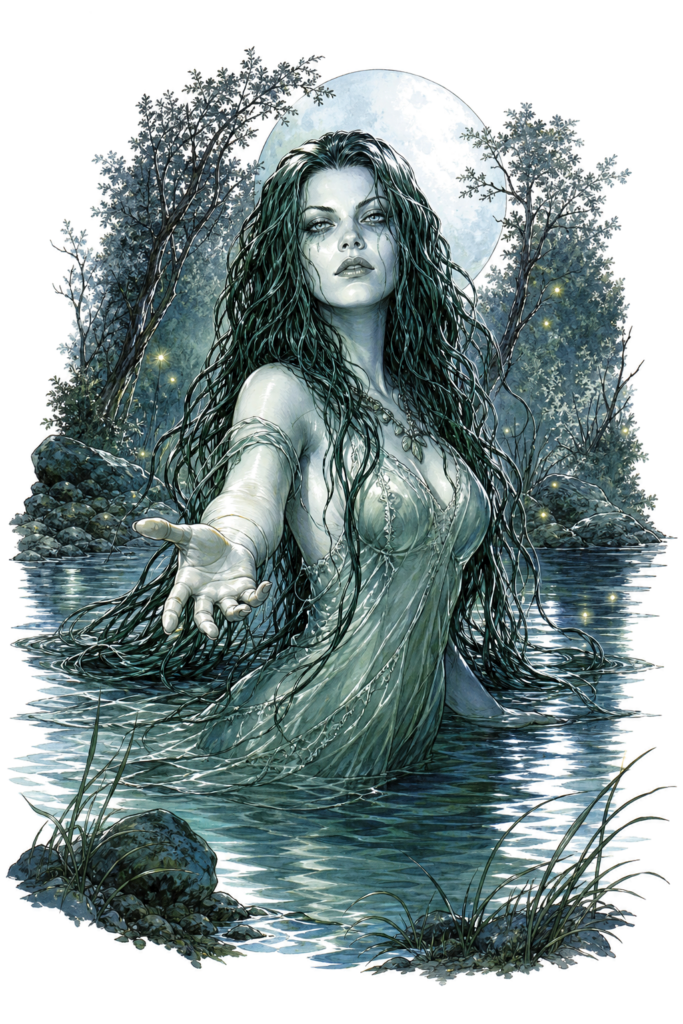
She was beautiful and she drowned and she is angry about it and she has been angry about it for a very long time and she is going to make sure you understand what it feels like.
What a Rusalka Is #
A Rusalka is the spirit of a woman who drowned, was murdered near water, or died by suicide in water — formed from the violent unresolved death and the cold water that preserved her body. She appears as a pale, beautiful woman with green or dark hair perpetually wet, standing waist-deep in a river or sitting at the water’s edge. She lures men specifically — tickling them to death in the water, dancing them to exhaustion, or simply dragging them under.
The distinction from nixies: Nixies charm victims into a year of happy service. Rusalki charm victims to their death through compelled dance or drowning. Nixies are mischievous; Rusalki are genuinely lethal and motivated by something that functions like grief transformed into predation.
Seasonal: Most active in the week before and after midsummer (Rusalki week in Slavic tradition — relevant in Traladaran areas of Karameikos). During this week they are freely active on land; at other times they are restricted to their water.
Core Statistics #
| Stat | Value |
|---|---|
| Hit Dice | 4d8** (avg 18 HP) |
| AC | 14 |
| AV | 0 |
| HR | +4 |
| FR | +3 |
| FD | 13 |
| Move | 120 ft (40 ft) ground (Rusalki week) / 60 ft (20 ft) near water (other times) / 180 ft (60 ft) swimming |
| Attacks | 1 touch (tickle-drain) + dance compulsion OR 1 drag |
| No. Appearing | 1d3 (2d6 during Rusalki week) |
| Save As | Elf 6 |
| Morale | 8 |
| Treasure | Type C — resting on the river floor among older bones. She has no interest in it. It is simply what remains. |
| Intelligence | Average (INT 10) |
| Alignment | Chaotic |
| XP | 175 |
Skill Slots (5 total — 4** HD = 3 base + 1 at 4 HD + 2 asterisks; Average INT 10) #
| Slot | Skill | Notes |
|---|---|---|
| 1 | Tickle-Drain (innate, special) | Touch: Save vs. Spells or compelled to laugh uncontrollably — cannot act, takes 1d4 damage per round as laughter exhausts breath; continues while Rusalka maintains contact. First asterisk |
| 2 | Dance Compulsion (innate, special) | Singing within 60 ft: Save vs. Spells or compelled to dance — cannot stop, move toward any other destination, or take any action except dance; dances until exhausted (CON check per turn or collapse from exhaustion); drags into water during dance if Rusalka moves. Second asterisk |
| 3 | Aquatic Drag (innate) | In water or at water’s edge: grapple attempt (FR +3 vs. FD); victim dragged underwater at 180 ft swim speed; drowning rules apply immediately |
| 4 | Appearance (innate) | Appears as a beautiful woman; in water only her upper body is visible; true nature identifiable by green tinge to skin, perpetually wet hair, absence of reflection in water beneath her |
| 5 | Rusalki Week Power (innate) | During the week before/after midsummer: immune to turning, operates on land freely, Dance Compulsion save is at –2, and groups of 2d6 appear instead of 1d3 |
The Rusalka and Men #
Rusalki specifically prey on men — their compulsions function at –2 save against male characters. Against female characters, saves are at +2. This is consistent with the folklore source and mechanically distinguishes Rusalki from standard charm effects.
Warding: Rusalki are repelled by wormwood (the herb) — a character carrying wormwood causes Rusalki to save vs. Spells or be unable to approach within 10 ft. Rusalki cannot enter a circle drawn with wormwood. This is traditional protective knowledge known to Traladaran communities and is why Traladaran women braid wormwood into their hair during Rusalki week.
VI. Jenny Greenteeth — The Pond Hag #
The pond has always been there. Jenny has always been in the pond. The children who fall in do not come back up. This is not a mystery. This is the pond.
What Jenny Greenteeth Is #
Jenny Greenteeth is a predatory water spirit specific to stagnant ponds, still pools, and mill ponds — not running rivers (the Rusalka’s territory) and not open water (the Kelpie’s territory). She dwells in the weedy shallows and the bottom mud, pulling down anyone who comes close enough to the surface. She appears as a thin, pale figure covered in green weed and algae, with long green hair and teeth filed to points — or she appears as the weeds themselves, indistinguishable from natural pond vegetation until the hands emerge.
The anchor: Stagnant water, the danger of ponds to children, the unseen things in the weeds. In Mystara, Jenny-types are known throughout the Known World wherever there are still bodies of water near settlements.
Core Statistics #
| Stat | Value |
|---|---|
| Hit Dice | 5d8* (avg 22 HP) |
| AC | 16 |
| AV | 2 |
| HR | +5 |
| FR | +6 |
| FD | 16 |
| Move | 30 ft (10 ft) ground / 120 ft (40 ft) swimming / Pond traverse (instant within her pond) |
| Attacks | 2 claw-grab (1d6/1d6 + drag) |
| No. Appearing | 1 |
| Save As | Fighter 7 |
| Morale | 10 |
| Treasure | Type B (on the pond floor) |
| Intelligence | Low (INT 6) |
| Alignment | Chaotic |
| XP | 300 |
Skill Slots (4 total — 5* HD = 4 base + 1 asterisk; Low INT 6) #
| Slot | Skill | Notes |
|---|---|---|
| 1 | FR Investment (Skilled) | FR +6; once Jenny has hold, she is nearly impossible to break free of |
| 2 | Weed Camouflage + Drag (innate, special) | Indistinguishable from pond vegetation when still; surprise on 1–5 on d6; on surprise: automatic claw-grab on nearest target (both claws, no attack roll needed); immediately drags into pond. The asterisk |
| 3 | Pond Omnipresence (innate) | Within her pond (up to 1 acre): moves instantly to any point in the water; cannot be evaded within the pond itself |
| 4 | Cold Mud Grip (innate) | Victims dragged to the pond floor are additionally gripped by the cold mud: FR check at –4 to break free; at the pond floor, the mud pulls (additional 1d4 drag damage per round) |
Her Pond #
Jenny Greenteeth cannot operate more than 100 ft from her specific pond. She does not pursue onto dry land beyond this range. Within her pond, she is functionally omnipresent — she cannot be outswum, cannot be hidden from, cannot be ambushed.
Draining the pond: The most reliable method of dealing with Jenny is draining the water from her pond. Without the water she is exposed, weakened (loses Pond Omnipresence and Cold Mud Grip), and reduced to her physical combat capability — which is significant but manageable. She will attempt to prevent the draining by dragging anyone near the sluice or channel into the water.
The pond floor treasure: Jenny’s victims accumulate on the pond floor. Type B treasure — primarily the personal effects of drowned locals going back as far as Jenny has inhabited the pond. In old settlements, this can include items from several generations back.
VII. Will-o’-the-Wisp — The Corpse Candle #
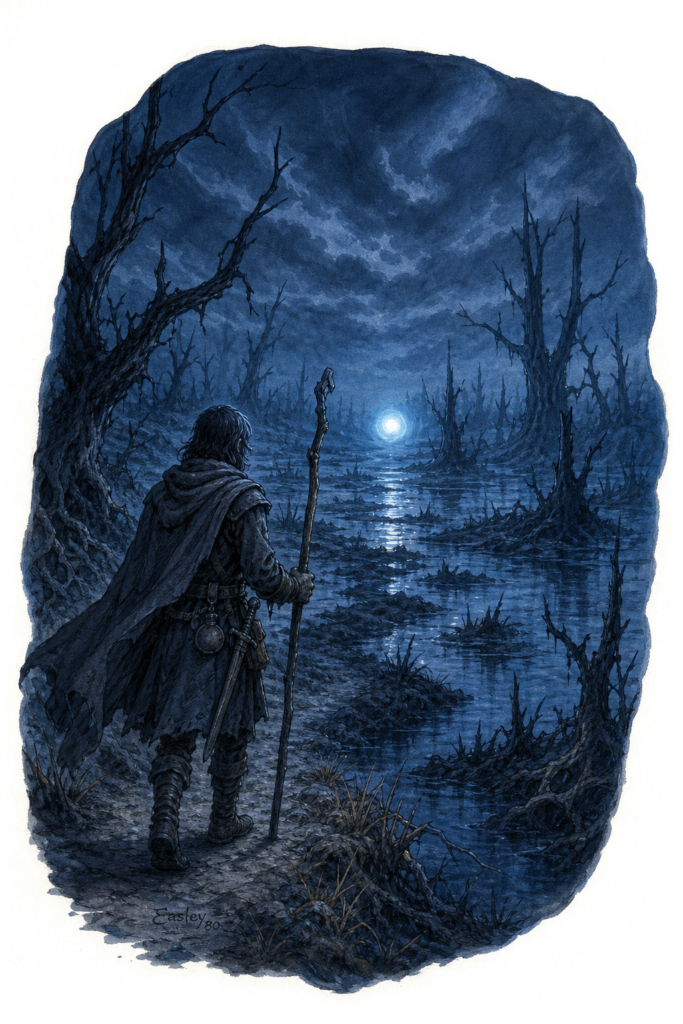
It is a light in the marsh. It is moving away from you. It looks like a lantern carried by someone who knows where they are going. It does not know where you are going. It knows where the deep mud is.
What a Will-o’-the-Wisp Is #
The Will-o’-the-Wisp is a predatory spirit of marshes, bogs, and fens — a floating light that lures travelers off safe paths and into fatal terrain. It is not malevolent in a thinking sense; it is drawn to the life force of living creatures and feeds on the fear and confusion of those it has led astray. It does not kill directly — it leads, and the bog does the killing.
Physical form: A floating sphere of cold light, approximately 1 ft in diameter — blue-white, yellow-green, or pale gold. It moves at walking pace, just fast enough that following it requires sustained effort, just slow enough that it seems catchable. It never speaks, never responds to calls, never stops.
Why it’s a nature spirit, not a construct: The Will-o’-the-Wisp is the spirit of the marsh itself, in the aspect of its most lethal feature — the way marshes look navigable from above but are not. It is not organized or directed by anything outside the marsh. It is what the marsh does to travelers.
Core Statistics #
| Stat | Value |
|---|---|
| Hit Dice | 9d8**** (avg 41 HP) |
| AC | 25 |
| AV | 0 |
| HR | +0 (it doesn’t attack) |
| FR | — (immune to physical force) |
| Move | 180 ft (60 ft) floating — ignores terrain entirely |
| Attacks | Luring only; 1 shock (2d8) if directly touched |
| No. Appearing | 1d6 |
| Save As | Fighter 9 |
| Morale | 10 |
| Treasure | Nil (the bog’s victims carry the treasure) |
| Intelligence | Low (INT 3) — driven by instinct, not thought |
| Alignment | Neutral |
| XP | 3,000 |
Four asterisks: Magic immunity (first), physical immunity (second), AC 25 from near-intangibility (third), shock touch (fourth).
Why CR and XP are high despite no attacks: The Wisp’s danger is not combat — it is the terrain it leads characters into and the near-impossibility of fighting it. AC 25 from near-intangibility plus magic immunity means most parties cannot meaningfully engage it even when they want to.
Skill Slots (7 total — 9**** HD = 4 base + 5 at 9 HD + 4 asterisks; Low INT 3) #
| Slot | Skill | Notes |
|---|---|---|
| 1 | Magic Immunity (innate, special) | Immune to all spells and magical effects. First asterisk |
| 2 | Physical Immunity (innate, special) | Immune to all physical attacks — weapons, projectiles, and physical force pass through it. Second asterisk |
| 3 | Near-Intangibility (innate, special) | AC 25; the few physical things that can affect it: cold iron weapons (+1 to hit; deal normal damage), Continual Light spell cast directly on it (forces Save vs. Death Ray or extinguished for 1d6 turns). Third asterisk |
| 4 | Shock Touch (innate, special) | A character who physically contacts the Wisp (deliberately or accidentally): 2d8 electrical damage, no save. Fourth asterisk |
| 5 | Lure Compulsion (innate) | A character who observes the Wisp and fails a Save vs. Spells becomes compelled to follow it; they can take other actions but will always trend toward the Wisp’s direction; renewed save each turn |
| 6 | Terrain Immunity (innate) | Floats above all terrain including deep mud, quicksand, open water; never impeded |
| 7 | Extinguish (innate) | Can extinguish all mundane light sources within 30 ft at will; plunges the party into darkness while the Wisp remains visible |
Fighting the Will-o’-the-Wisp #
Almost nothing works:
- Standard weapons: Pass through
- Spells: Immune
- Cold iron weapons: Work. +1 to hit the AC 25; deal normal damage. This is one of the few encounters where having iron weapons (not steel) specifically matters.
- Continual Light directly on it: Forces a save or temporary extinguishment. Does not kill; temporarily removes it.
- Running away: Viable and correct. The Wisp cannot follow beyond its marsh boundary (typically 1d6 miles from the marsh center). A party that recognizes what it is and runs in the opposite direction escapes.
The actual danger: By the time the party realizes they should run, they have followed the Wisp deep into the marsh. Turning back requires navigating terrain they crossed while distracted, in darkness (the Wisp has extinguished their torches), possibly at night, in a bog. The Will-o’-the-Wisp does not need to fight. The marsh fights for it.
VIII. Jengu — The River’s Fortune #
She will give you what you want. She will give you exactly what you want, in exactly the way you asked for it. You should think very carefully about what you want and how you ask for it. You should think about this before you meet her, not after.
What a Jengu Is #
The Jengu (Mami Wata tradition, central and western African water spirit) is a beautiful water spirit associated with rivers and coastal waters — specifically the spirits that exist at the meeting point of fresh and salt water, estuaries, and the deep river channels where trading vessels pass. She appears as a strikingly beautiful woman from the waist up with a fish or snake lower body, often accompanied by snakes that wind around her without threatening her.
The divine-commerce relationship: The Jengu is a spirit of fortune and healing — but the fortune she brings is double-edged. She chooses devotees, grants them wealth, healing, and protection, and expects worship, offerings, and loyalty in return. The favored who are faithful prosper. The favored who are faithless or greedy are ruined in ways that match exactly the blessing they abused. She is not malicious. She is simply literal.
In Mystara: Jengu-type spirits are found throughout Ierendi, the Minrothad Guilds’ coastal waters, and along major river trading routes. Merchants leave offerings at river confluences specifically to avoid drawing the Jengu’s exact justice to their inevitable moments of greed.
Core Statistics #
| Stat | Value |
|---|---|
| Hit Dice | 7d8** (avg 32 HP) |
| AC | 17 |
| AV | 1 |
| HR | +6 |
| FR | +5 |
| FD | 15 |
| Move | 90 ft (30 ft) ground / 240 ft (80 ft) swimming |
| Attacks | 1 snake-strike (1d6 + poison — snakes, not the Jengu attacking directly) OR negotiation |
| No. Appearing | 1 |
| Save As | Cleric 9 |
| Morale | 8 |
| Treasure | Type H (accumulated offerings and the wealth of those she has blessed) |
| Intelligence | Exceptional (INT 16) |
| Alignment | Neutral |
| XP | 1,175 |
Skill Slots (7 total — 7** HD = 4 base + 2 at 6–7 HD + 2 asterisks; Exceptional INT 16) #
| Slot | Skill | Notes |
|---|---|---|
| 1 | HR Investment (Basic) | HR +6 |
| 2 | Exact Fortune — Blessing and Curse (innate, special) | Can bestow a specific fortune on a willing devotee; fortune manifests exactly as described; cannot be refused once accepted without triggering the exact-justice response. First asterisk |
| 3 | Exact Justice — Ruin (innate, special) | A devotee who betrays the compact has their fortune inverted exactly — every blessing becomes a corresponding curse of equal magnitude; this is not vindictive, it is geometric. Second asterisk |
| 4 | Healing Waters (innate) | Cures disease (Cure Disease equivalent) 3/day; heals 3d6 HP by immersion in water she sanctifies; she does this for genuine suppliants and charges nothing |
| 5 | Snake Companions (innate) | Accompanied by 1d6 non-venomous-to-her snakes; these serve as extensions of her will; a snake’s bite is venomous to others (Save vs. Poison or 1d6 damage/round for 1d4 rounds) |
| 6 | Water Sight (innate) | Perceives all events occurring on or in the water within 10 miles of her domain; she knows who has drowned, who has thrown offerings in, and who has taken from the water without tribute |
| 7 | Beauty Compulsion (innate) | Her appearance: Save vs. Spells or the observer becomes cooperative and open to negotiation; they will not attack her; they will consider what she offers fairly |
The Exact Fortune System #
The Jengu grants what is asked for — precisely, literally, completely. A merchant who asks for “safe passage for my ship” gets exactly that. If they then ask for “safe passage for my fleet” having only offered for one ship, the extra ships are not covered and the Jengu’s Exact Justice ensures the uncovered ships encounter whatever danger the covered one avoided.
The compact: A devotee who accepts the Jengu’s blessing enters a specific compact:
- Regular offerings at the water (DM determines type and frequency)
- Not lying to or about the Jengu
- Not taking more than was asked for
- Not abandoning the compact while still benefiting from the fortune
Violation: The Exact Justice is not a punishment the Jengu imposes — it is what happens when the compact’s terms are broken. The fortune inverts mathematically. A merchant granted profitable trade who lies to the Jengu begins losing exactly as much as they gained, through means that correspond exactly to how they gained it. The Jengu does not need to act. The compact acts for her.
The party as devotees: A party that negotiates honestly with the Jengu and accepts a specific fortune gains a genuinely powerful ally. A party that tries to gain more than they offered for, or lies about what they received, or abandons the compact — faces Exact Justice on the same scale. The Jengu does not track this with malice. She simply observes the compact and the compact observes itself.


