
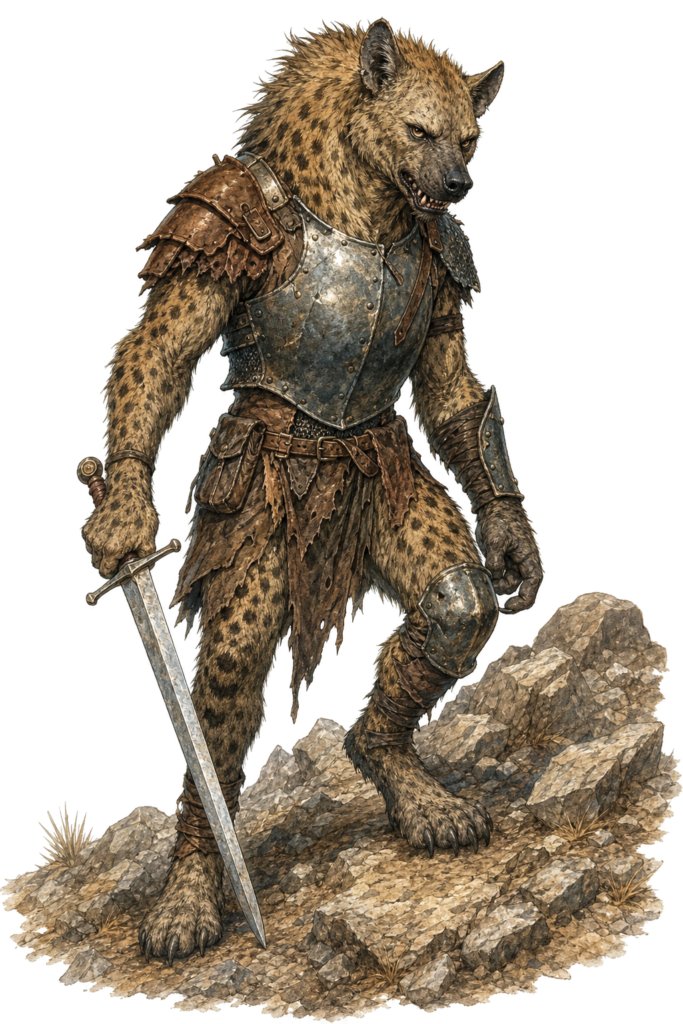
They took the swords from the bodies of the last patrol. That is why you are looking at a gnoll carrying a human longsword. It fits awkwardly in its hand — gnolls are not built for human-proportioned weapons — but it will still kill you.
What a Gnoll Is #
A gnoll is a Large humanoid that resembles a cross between a human and a hyena — upright posture, humanoid limbs, but with hyena-like features: spotted or striped fur, elongated muzzle, powerful jaws, and the distinctive sloping back of the hyena’s rear-heavy build. They are stronger than humans, ferocious in combat, and chronically lazy — preferring to steal and bully rather than produce.
Origin rumor: Gnolls are rumored to be the result of a magical combination of a gnome and a troll by an evil magic-user. This is explicitly presented as a rumor, not confirmed fact. Whether true or not, it explains the name and gives the DM a specific villain to attach to their origin if desired. The gnoll’s combination of troll-like ferocity and something almost clever in their pack tactics gives the rumor some plausibility.
The stolen economy: Gnolls may use all weapons but most do not work metal — they steal their metal weapons from humans. A gnoll band’s armament tells the story of its recent raiding history: a gnoll with a fine longsword killed a well-equipped soldier; one with a bent scimitar took it from a bandit; one with a wood-and-bone club hasn’t found anything better yet. The +1 damage bonus applies regardless of weapon type — gnoll strength is the constant.
Regional distinction. As with most widespread humanoid species, gnoll populations have diverged across the Known World’s varied territories. Generations of adaptation to different climates, terrains, and available prey have produced visibly distinct regional populations. The differences are not cosmetic alone — diet, climate, and the specific pressures of a territory shape behavior, build, and capability. The common gnoll described below is the baseline; the regional variants that follow are full populations with their own established territories, distinguishable on sight by anyone who has dealt with more than one gnoll band.
Core Statistics — Common Gnoll #
| Stat | Value |
|---|---|
| Hit Dice | 2d8 (avg 9 HP) |
| AC | 15 |
| AV | 2 (melee) / 1 (missile) |
| HR | +2 |
| FR | +3 |
| FD | 12 |
| Move | 90 ft (30 ft encounter) |
| Attacks | 1 weapon: by weapon +1 |
| No. Appearing | 1d6 (3d6) |
| Save As | Fighter 2 |
| Morale | 8 |
| Treasure | (P) individual / D lair |
| Alignment | Chaotic |
| Intelligence | Low (INT 7) |
| XP | 20 |
| Terrain | Hill, Mountain |
AC/AV Reasoning #
RC original is AC 5 (descending) = Ascending AC 15. Gnolls wear whatever armor they have stolen or scavenged — typically leather and hide pieces, occasionally a breastplate or chainmail section taken from a victim.
- AC 15 — Piecemeal scavenged armor provides moderate protection. The gnoll’s large frame (Large size) makes human-proportioned armor fit poorly, reducing its effectiveness
- AV 2 — The scavenged armor provides modest absorption. Combined with the gnoll’s natural toughness (they are Large humanoids with hyena-like resilience), AV 2 is appropriate
- FR +3 — Gnolls are stronger than their HD suggests, reflecting the troll-element in the origin rumor. The Large size modifier applies to FD
The +1 Damage Bonus #
“By weapon + 1” — every gnoll attack deals 1 additional point of damage regardless of weapon type. This reflects their exceptional strength for their size.
A gnoll with a hand axe deals 1d6+1 (avg 4.5). A gnoll with a stolen longsword deals 1d8+1 (avg 5.5). A gnoll with a crude wooden club deals 1d4+1 (avg 3.5). The bonus is constant across all weapon types.
Practical effect: Against lightly armored 1st-level characters, the consistent +1 makes gnolls slightly more dangerous than their 2 HD implies. In a group of 1d6, total damage output is meaningfully higher than an equivalent group of goblins or orcs.
Skill Slots (2 total — 2 HD = 2 base; no asterisks; Low INT 7) #
| Slot | Skill | Notes |
|---|---|---|
| 1 | HR Investment (Basic) | HR +2; the gnoll fights with stolen weapons and natural ferocity — no trained style, but effective aggression |
| 2 | Intimidation (Basic) | Gnolls bully rather than negotiate. Morale check at –1 for creatures of 1 HD or fewer in the first round of a gnoll encounter; the pack’s aggressive display and hyena-like vocalizations are genuinely unsettling |
Martial Style #
Style: Hard (Basic rank) Rank: Basic
Gnolls fight with raw aggression — no tactical sophistication beyond “attack the nearest target.” Hard Basic reflects the straightforward application of force: they hit hard (weapon +1), they commit to the attack, and they don’t hold back. What they lack is any defensive discipline or tactical awareness. A gnoll that is being outmaneuvered doesn’t change approach — it just attacks harder.
Combat Breath (CB): HD + CON modifier (assumed +1 for Large humanoid constitution) = 3 CB. Gnolls are not endurance fighters. They are fast and ferocious in the first few rounds; if the fight drags on they begin to flag.
Leader Mechanic #
For every 20 gnolls encountered, one will be a leader with 16 hit points who attacks as a 3 Hit Die monster.
Leader statistics:
| Stat | Value |
|---|---|
| Hit Points | Fixed 16 |
| Attack as | 3 HD monster (HR +3 effective) |
| Damage | By weapon +1 (same as followers) |
| Morale | 9 (leader’s presence raises group Morale by 1) |
Leader identification: The leader is the largest individual in the group, wearing the best stolen armor and carrying the best stolen weapon. Among gnolls, status is determined by what you have taken — the leader has taken the most.
Presence effect: While the leader is alive, the group’s Morale is 9 instead of 8. When the leader falls, surviving gnolls immediately check Morale (roll 2d6 vs. Morale 8) — a failed check means they break and flee.
Spellcaster note: Gnoll spellcasters exist per “Monster Spellcasters.” A gnoll spellcaster is almost certainly a leader-tier individual — access to magic represents taking the most powerful thing available, which is exactly what gnoll culture rewards.
Habitat and Ecology #
Gnolls occupy the transitional zones between civilization and true wilderness — areas too harsh for consistent farming or settlement but not remote enough to be free of humanoid traffic. They raid downhill into farmland and trading routes, retreating uphill to rocky terrain where pursuit is difficult.
The raiding economy: Gnolls do not farm, mine, or manufacture. They raid. Their entire material culture is stolen — weapons, tools, food stores, clothing. The gnoll lair contains the accumulated loot of however many raids the band has conducted, minus what they have consumed or lost.
Pack structure: Gnolls operate in loosely organized bands. The 3d6 lair number (up to 18) represents a full band around a shared territory. The 1d6 encounter number represents a raiding party at range from the lair.
Hyena behavior parallels: Gnolls’ hyena heritage gives them scavenging tendencies alongside active predation. When living prey is not available, they will eat carrion. They are not above finishing off wounded creatures left by larger predators. This behavioral flexibility makes them persistent threats in wilderness areas — they do not starve even when active hunting fails.
Treasure #
Individual (P): Small coins and minor valuables carried on the person — pocket loot from recent raids.
Lair (D): The accumulated hoard from the band’s raiding history. Type D includes reasonable chance of coins (mostly silver and copper from raided villages), some chance of gems or jewelry (taken from wealthier victims), and a small chance of a magical item (taken from someone who could not stop them from taking it).
Regional Variants #
What follows are four established gnoll populations, each adapted to a distinct territory within the Known World. Each represents generations of separation from other gnoll populations, producing visible and behavioral divergence significant enough that an experienced wilderness scout can identify a gnoll’s home territory at a glance.
Highland Gnoll (Crocuta Bipedis Montana) #
Territory: The high hill country and lower mountain slopes bordering the Broken Lands — the most common gnoll population and the baseline for the species description above.
Appearance: Tawny-brown to grizzled grey fur, heavier coat for cold-weather endurance, dark facial mask around the eyes and muzzle. Average height 7 ft. The Highland Gnoll is what most travelers picture when they hear the word “gnoll.”
Statistics: As Common Gnoll above, unmodified. This is the reference population.
Sand Gnoll (Crocuta Bipedis Aridus) #
Territory: The fringe wastes bordering the Sind Desert and the dry hill country to its north.
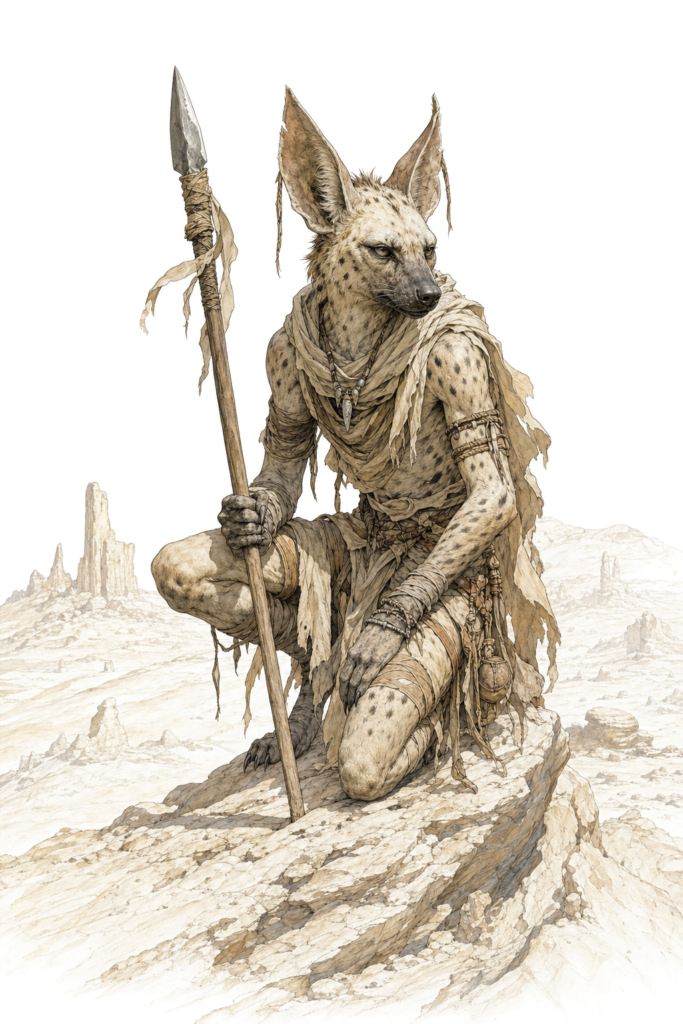
Appearance: Pale sand-yellow to bone-white fur, notably leaner build than the Highland Gnoll, larger ears for heat dissipation. They favor light scavenged cloth wraps over heavy armor — the desert sun makes metal armor a liability as much as a protection.
Behavioral note: Sand Gnolls range further between raids than their highland cousins — water scarcity forces larger territories and longer travel between the band’s lair and viable targets. They are more opportunistic scavengers than active raiders, a survival adaptation to a territory where prey is scarce and unpredictable.
Statistics: As Common Gnoll, with the following changes:
| Stat | Value | Change from Common |
|---|---|---|
| AC | 14 | –1 (lighter armor by necessity) |
| AV | 1 (melee) / 0 (missile) | –1 (cloth wraps, not scavenged metal) |
| Move | 120 ft (40 ft encounter) | +30 ft (lean desert-adapted build) |
| XP | 22 | +2 (faster movement offsets lighter armor) |
Additional skill — Slot 2 replaced: Heat Endurance (Basic) — immune to non-magical heat exhaustion and fatigue effects from desert travel; +2 to saves vs. fire-based effects in their home territory.
Marsh Gnoll (Crocuta Bipedis Paludis) #
Territory: The fen country and lowland marshes found in scattered pockets throughout the Known World, most notably the wetlands bordering major river deltas.
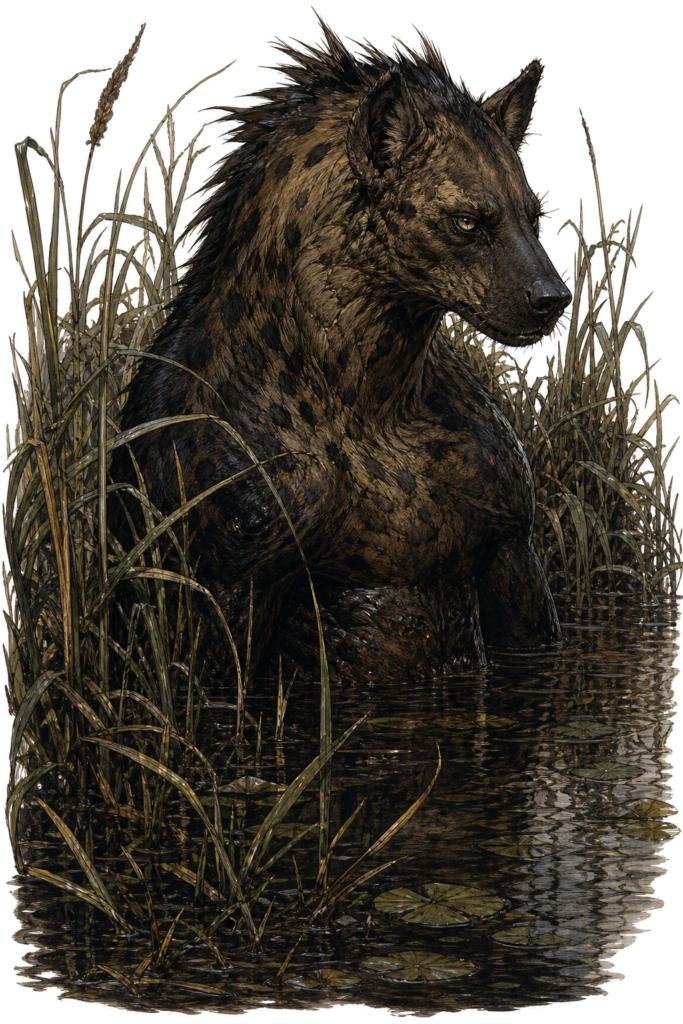
Appearance: Dark mottled brown-black fur with a slick, water-resistant quality. Shorter legs relative to body than other gnoll populations, webbed toes. Average height slightly shorter at 6½ ft, but broader and heavier-set.
Behavioral note: Marsh Gnolls are competent swimmers and ambush predators rather than open-field raiders — the marsh terrain rewards patience and concealment over the Highland Gnoll’s direct aggression. They are more willing to negotiate passage or tribute than other gnoll populations, having learned that the marsh’s limited resources make prolonged conflict costly for everyone involved.
Statistics: As Common Gnoll, with the following changes:
| Stat | Value | Change from Common |
|---|---|---|
| Move | 60 ft (20 ft encounter) ground / 90 ft (30 ft encounter) swimming | –30 ft ground / new swim speed |
| FD | 13 | +1 (broader, harder to Shove in marsh footing) |
| Morale | 7 | –1 (more willing to disengage than fight to the last) |
Additional skill — Slot 2 replaced: Ambush (Basic) — +2 to surprise rolls when attacking from concealment in marsh, swamp, or heavy reed terrain; standard surprise elsewhere.
Frost Gnoll (Crocuta Bipedis Glacialis) #
Territory: The northern wilderness and sub-arctic hill country at the edges of the Known World’s most hostile climates.
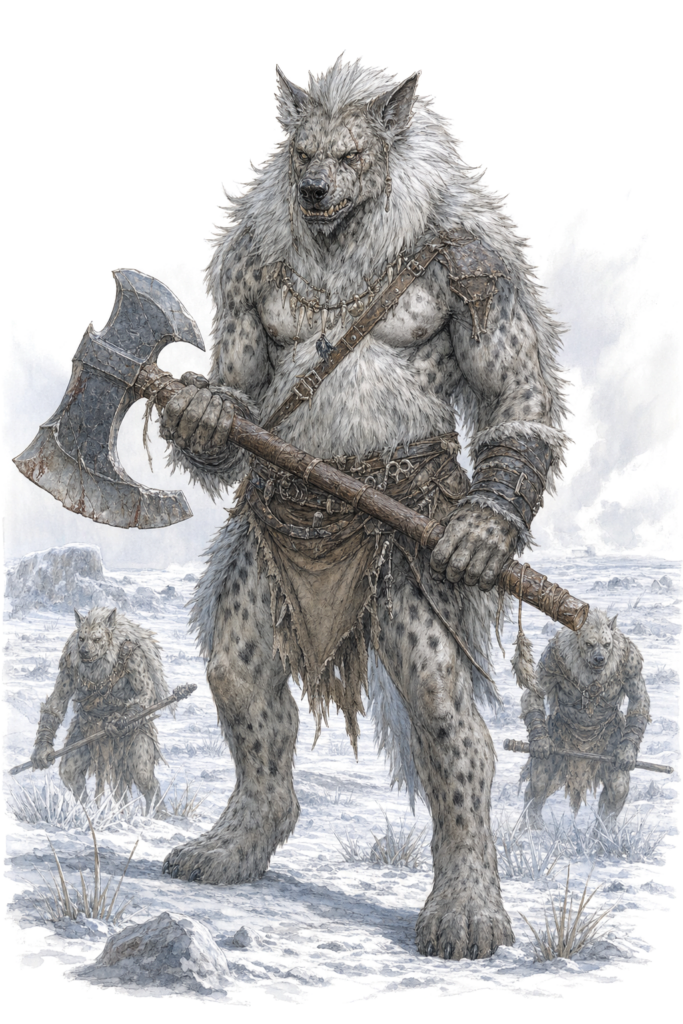
Appearance: Thick white-to-pale-grey double coat, noticeably stockier and more heavily muscled than other populations — the cold-adapted body plan trades speed for raw mass and insulation. Average height 7½ ft, the tallest of the regional populations.
Behavioral note: Frost Gnolls live in smaller, tighter-knit bands than other gnoll populations — the harsh climate does not support the larger lair numbers common elsewhere. What they lack in numbers they compensate for in individual toughness and willingness to fight to the death defending limited territory and food stores. They are, band for band, the most dangerous gnoll population to encounter, though the smallest in number.
Statistics: As Common Gnoll, with the following changes:
| Stat | Value | Change from Common |
|---|---|---|
| Hit Dice | 2d8+2 (avg 11 HP) | +2 HP (cold-hardened constitution) |
| AC | 16 | +1 (thick coat provides natural insulating protection) |
| FR | +4 | +1 (greater raw strength) |
| No. Appearing | 1d4 (2d6) | Smaller bands — fewer per lair |
| Morale | 9 | +1 (fight harder for scarce territory) |
| XP | 28 | +8 (tougher, stronger, more resolved) |
Additional skill — Slot 2 replaced: Cold Endurance (Basic) — immune to non-magical cold exhaustion and exposure; +2 to saves vs. cold-based effects in their home territory.
Leader mechanic note: Because Frost Gnoll bands rarely exceed 12 individuals, the standard “1 leader per 20” rule rarely applies in the field. A Frost Gnoll lair of any size still produces exactly one leader (same statistics as the Common Gnoll leader), reflecting that even small Frost Gnoll bands maintain the same dominance hierarchy as larger populations elsewhere.
Regional Variant Summary Table #
| Variant | HD | AC | AV | Move | Morale | XP | Key Trait |
|---|---|---|---|---|---|---|---|
| Highland (common) | 2d8 | 15 | 2/1 | 90 ft | 8 | 20 | Baseline |
| Sand | 2d8 | 14 | 1/0 | 120 ft | 8 | 22 | Speed; heat endurance |
| Marsh | 2d8 | 15 | 2/1 | 60/90 ft (swim) | 7 | 20 | Ambush; swimming |
| Frost | 2d8+2 | 16 | 2/1 | 90 ft | 9 | 28 | Toughness; cold endurance |
Encounter Notes #
The raiding party: 1d6 gnolls encountered in hill terrain. They are moving toward something — a farmstead, a trade road, a shepherd’s camp. They have not yet committed to the raid; encountering the party may cause them to evaluate whether the party is a better target than their original objective. Morale 8 means they break if seriously threatened, but the first round is aggressive — they move to intimidate and attack simultaneously.
The lair: 3d6 gnolls in their established territory. Full group includes the leader (if 20 or more, otherwise just the highest-HP individual as de facto leader). The stolen-weapons variety is highest here — the lair contains whatever the band has accumulated, meaning some gnolls may be better armed than expected (a stolen +1 sword is possible).
The stolen weapon tell: A perceptive party member notices that the gnoll’s weapon has a family crest or military mark — it came from a specific unit or noble house. This is both a loot-identification opportunity (the weapon may be sought by its original owner’s family) and an intelligence item (this gnoll band has been in a specific area recently).
Mixed-territory encounters: A DM running a region where two gnoll territories border one another (e.g., Highland hill country meeting Sand Gnoll desert fringe) may run encounters with mixed bands — typically a Highland Gnoll leader with a minority of Sand Gnoll followers who have been absorbed after territorial conflict, or vice versa. This is uncommon but not unheard of; gnoll bands are pragmatic about absorbing useful fighters regardless of origin.
The origin question: A scholarly NPC claims gnolls are the result of magical cross-breeding of gnomes and trolls. This is unverified. A party with access to a sage, a gnoll prisoner willing to communicate (INT 7 is workable if they speak a common language), or magical truth-telling abilities could investigate. The gnolls themselves either don’t know their origin or don’t care — they are what they are. The existence of four distinct regional populations, each adapted to its specific territory over generations, suggests whatever the origin was, it has had time to diversify naturally since.
CR justification:
- 2 HD = CR 2 base for all variants
- Weapon +1 slightly above 2 HD damage expectation
- Large size provides FD advantage in Wrestling
- Frost Gnoll’s additional HP and FR push it to CR 3 in practice
- No special abilities or immunities beyond the noted variant traits
- Morale breaks reliably under pressure (except Frost Gnoll, which is more resolved)
- Individual (P) treasure suggests they are not especially dangerous to encounter alone — the danger is the group and the environment


