
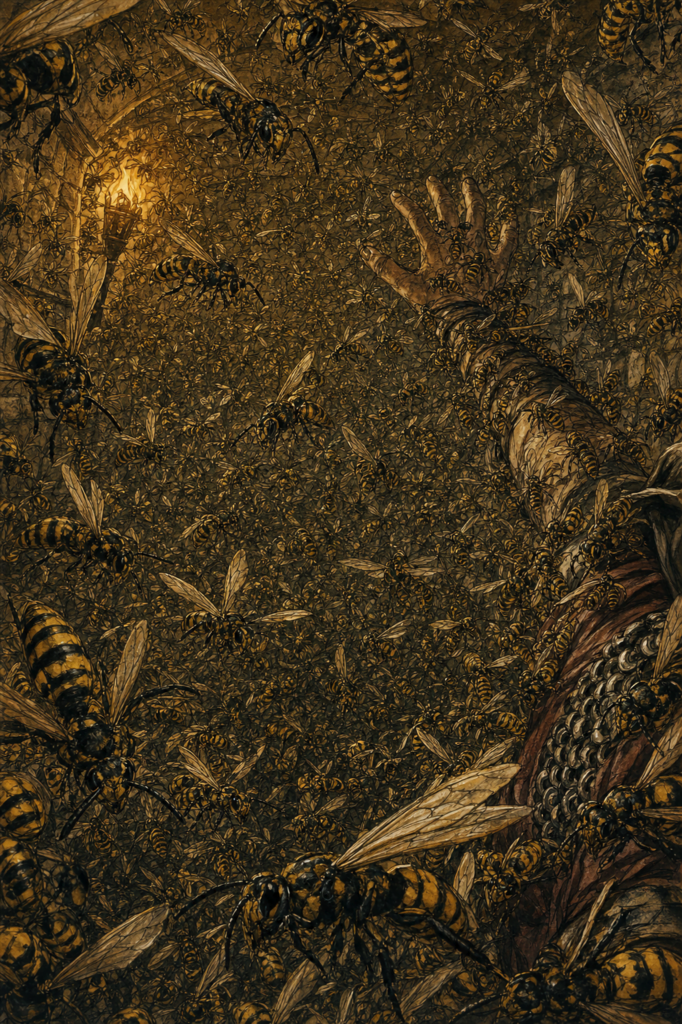
You stepped into the wasp’s nest. There is no attack roll. There is no armor save. There are just wasps, everywhere, all at once.
What an Insect Swarm Is #
An insect swarm is not a single creature — it is a group of small insects acting together as a unified threat. The insects may be crawlers (ants, centipedes, spiders), flyers (bees, wasps), or both (beetles, locusts). The swarm fills a 10 × 10 × 30 ft area and treats everything inside it as prey.
The key mechanic: No attack roll is made. The swarm is an area effect — it automatically hits everything in its space every round. Armor helps only partially. Escaping the swarm requires leaving its area, becoming invisible, or going underwater.
When to use this entry: “Use these characteristics for the occasions when a character stumbles into a beehive or wasp’s nest.” The insect swarm is the mechanical representation of an environmental encounter — the party disturbs a nest, walks into a cloud of locusts, or opens a container full of spiders.
Core Statistics #
| Stat | Value |
|---|---|
| Hit Dice | 2d8 (25 XP) / 3d8 (50 XP) / 4d8* (125 XP) |
| AC | 13 |
| AV | 0 |
| HR | N/A — automatic area hit |
| FR | +0 |
| FD | 10 |
| Move | 30 ft (10 ft encounter) ground / 60 ft (20 ft encounter) flying |
| Attacks | 1 area effect: automatic hit |
| Area | 10 × 10 × 30 ft (or more) |
| No. Appearing | 1 swarm (1d3 swarms in lair) |
| Save As | Normal Man |
| Morale | 11 |
| Treasure | Nil |
| Alignment | Neutral |
| Intelligence | None (INT 0) |
| XP | 25 / 50 / 125 by HD |
AC/AV Reasoning #
RC original is AC 7 (descending) = Ascending AC 13. A swarm of small insects is genuinely difficult to damage effectively.
- AC 13 — Strikes against a swarm must hit its dispersed mass rather than a single target; most blows pass through gaps between insects without dealing meaningful damage. The AC represents this distributed body
- AV 0 — When damage is dealt, it deals full effect — the swarm’s “body” has no absorption capacity. Area effects are the most efficient damage source
- The asterisk: The Enchanted status reflects the swarm’s unusual coherence and pursuit behavior — this is not ordinary random insects but an aggregated entity behaving with collective purpose
Damage — The Area Effect Mechanic #
“No attack roll is made for the swarm; it is an ‘area effect’ and automatically hits.”
Every round, every living creature inside the swarm’s area takes automatic damage. No attack roll. No AC defense. The swarm doesn’t miss.
Damage by Armor Status #
| Condition | Damage per Round |
|---|---|
| Armored (AC 15 or better in ascending terms) | 2 points |
| Unarmored (AC 14 or worse in ascending terms) | 4 points |
RC wording: “All armored victims within the area (and any monsters with AC 5 or better) automatically take 2 points per round. Unarmored victims (and monsters with AC 6 or worse) take 4 points per round.”
Ascending AC conversion: RC AC 5 (descending) = Ascending AC 15. Characters at AC 15 or higher take 2 damage/round; characters at AC 14 or lower take 4 damage/round.
Why armor helps: Full coverage armor (chain, plate) reduces the insects’ access to skin — gaps are fewer, exposed flesh is less. An unarmored character has no protection against insects crawling everywhere simultaneously.
The Swatting Option #
“Any victim who runs out of the swarm, or who swats the insects instead of making another attack or taking another action, takes only 1 point per round.”
Swatting mechanics:
- The victim dedicates their action to swatting — no other attack, spell, or significant action
- Must use a weapon or torch; “attempts to swat with hands or arms have no effect” (the insects crawl back up your arms)
- Result: 1 point of damage per round instead of 2 or 4
The tactical choice: A character who swats takes 1 damage/round and cannot attack, cast spells, or use items. A character who fights through takes 2–4 damage/round but retains full action economy. Against a combat encounter alongside the swarm, fighting through (2 damage/round for armored) may be worth maintaining combat effectiveness.
The torch swat: Using a torch to swat is the most effective swat tool — fire can kill insects on contact. At DM discretion, a torch used as a swatting weapon deals 1d4 fire damage to the swarm per round of active swatting, potentially destroying individual insects faster than other weapons.
Skill Slots (2 total — 2–4* HD = 2–4 base + 1 asterisk; INT 0) #
| Slot | Skill / Ability | Notes |
|---|---|---|
| 1 | Area Effect (innate, special) | Automatic hit; no attack roll; 2 or 4 damage/round by armor status. The asterisk |
| 2 | Relentless Pursuit (innate) | ML 11 when pursuing an attacker; will follow anyone who damages it |
Pursuit Behavior #
“If the swarm is damaged, it will pursue its attacker nearly without fail (ML 11).”
Morale 11 means the swarm will not stop pursuing unless:
- The target escapes its pursuit (see Escape below)
- The swarm is destroyed
“Nearly without fail” is the RC’s qualifier — a Morale 11 check fails only on a 2d6 roll of 12 (approximately 3% per check). In practice the swarm always pursues once it has been attacked.
Pursuit speed: 30 ft ground / 60 ft flying. A character running at full speed (typically 120 ft or more per round) can outpace a ground swarm but may struggle against a flying swarm (60 ft) if they are also swatting (action dedicated to swatting reduces movement options).
Escape Methods #
Running Out of the Area #
Simply moving outside the swarm’s 10 × 10 × 30 ft area. The swarm will pursue at its move rate — a character who can maintain distance escapes.
Flying swarms vs. ground escape: A flying swarm (60 ft encounter) pursues characters trying to run. Against a flying swarm, running may not suffice — the swarm keeps up with most characters who are also taking 2–4 damage per round while running.
Disappearing from Sight #
Invisibility, moving around a corner, or similar visual disappearance. The swarm is INT 0 — it cannot track invisible targets and cannot navigate corners. Once the target is out of the swarm’s direct perception, pursuit ends.
Corner escape: Moving around a building corner or dungeon turn breaks line of sight — the swarm continues straight rather than following the turn. A character who turns two corners has effectively escaped a non-intelligent swarm.
Underwater Immersion #
“Diving under water kills all the insects after one round, during which normal damage is done.”
- The character dives underwater
- Takes normal swarm damage for the 1 round before the insects drown
- After 1 round: all insects in the swarm are dead; the swarm is destroyed
This is the definitive escape against a pursuing swarm — regardless of the swarm’s size or HD, full submersion in water destroys it in 1 round. The cost is 2–4 damage for that final round.
Damaging the Swarm #
The swarm has AC 13, AV 0, and HD × d8 HP. It can be damaged by:
- Normal weapons (each hit kills some insects but the swarm absorbs most blows through its distributed body)
- Area effects: Fireball, Wall of Fire, Burning Hands, Insect Plague (ironic) — area spells damage all insects simultaneously and are the most effective counter
- Water: Full submersion kills all insects instantly (1-round process)
- Smoke: At DM discretion, dense smoke (torch smoke, fire smoke) disperses or confuses insect swarms; may impose –1 to damage per round while in smoke
The asterisk as “Enchanted”: The Enchanted designation means the swarm has unusual coherence — it will not disperse from normal distraction (loud noise, bright light) the way a real insect swarm might. It behaves with single-minded purpose.
Multiple Swarms #
“1d3 swarms in lair” — up to 3 swarms in a nest or hive encounter.
Three simultaneous swarms: Each occupies its own 10 × 10 × 30 ft area. A party that wanders into a large hive area might find themselves in overlapping swarm zones — taking damage from all three simultaneously, each dealing their damage per round.
Swarm interaction: Overlapping swarm areas stack damage — a character in two swarms takes damage from both independently.
Encounter Notes #
The nest trigger: The party is searching a ruined building. Someone opens the wrong door, disturbs a wooden beam, or walks through a doorway. A swarm emerges. Everyone in the doorway area is immediately taking 2–4 damage per round, no save, no attack roll needed. The party’s first priority is getting out of the area; the second is dealing with the pursuing swarm.
The forest encounter: The party walks through tall grass that turns out to be ground-nesting hornets. The swarm rises around them (10 × 10 × 30 ft fills a large section of the path). Characters in heavy armor take 2/round; the unarmored Guildsman in leather takes 4/round. The Cleric can swat with their torch (1/round instead of 4, but can’t cast spells while swatting). Running is the primary option — but the swarm pursues.
The dungeon hive: 1d3 swarms in a dungeon room. The party opens the door. Three swarms fill the room. Their area of effect likely covers the entire accessible dungeon space. The party cannot enter the room — they must either clear the doorway and hold, or use area-effect magic to destroy the swarms before entering. A Fireball centered on the room handles all three.
CR summary:
| HD | CR | Notes |
|---|---|---|
| 2* | 2 | Small swarm; 9 avg HP; annoying rather than lethal |
| 3* | 3 | Medium swarm; manageable with area magic |
| 4* | 4 | Serious swarm; 18 avg HP; lethal to unarmored low-level characters |
| 1d3 swarms | 5–6 | Combined area damage; room-filling encounter |


