
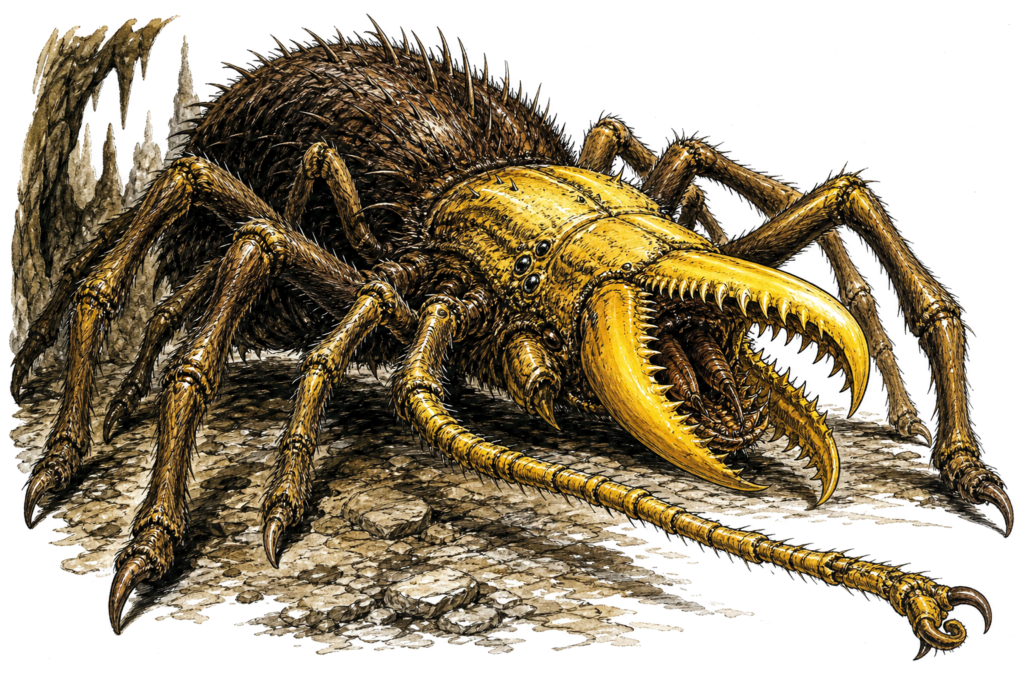
The yellow head is what you see first. The mandibles are a third of its body weight. By the time you have processed this, the front legs have already found you, and they do not let go.
What a Rhagodessa Is #
The rhagodessa is a horse-sized primeval arachnid predator — a solifugid scaled to nightmare proportion. It has a dark brown bristle-furred thorax, a massive bright yellow head dominated by scissor-like mandibles, and ten legs total: eight locomotion legs and two specialized front pedipalps tipped with hooked suckers rather than claws. It is not venomous. It does not need to be. The mandibles are sufficient.
Non-venomous and hyper-aggressive. The rhagodessa kills by grabbing and crushing. Everything about its anatomy — the sucker pedipalps, the oversized mandibles, the powerful climbing legs — is optimized for one sequence: secure the target, pull it into the jaws, eat it before anything else can intervene. It is entirely driven by predatory instinct. It does not evaluate threats. It does not retreat. It grabs what it can reach and it eats what it grabs.
Nocturnal. The rhagodessa hunts at night and shelters during the day. Encountered in daytime: it will be in its lair (a cave, a dense ruin, a tree hollow). The DM may apply surprise 1–4 on d6 for a party that blunders into a daytime lair without light. At night in its hunting range: it surprises normally (1–2 on d6) but is actively hunting — it will pursue.
Core Statistics #
| Stat | Value |
|---|---|
| Hit Dice | 7d8 (avg 31 HP) |
| AC | 14 (RC AC 5 equivalent — chitinous carapace) |
| AV | 2 |
| HR | +7 |
| FR | +8 |
| FD | 18 |
| Move | 150 ft (50 ft encounter) ground / 150 ft (50 ft encounter) wall and ceiling climbing |
| Attacks | 1 sucker-grab (no damage) + 1 automatic bite (2d8) on grabbed target |
| No. Appearing | 1d6 (1d8) |
| Save As | Fighter 3 |
| Morale | 9 |
| Treasure | Nil |
| Intelligence | Animal (INT 1) |
| Alignment | Neutral |
| XP | 450 |
FR +8 / FD 18: Ten legs and low center of gravity. The rhagodessa is exceptionally difficult to dislodge, shove, or Wrestle. A grabbed rhagodessa carrying a victim up a wall cannot be pulled back down by any creature with FR less than +10 without magical assistance.
Wall and ceiling climbing at full move: The hooked suckers and climbing legs allow the rhagodessa to move on vertical and inverted surfaces at the same speed as flat ground. It does not slow down when climbing. It does not check for grip. It simply goes.
Skill Slots (5 total — 7 HD = 4 base + 1 at 7 HD; no asterisks; Animal INT 1) #
| Slot | Skill | Notes |
|---|---|---|
| 1 | HR Investment (Skilled) | HR +7 |
| 2 | FR Investment (Expert) | FR +8; ten-leg stability; extremely hard to dislodge |
| 3 | Sucker Grab — Automatic Hold (innate) | Pedipalp attack: no damage; on hit, target is grabbed; no save; see below |
| 4 | Automatic Bite on Grabbed Target (innate) | While a target is held, bite is automatic each round (no attack roll): 2d8 |
| 5 | Wall Carry and Climb Escape (innate) | Can carry up to 700 cn of held target while climbing at full move; uses this to escape melee |
The Combat Sequence — Complete Mechanics #
The rhagodessa’s entire combat architecture is built around a single predatory sequence. Everything else is incidental.
Step 1 — The Sucker Grab #
Attack: The rhagodessa makes one attack roll with its pedipalps (HR +7 vs. target AC).
On a hit: The target is grabbed. The sucker-pedipalps lock onto the target’s body. No damage is dealt by the grab itself.
The grab has no saving throw. It is not a Wrestle attempt (which allows FD resistance). It is a successful physical contact that establishes a mechanical lock. The only question is whether the attack roll hits.
Escape from the grab:
- The grabbed character may attempt to break free on their action: FR check vs. the rhagodessa’s FD 18. A character with FR +6 needs a 12 on d20. Difficult but not impossible — this should feel like a genuine struggle.
- Allies can assist: another character may use their action to help the grabbed character escape — adds +2 to the escape FR check per assisting character (maximum 3 assistants, +6 total)
- Edged weapons to the pedipalp (targeting specifically): a hit dealing 6+ damage to the pedipalp specifically forces a FR check from the rhagodessa (vs. the attacker’s FR roll). The pedipalp can be severed — a single hit of 10+ damage to the pedipalp severs it, automatically releasing the grabbed character. The rhagodessa loses that pedipalp attack for the rest of the encounter and takes the damage as normal HP loss
The grab persists until the character escapes, the pedipalp is severed, or the rhagodessa is killed.
Step 2 — The Automatic Bite #
Once a character is grabbed, the bite is automatic every round — no attack roll, no defense possible.
Damage: 2d8 (avg 9) per round, every round, until the grab is broken or one party is dead.
The grabbed character’s actions: A grabbed character can still act — they are secured, not paralyzed. Their options:
- Attempt to escape (FR check vs. FD 18)
- Cast spells (if not prevented by the grab — DM determines whether somatic components are possible while being crushed; verbal components work freely)
- Attack the rhagodessa at –2 HR (cramped fighting position, pulled against the body)
- Draw and use a dagger or similar small weapon at full HR (a grabbed character can use small weapons freely — this is the primary reason every experienced adventurer carries a dagger)
The bite’s AV interaction: The grabbed character’s AV still applies to the bite damage. A Fighter in plate (AV 6) takes avg 3 per round from the automatic bite (9 – 6 = 3, minimum 1). A lightly armored character (AV 1) takes avg 8 per round. The rhagodessa is slower at killing well-armored targets — it compensates by climbing away with them.
Step 3 — The Wall Carry #
“If actively attacked by other party members while eating, the beast can lift up to 700 pounds and scale vertical dungeon or cavern walls to finish its meal in safety.”
Trigger: The rhagodessa is being attacked by characters other than its grabbed victim — specifically when those attacks are landing and doing damage. The rhagodessa does not think. It responds to the stimulus of being hurt by removing the meal from the threat.
Mechanics:
- As a move action, the rhagodessa moves with its grabbed victim to the nearest vertical surface and begins climbing at full move (150 ft)
- It can carry up to 700 cn of held target while doing this — sufficient for a fully armored human (approximately 500–600 cn with equipment)
- While climbing: the grabbed character takes the automatic 2d8 bite as normal; the rhagodessa continues climbing until it reaches a surface inaccessible to its pursuers
- Ranged attacks against a climbing rhagodessa: normal attack rolls against AC 14 at whatever range; hitting does not automatically dislodge it (FR check required against the damage-source’s FR roll if the attacker specifically attempts to pull it off the wall — effectively impossible at normal attacker FR values)
The ceiling option: The rhagodessa can move to the ceiling and hang there, upside down, eating. A character hanging from a ceiling-mounted rhagodessa is in a specifically terrible position — they cannot stand to fight, their ranged-attack options from that position are severely limited, and anyone attempting to reach them by climbing is doing so while the rhagodessa can attack the climber with its free pedipalp.
The 700 cn limit: If the grabbed target plus their equipment exceeds 700 cn, the rhagodessa cannot climb while carrying them. It continues the automatic bite on the ground but cannot use the escape mechanic. Well-encumbered fighters in full plate carrying significant gear may be too heavy to carry — this is one of the few tactical advantages of heavy equipment in this specific encounter.
Tactical Analysis #
The rhagodessa is not a powerful opponent in raw terms — 7 HD, AC 14, no venom, no special save effects. Without its grab sequence, it is a large animal the party can handle at mid-level. The grab sequence is why it is dangerous.
Why the grab is the problem:
Every round a party member is grabbed: they take 2d8 automatic damage (reduced by AV), they must spend their action on escape attempts or cramped fighting, and the rest of the party is simultaneously trying to attack the rhagodessa (which may be climbing a wall with their companion). This creates a two-front action economy problem: enough party members must attack the rhagodessa to kill it before it kills the grabbed character, but every attack also risks triggering the wall-climb escape.
The escape trigger paradox: The wall-climb triggers when the party attacks effectively. A party that attacks hard enough to hurt the rhagodessa risks causing it to climb away with their companion. A party that holds back to prevent the climb watches their companion take 2d8 per round indefinitely. The correct answer is maximum damage as fast as possible — kill it before it can climb, or before the grabbed character runs out of HP — but this requires the party to commit to the aggressive option and accept the wall-climb risk.
The dagger solution: A grabbed character with a dagger can attack the rhagodessa at full HR for 1d4 damage per round. Over several rounds this adds up, and unlike attacks from outside it does not trigger the wall-climb (it is the grabbed character, not other party members, doing damage). Experienced parties keep daggers specifically for this scenario.
Targeting the pedipalp: The mechanical option to sever the pedipalp (10+ damage, single hit, targeting specifically) is the cleanest resolution — it releases the grabbed character and removes one of the rhagodessa’s two primary tools. The DM should treat pedipalp-targeting as a called shot: the attacker declares the target, takes –2 HR, and if the hit deals 10+ damage the pedipalp is severed. This requires coordination and a capable fighter, but it is the fastest resolution that does not require killing the whole creature first.
Encounter Notes #
The lair ambush (day): The party enters a cave. Daytime — the rhagodessa is sheltering. Surprise 1–4 on d6. When it activates: initiative, sucker grab on the nearest character (HR +7 — likely hits), automatic bite begins. The party is immediately in the escape-or-damage dilemma. The cave’s walls and ceiling are accessible — if attacked, the rhagodessa climbs.
The night hunt (outdoor): The party is camping. The rhagodessa approaches from darkness, making minimal noise (no Move Silently skill, but INT 1 animals that hunt by instinct move slowly and carefully — DM determines noise level). Standard surprise. First round: grab. The party wakes up with a companion already being bitten. No lair walls — the rhagodessa must climb a tree or cliff face if it wants to escape. Whether one is nearby is terrain-dependent.
The group encounter (1d6): Multiple rhagodessa in their home territory — the Isle of Dread’s jungle interior or a large cavern complex. Each one is pursuing the same grab-bite sequence. Against six rhagodessa, the party faces the real risk of multiple simultaneous grabs in round 1. A party of four against six rhagodessa all making HR +7 attacks in round 1 is likely to have two or three characters grabbed before anyone has acted. This is the encounter that makes Isle of Dread infamous.
CR 7 justification:
- 7 HD = CR 6 base
- +1 for the grab sequence creating sustained guaranteed damage and the action economy crisis it generates
- The wall-carry mechanic turns a winnable fight into a rescue operation mid-combat
- No-save grab mechanic means even well-prepared parties have no reliable prevention, only response
- Group encounters (1d6 appearing) multiply the threat exponentially


