
It is fifteen to twenty-five feet tall and made of metal. It was built by a long-dead race of insectlike sorcerers. It has been standing in this chamber for somewhere between two hundred and two thousand years. It is still working perfectly. No one living knows how to make one.
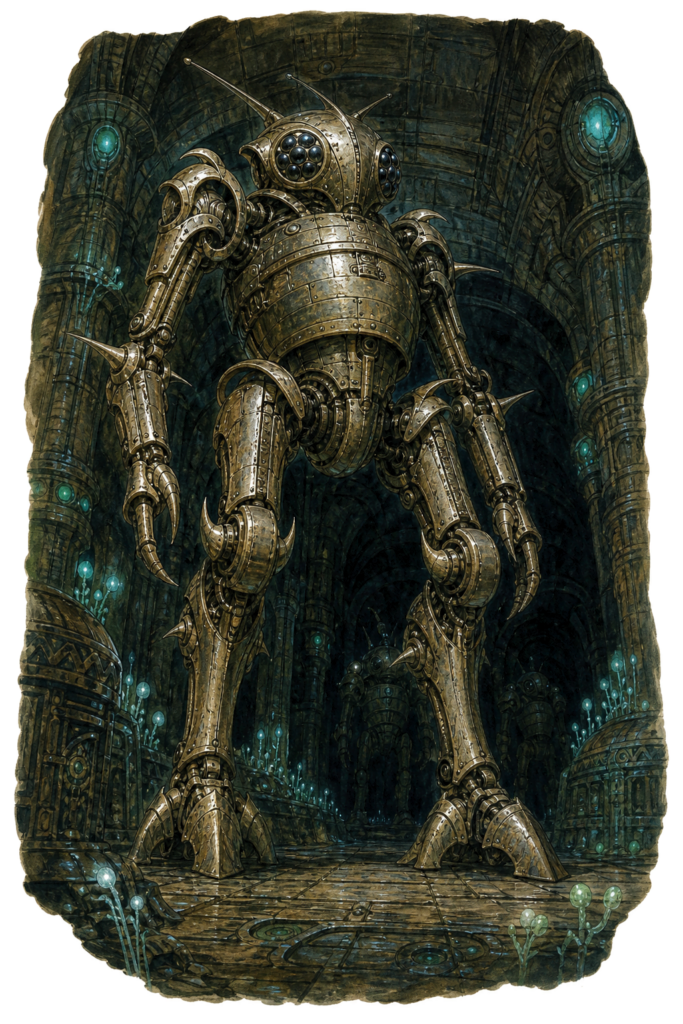
What a Mek Is #
A mek is a huge metallic construct — 15 to 25 ft tall — created by a long-dead race of inhuman insectlike sorcerers. It is not a golem in the conventional sense; it is not animated by a bound elemental or a simple enchantment. It is a construction of a civilization that no longer exists, using methods that are no longer understood. Most resemble their creators — insectlike features, barrel-like chests, double-jointed arms and legs with barbs — but meks resembling giants, lizards, and other forms have been encountered.
Masterless state: Without a master, a mek “wanders randomly, attacking most creatures it encounters.” It has no goal, no agenda, and no target selection logic beyond proximity. It simply attacks whatever is nearby. This is not evil — it is the behavior of a machine whose operator is no longer present.
With a master: A mek responds to simple verbal commands from whoever it recognizes as its master. It is not intelligent enough to interpret complex instructions, but it follows direct orders (“guard this door,” “attack that creature,” “stop”) reliably. The Lawful alignment reflects this: the mek with a master operates within a defined command structure.
Core Statistics #
| Stat | Value |
|---|---|
| Hit Dice | 11–16d8** (avg 50–72 HP) |
| AC | 26 |
| AV | 8 (melee) / 5 (missile) |
| HR | +HD |
| FR | +14 to +20 |
| FD | 24 to 28 |
| Move | 90 ft (30 ft encounter) |
| Attacks | 2 strikes (1d6×10 / 1d6×10) + paralyzing breath (20 ft cloud) |
| No. Appearing | 1 (1) |
| Save As | Fighter 36 (all HD) |
| Morale | 12 |
| Treasure | See below |
| Intelligence | None (responds to simple verbal commands only) |
| Alignment | Lawful (with master) / Chaotic (without) |
Statistics by HD #
| HD | Avg HP | HR | XP |
|---|---|---|---|
| 11** | 50 | +11 | 2,700 |
| 12** | 54 | +12 | 3,000 |
| 13** | 59 | +13 | 3,250 |
| 14** | 63 | +14 | 3,500 |
| 15** | 68 | +15 | 3,750 |
| 16** | 72 | +16 | 4,050 |
AC/AV Reasoning #
RC original is AC –4 (descending) = Ascending AC 26. This is the highest AC in the standard RC monster list.
- AC 26 — A 15–25 ft metallic construct built by an advanced civilization for purposes that include enduring combat. The metal composition is unknown to current metallurgy; it is harder and more resilient than any weapon currently made. Strikes that “hit” are striking a surface that most weapons cannot meaningfully affect
- AV 8 — Maximum standard AV. Even when a weapon somehow penetrates the AC, the dense metallic construction absorbs most impact. AV 8 means 8 points are subtracted from every hit, with 1 point always penetrating
Save As F36: “Save As F36” regardless of HD. This exceeds the standard RC character level cap of 36. The mek’s magical resistance is extraordinary — it is immune to virtually all spells (see immunities).
Skill Slots #
(8 total — 11** HD = 4 base + 2 asterisks; high HD base compensated by INT 0)
| Slot | Skill / Ability | Notes |
|---|---|---|
| 1 | HR Investment (Expert) | HR by HD |
| 2 | FR Investment (Skilled) | FR by HD |
| 3 | Double Strike (innate, special) | 2 × 1d6×10 simultaneous attacks. First asterisk |
| 4 | Paralyzing Breath Cloud (innate, special) | 20 ft diameter cloud; Save vs. Breath Weapon each round or paralyzed 1d3 turns. Second asterisk |
| 5 | Spell Immunity (innate) | Immune to all spells except cold (slow) and Disintegrate |
| 6 | Command Response (innate) | Responds to simple verbal commands from master; Morale 12 always |
| 7 | Cold Vulnerability (innate) | Cold attacks halve movement to 45 ft for duration |
| 8 | Ancient Construction (innate) | Cannot be permanently damaged except by Disintegrate; normal weapons deal full damage subject to AV but the creature regenerates structural integrity over time (DM option) |
Martial Style #
Style: Hard (Basic rank) — Mechanical certainty, maximum force Rank: Basic
The mek fights with the simplicity of a machine. No tactics, no target selection logic beyond proximity, no response to morale or situational assessment. Hard Basic reflects the mechanical commitment to maximum force every round. The mek does not change tactics, does not retreat, does not hesitate. It strikes with both arms and its breath fills the surrounding air simultaneously.
The Two Strikes #
“Each ‘normal’ mek attacks by striking with its heavy limbs.”
2 attacks per round: 1d6×10 / 1d6×10
Damage scale: 1d6×10 = 10, 20, 30, 40, 50, or 60 damage per hit (avg 35 per strike, avg 70 for both).
This is the highest standard damage output in the RC. A single strike from a mek averages more damage than many monsters’ total HP. Against any creature without extraordinary HP or damage reduction, a single hit is potentially lethal.
The mechanical implication: The mek is not designed to fight adventurers — it is designed to fight threats on the scale of its creators’ civilization. Against human-sized creatures, it is overkill by several orders of magnitude.
The Paralyzing Breath — Complete Mechanics #
“Breathing a paralyzing gas in a 20 ft diameter cloud around it.”
Area: 20 ft diameter (10 ft radius) centered on the mek. This moves with the mek — wherever it walks, it breathes.
Effect: Every living creature within the cloud must Save vs. Breath Weapon each round they remain in it.
Save failure: Paralyzed for 1d3 turns (10–30 rounds).
Save success: No effect that round; must save again next round if still in the cloud.
The mechanical implication: The party cannot stand near the mek. Melee range (within 10 ft) means being inside the breath cloud. Every round in melee requires a save vs. paralysis. Over 5 rounds of melee, a character with a 60% save success rate has approximately a 7% chance of never being paralyzed — they will almost certainly be paralyzed at least once.
Ranged combat: The only way to avoid the breath cloud is to attack from beyond 10 ft. Ranged weapons, spells (the few that work), and attacks from above all avoid the cloud. But the mek’s AC 26/AV 8 makes ranged attacks nearly useless with normal weapons.
The trapped ranged character: Once the mek closes to melee (10 ft of the character), that character is inside the cloud whether they like it or not. At 90 ft movement (30 ft encounter), the mek can close 30 ft per round — a retreating character needs to move faster than 30 ft per round to maintain distance.
Immunities and Vulnerabilities #
Spell Immunity #
“They are immune to all other spells except Disintegrate.”
Immune to everything except:
- Cold-based attacks (slows, does not damage or destroy)
- Disintegrate (fully functional against the mek)
What this means in practice:
- Fireball: No effect
- Lightning Bolt: No effect
- Hold Monster: No effect
- Magic Missile: No effect
- Power Word Kill: No effect
- Wish to destroy it: No effect (it is immune to spells)
- Disintegrate: Full effect — the mek must save (F36) or be destroyed
The F36 save against Disintegrate: Save vs. Death Ray at F36. At F36, the required roll is approximately 3 (base 4 at F36 per RC tables, possibly lower). The mek is nearly impossible to Disintegrate as well — it will save on almost any roll except a natural 1.
Cold — Slow Effect #
“A cold-based attack will slow a mek to half speed.”
- Cold damage deals no structural damage
- Movement reduced to 45 ft (15 ft encounter) for the duration
- The slow persists for the spell’s duration or until the cold effect ends
Tactical value: A slowed mek can be kited more effectively — the party can maintain distance at 45 ft movement vs. standard movement rates. This is the only consistent way to avoid the breath cloud in open terrain.
Treasure — “See Below” #
The RC’s “See below” for mek treasure reflects that meks themselves have no intrinsic wealth — their treasure is contextual:
Guard mek (with master): The treasure it guards is whatever its master placed it to protect. Type H, I, or higher depending on what the master was guarding.
Wandering mek (without master): The scattered remains of every creature it has destroyed since its master was lost. Type E or F equivalent — accumulated over potentially centuries of wandering.
The mek’s own body: The metallic composition of a mek may be valuable to the right scholar, artificer, or collector. A dead mek’s components are made from materials no living civilization knows how to produce. DM determination — likely 10,000–100,000 gp in salvage value to the right buyer.
Intelligence Note #
“Meks are not intelligent, but respond to simple verbal commands from their masters.”
INT 0 equivalent: No self-directed decision-making. No tactical assessment. No target priority beyond proximity. No ability to be deceived, reasoned with, or bribed.
Command limitations: “Simple verbal commands” — “attack that creature,” “stop,” “guard this room,” “come,” “go there.” Not “analyze the situation and respond appropriately” or “if they try to pass, let the woman through but stop the others.”
Master recognition: How the mek identifies its master is not specified — presumably the original creator established this during construction. A mek without a master may be claimed by a character with the right knowledge (DM determination — likely requires research into the creating civilization’s methods or finding original control documentation).
Encounter Notes #
The ancient guardian: The party enters a chamber that has not been opened in centuries. In the center is a 20 ft metallic construct with insectlike features, perfectly still. It responds to the first verbal command issued — by whoever issued it, because the original master is long dead and the mek recognizes “first voice in this chamber after activation” as master (DM option). Alternatively, it activates on intrusion and immediately attacks (masterless state). The party has one round of observation before it begins.
The masterless wanderer: A mek has been wandering a dungeon complex for an unknown time. Everything in its path has been destroyed. The party encounters it in a long corridor — 90 ft movement, 20 ft breath cloud, AC 26/AV 8, both strikes at 1d6×10. Ranged attacks are nearly useless. Melee requires being inside the cloud. Cold magic slows it to 45 ft — the party can now maintain distance but still cannot meaningfully damage it. Disintegrate is the specific answer; it will almost certainly save.
The claim: A scholar has sent the party to retrieve control documentation for a specific mek — ancient inscriptions that serve as the “first command” sequence. With this documentation, whoever speaks the sequence becomes the mek’s master. The mek is currently wandering and the party must either avoid it until they find the documentation or find another way to claim it.
The Disintegrate attempt: A 13th-level Magic-User casts Disintegrate at a 13 HD mek. The mek saves at F36 — needs approximately a 3 on a d20 to fail the save. 90% chance of success (survival). The spell had no effect. The mek’s breath cloud is now filling the room. There is no good option.
CR by HD:
| HD | CR | Notes |
|---|---|---|
| 11** | 16 | Entry-level mek; still essentially unkillable conventionally |
| 13** | 18 | Avg 59 HP; 1d6×10 strikes likely kill most opponents in 1 hit |
| 16** | 20 | Maximum; AC 26; F36 saves; the hardest conventional fight in the RC |


