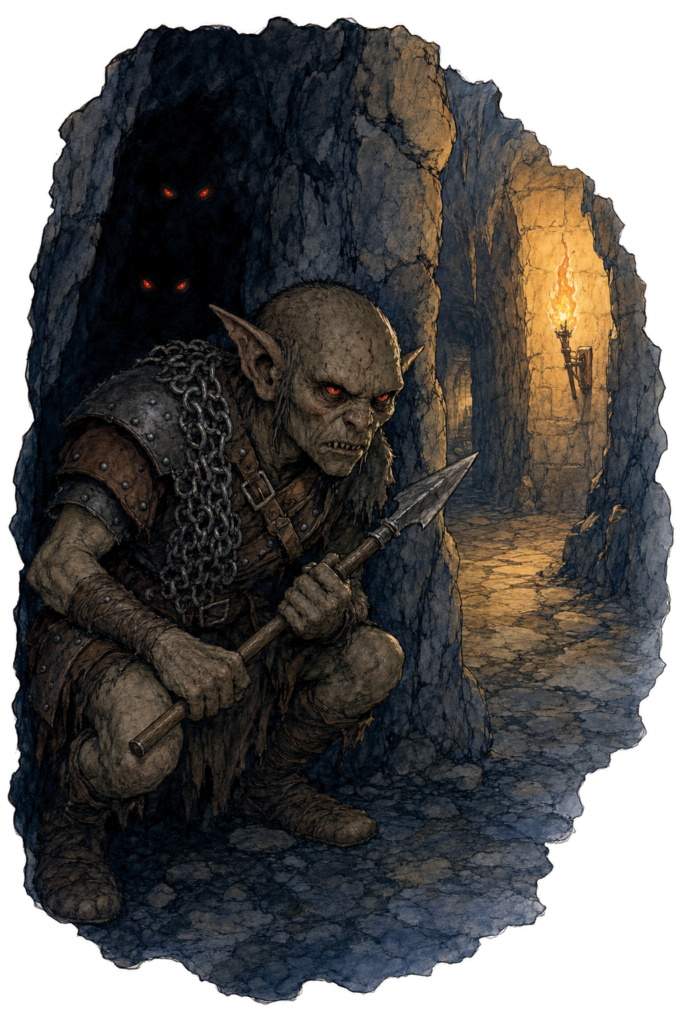
They come out at night. Three to four feet tall, ugly, red-glowing eyes in the dark. There are six of them visible. The ones you cannot see are behind you.
What a Goblin Is #
Goblins are Small humanoids — 3½ to 4½ ft tall, ugly by human standards, with pointed ears, misshapen teeth, and pale earthy skin (chalky tan or livid gray). Their eyes are red and glow when there is little light, making them visible in darkness before their bodies are. They live underground in caves and caverns, hunt at night, and hate dwarves with an intensity that mirrors the gnome-kobold relationship.
Daylight penalty: In full daylight, goblins fight at –1 to all attack rolls. This is a genuine tactical consideration — goblin encounters in daylight are measurably less dangerous than the same encounter at night or underground. The king and his bodyguard are exceptions (see below).
Underground supremacy: Goblins with 90 ft infravision in their own cave systems are fighting at full capability in conditions that blind most opponents. The standard goblin encounter in a dungeon is more dangerous than the stat block alone implies because of this environmental advantage.
Regional distinction. Goblin populations have spread across nearly every cave system, hill range, and badland in the Known World, and that breadth of territory has produced visibly distinct regional populations — differences in coloring, build, and even social structure shaped by the specific environment each population has occupied for generations. The common goblin described below is the baseline. The regional variants that follow are established populations with their own territories and tendencies.
Core Statistics — Common Goblin #
| Stat | Value |
|---|---|
| Hit Dice | 1d8–1 (avg 4 HP; minimum 1) |
| AC | 14 |
| AV | 1 (melee) / 0 (missile) |
| HR | +0 (–1 in full daylight) |
| FR | +0 |
| FD | 9 |
| Move | 90 ft (30 ft encounter) |
| Attacks | 1 weapon: by weapon |
| No. Appearing | 2d8 (6d10) |
| Save As | Normal Man (0 HD) |
| Morale | 7 (9 when king is present and alive) |
| Treasure | (R) individual / C lair |
| Alignment | Chaotic |
| Intelligence | Average (INT 9) |
| XP | 5 |
| Terrain | Cavern, Hill, Mountain, Woods |
AC/AV Reasoning #
RC original is AC 6 (descending) = Ascending AC 14. Goblins wear whatever scavenged armor they can find or steal.
- AC 14 — Small, fast-moving creatures in dim or dark environments. Their natural quickness and small profile make them harder to hit cleanly than their fragile bodies suggest
- AV 1 — Minimal scavenged armor provides modest protection
- FD 9 — Small creatures are trivially easy to Shove or Wrestle; –4 Small size modifier applied to base FD
Skill Slots (1 total — 1–1 HD = 1 base; no asterisks; Average INT 9) #
1–1 HD rounds to 1 for slot calculation = 2 base slots. Average INT supports basic skill development.
| Slot | Skill | Notes |
|---|---|---|
| 1 | HR Investment (Basic) | HR +0 in daylight (penalty reduces to –1 effective); HR +0 in darkness (full capability) |
| 2 | Underground Tactics (Basic) | In cave/dungeon environments the goblin uses terrain instinctively — flanking from side passages, retreating around corners, using infravision to stay outside torch range while pelting with missiles |
Martial Style #
Style: Reactive (Basic rank) Rank: Basic
Goblins are not front-line fighters by inclination. Reactive Basic reflects their preferred approach: stay out of reach, use missiles or spears from distance, retreat when pressed, and swarm when opponents are isolated or weakened. Individual goblins are trivial; a disciplined goblin group that uses terrain and infravision effectively is a genuine threat to unprepared low-level parties.
The goblin swarm: 2d8 to 6d10 goblins appearing means up to 60 individuals in a lair encounter. Even at 4 average HP each, 60 goblins with 1 attack per round produce overwhelming damage output if they close to melee simultaneously. The correct goblin tactic (and the one INT 9 suggests they would use) is to not close to melee simultaneously — instead, funnel opponents into narrow passages where numbers mean less, maintain missile fire from one direction while others flank, and retreat to draw opponents into prepared positions.
Daylight Penalty — Complete Mechanics #
In full daylight goblins fight with a penalty of –1 on their attack rolls.
Full daylight only: The penalty applies outdoors in daylight, or in areas of magical full-spectrum light equivalent to daylight. Torchlight, lantern light, and dim magical illumination do not trigger the penalty — only genuine daylight.
Not underground: In dungeon environments (even if brightly lit by torches), the penalty does not apply. The goblin’s red-glowing eyes are adapted to artificial and infravision light, not to natural daylight.
–1 effective HR: At HR +0, a daylight-penalized goblin effectively attacks at HR –1, hitting AC 13 only on a natural 14+. This makes the average 1st-level character (AC 12–14) significantly harder to hit for goblins in sunlight.
King and bodyguard exception: The king and his bodyguard may fight in full daylight without the penalty. This exceptional capability is part of what makes them leaders — they can function in conditions that weaken their followers.
Dire Wolf Riders #
There is a 20% chance that when goblins are encountered outdoors, 1 of every 4 will be riding a dire wolf.
Probability: Roll once for any outdoor goblin encounter — 20% chance the entire encounter includes riders (1 in 4 goblins mounted).
Mounted goblin combat: A goblin on a dire wolf:
- Uses the dire wolf’s movement (150 ft, 50 ft encounter) rather than 90 ft
- May attack with both the goblin’s weapon AND the dire wolf’s bite in the same round
- Gains +1 HR from height advantage on first charge
- The dire wolf’s Morale (8) and the goblin’s Morale (7 or 9) are tracked separately — the wolf may break even if the goblin does not and vice versa
Dismounted: If the dire wolf is killed, the goblin is unhorsed and reverts to standard statistics. The fall itself is typically 1d3 damage (DM discretion for speed and terrain).
Only outdoors: The dire wolf rider combination appears only in outdoor encounters. Goblin lairs do not keep dire wolves stabled underground — the wolves are wilderness animals that associate with goblin hunting parties.
The Goblin Hierarchy #
Common Goblin #
Standard statistics as above. The backbone of any goblin force.
Goblin Bodyguard (2d6, in lair) #
| Stat | Value |
|---|---|
| Hit Points | 2d6 (avg 7; range 2–12) |
| Attacks as | 2 HD monster (HR +2) |
| Damage | By weapon |
| Daylight | Still subject to –1 penalty |
| Context | Goblin lair only |
Bodyguards are the king’s personal guard — the most capable fighters in the lair, with nearly twice the HP of a common goblin and significantly better attack capability.
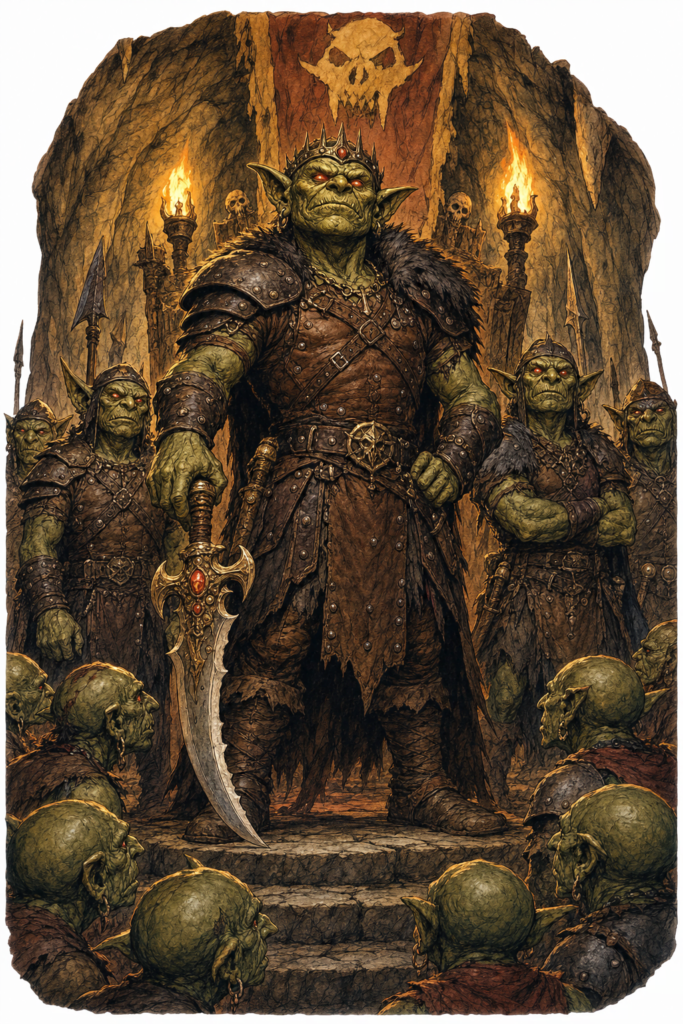
Goblin King (1, in lair) #
| Stat | Value |
|---|---|
| Hit Points | Fixed 15 |
| Attacks as | 3 HD monster (HR +3) |
| Damage | By weapon +1 |
| Daylight | No penalty |
| Morale | 9 (own) |
| Presence | All goblins within sight: Morale 9 |
The +1 damage bonus reflects the king’s superior weapon (the best in the lair) and exceptional strength for a goblin.
No daylight penalty: The king functions in full daylight without the –1 penalty. This is practically significant — a goblin raiding party led by the king can operate in daylight at full capability when it would otherwise be penalized.
The Morale Aura #
The goblin morale is 9 rather than 7 as long as their king is with them and still alive.
Mechanics: +2 Morale to all goblins within line of sight of the living king. Two-point increase changes break probability dramatically:
- Morale 7 breaks on 2d6 roll of 8+ (approximately 42% per check)
- Morale 9 breaks on 2d6 roll of 10+ (approximately 17% per check)
Killing the king more than doubles the break probability. In a large lair encounter, the king is the tactical priority — not for his individual combat capability (which is formidable) but for his morale effect on potentially 60 followers.
The Dwarf Enmity #
Goblins hate dwarves and will attack them on sight.
Automatic hostility — no reaction roll possible. A goblin who sees a dwarf attacks. The enmity mirrors the gnome-kobold relationship in intensity.
Campaign implications:
- A party with a dwarf member cannot use diplomacy with goblins unless the dwarf is hidden or disguised
- Goblin territory adjacent to a dwarven hold is a permanent war zone
- Goblins may negotiate with humans, elves, and halflings but not dwarves
- A dwarf PC who is captured by goblins is in worse danger than other party members
Nocturnal Hunting Pattern #
They normally send hunting parties out at night to scavenge food and attack poorly-defended groups of humans.
Hunting party composition: The 2d8 wilderness encounter represents a hunting party, not the full lair force. These are the goblins away from home, at range, looking for easy prey — poorly defended farmsteads, small traveling groups, livestock on the edge of settled land.
Night operation: Goblin hunting parties operate at night specifically to avoid the daylight penalty. A party traveling at night without adequate light is encountering goblins on their preferred terms.
Scavenge food: Goblins eat opportunistically — livestock, game, carrion, and humanoids. The hunting party is looking for food as much as for plunder. This behavioral context explains encounter approaches: a hunting party that encounters an armed, alert party may evaluate whether the fight is worth the risk (Morale 7 suggests it usually is not).
Regional Variants #
What follows are three established goblin populations beyond the common cave-dwelling baseline, each adapted to distinct territory and circumstance. Goblin society’s underlying hierarchy structure (king, bodyguard, morale aura) is preserved across all variants — what differs is appearance, terrain adaptation, and in some cases social organization.
Stone Goblin (Goblinus Communis Petrus) #
Territory: Deep cavern systems and old dwarf-hold ruins — the baseline population described above.
Appearance: Chalky tan to grey skin, very short rough hair if any, studded leather or scavenged chain pieces. Average height 4 ft.
Statistics: As Common Goblin above, unmodified. This is the reference population, found throughout cavern and hill terrain across the Known World.
Ash Goblin (Goblinus Communis Cinereus) #
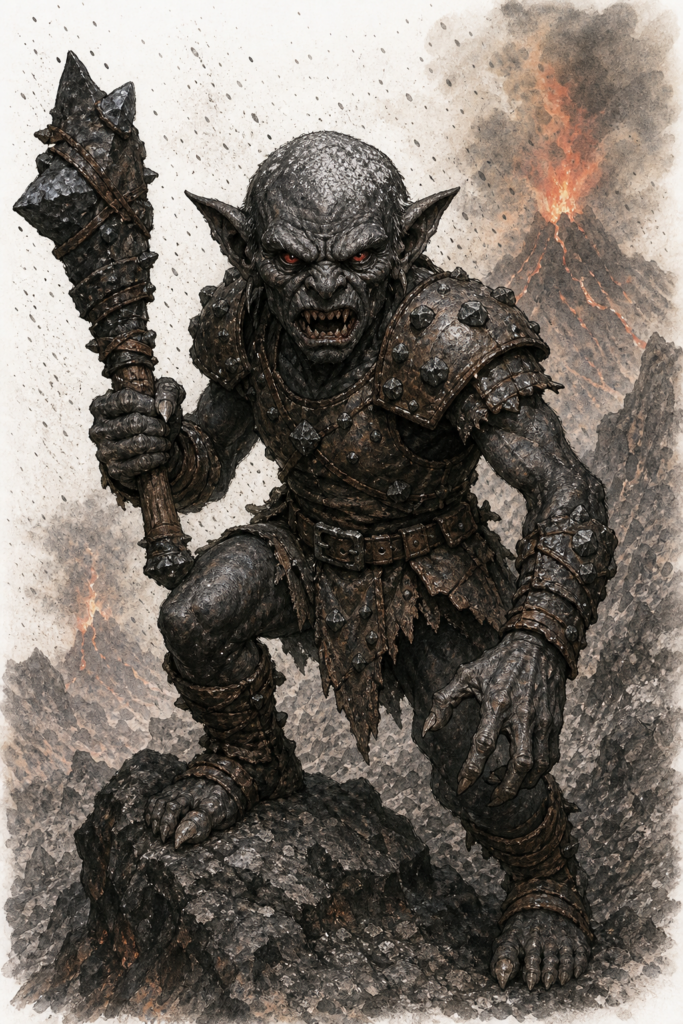
Territory: Volcanic hill country and the blasted, ash-fall regions found near active or recently active volcanic terrain.
Appearance: Dark grey to near-black skin with a fine ash-pale dusting that never fully washes off, eyes a duller red than the Stone Goblin’s bright glow. Heat-blistered, leathery skin texture.
Behavioral note: Ash Goblins have adapted to a harsher and more dangerous home territory than most goblin populations — volcanic terrain is unforgiving, and the population that survives there has developed a correspondingly harder edge. They are more aggressive raiders than the Stone Goblin baseline, having learned that hesitation in their home terrain often means losing a kill to the environment itself.
Statistics: As Common Goblin, with the following changes:
| Stat | Value | Change from Common |
|---|---|---|
| AV | 2 (melee) / 0 (missile) | +1 melee (leathery heat-toughened skin) |
| HR | +1 (+0 in full daylight) | +1 (more aggressive, better trained with what they have) |
| Morale | 8 (9 when king present) | +1 (hardier temperament) |
| XP | 7 | +2 (tougher and more aggressive) |
Additional skill — Slot 2 replaced: Fire Endurance (Basic) — immune to non-magical heat and smoke-based exhaustion; +2 to saves vs. fire-based effects in their home territory. Daylight penalty unchanged — Ash Goblins remain light-sensitive despite their volcanic adaptation.
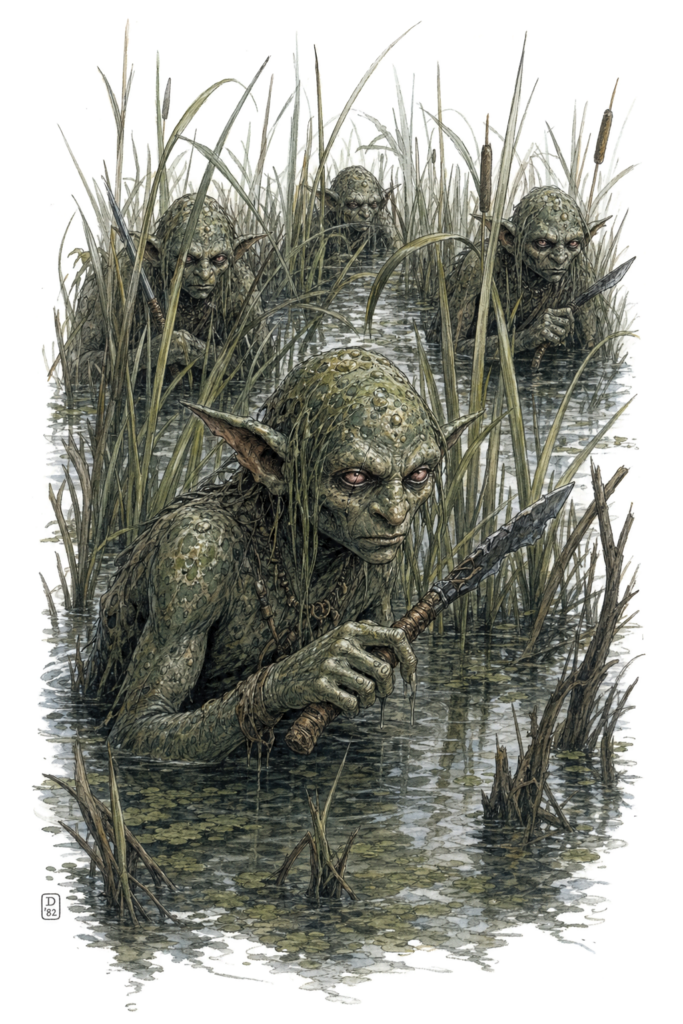
Fen Goblin (Goblinus Communis Paludis) #
Territory: Marsh and swamp country, typically found nesting in dry hummocks and old ruins within larger wetland regions.
Appearance: Mottled green-grey skin with a faint sheen, longer fingers and toes than other goblin populations (useful for grip in wet terrain), eyes a paler, more washed-out red.
Behavioral note: Fen Goblins are notably more organized than other goblin populations — the harsh logistics of marsh living (limited dry ground, seasonal flooding, scattered resources) have pushed them toward larger cooperative structures rather than the loosely organized hunting-party model common elsewhere. Fen Goblin kings tend to hold power longer and command more genuine loyalty, as marsh survival rewards stable leadership over opportunistic challenge.
Statistics: As Common Goblin, with the following changes:
| Stat | Value | Change from Common |
|---|---|---|
| Move | 60 ft (20 ft encounter) ground / 90 ft (30 ft encounter) swimming | –30 ft ground / new swim speed |
| Morale | 8 (9 when king present) | +1 (stronger social cohesion) |
| XP | 6 | +1 |
Additional skill — Slot 2 replaced: Wetland Tactics (Basic) — as Underground Tactics, but applies to marsh, swamp, and flooded terrain instead of caverns; +2 to surprise rolls when attacking from concealment in reeds or shallow water.
Fen Goblin King variant note: Because Fen Goblin social structure rewards stability, a Fen Goblin King who has held power for an extended in-game period (DM discretion, typically years of game-time) may have accumulated a second tier of authority — up to 2 additional Bodyguard-tier individuals beyond the standard 2d6. This reflects an unusually long and successful reign rather than a baseline rule.
Regional Variant Summary Table #
| Variant | HD | AC | AV | Move | Morale | XP | Key Trait |
|---|---|---|---|---|---|---|---|
| Stone (common) | 1d8–1 | 14 | 1/0 | 90 ft | 7 (9) | 5 | Baseline |
| Ash | 1d8–1 | 14 | 2/0 | 90 ft | 8 (9) | 7 | Aggression; fire endurance |
| Fen | 1d8–1 | 14 | 1/0 | 60/90 ft (swim) | 8 (9) | 6 | Cohesion; wetland tactics |
Encounter Notes #
The outdoor night encounter: 2d8 goblins, 20% chance of dire wolf riders (1 in 4 mounted). Night: no daylight penalty. The mounted goblins (if present) move to flank while foot goblins advance in front. The dire wolves will attempt to close to bite range immediately — they are the primary threat. Killing wolves first forces goblins to close to melee on foot.
The dungeon lair: 6d10 goblins (up to 60), including the goblin king (1) and bodyguard (2d6). The lair is in their chosen underground terrain — infravision effective for all of them, narrow passages that limit how many opponents can engage simultaneously, prepared positions from which the bodyguard can defend the king. With the king alive, Morale 9 means they fight seriously. The king will use his bodyguard as a defensive screen while directing the overall fight.
The dwarf problem: A party with a dwarf member in goblin territory cannot use standard diplomatic approaches. Options: dwarf stays behind while party negotiates (leaves the dwarf isolated and is suspicious), dwarf disguises (Deception difficulty –2 at close range given height and beard), party accepts combat-only interaction with goblins, or party finds a way to use the automatic goblin-dwarf aggression as a tactical tool.
Mixed-territory encounters: Where goblin territories border one another — Stone Goblin cavern systems opening onto marsh country, for example — mixed-population bands occasionally form, typically when a smaller population is displaced by territorial pressure and absorbed into a neighboring group. The dominant population’s king mechanic always governs; absorbed individuals from another population retain their physical traits but follow the host band’s social structure.
CR summary:
| Rank | CR | Notes |
|---|---|---|
| Common goblin (any variant) | 1 | Trivial alone; dangerous in large numbers |
| Common + daylight | 1 | –1 HR reduces threat meaningfully (Ash Goblin retains penalty) |
| Dire wolf rider | 2 | Wolf adds significant bite + movement |
| Bodyguard | 2 | 2 HD attacks, variable HP |
| Goblin king (any variant) | 3 | No daylight penalty; +1 damage; morale aura for up to 60 followers |


