
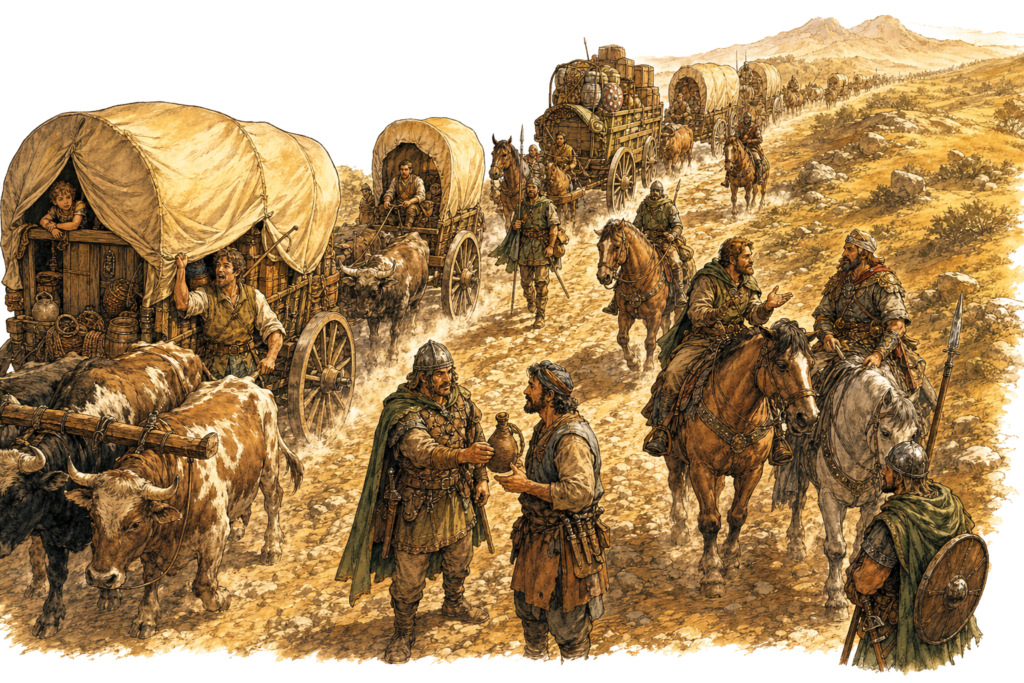
The road ahead is not empty. Dust, the sound of axles, the smell of animals, the shouts of drovers. A caravan — a moving village of commerce, debt, and ambition, three weeks out of the last city and six weeks from the next.
What a Merchant Caravan Is #
A merchant caravan is not a single encounter — it is a mobile encounter location. It has a population, an economy, a social structure, and its own problems. Meeting a caravan on the road may last an afternoon, a day, or a week if the party travels alongside it. Every element generates potential encounters: the merchants want things, the guards are bored and watchful, the craftspeople need supplies, and someone in the caravan always knows something useful.
Based on: The RC Trader entry (wagon scale, guard ratios, equipment). Extended with caravan population, wagon types, goods categories, and road-craft NPC types.
Caravan Scale #
Roll or choose based on campaign context:
| Size | Wagons | Merchants | Guards (L1) | Guards (L2–3) | Guards (L4–5) | Pack Animals | CR |
|---|---|---|---|---|---|---|---|
| Small | 5 | 10 | 15 | 20 | 2 | 1d12 | 3 |
| Medium | 10 | 20 | 30 | 40 | 4 | 1d12 | 5 |
| Large | 15 | 30 | 45 | 60 | 6 | 1d12 | 7 |
| Grand | 20 | 40 | 60 | 80 | 8 | 1d12 | 8 |
Pack animals by terrain:
- Standard road: Riding horses and draft horses
- Desert: Camels (primarily) + mules for rough loads
- Mountain passes: Mules (primarily) — superior footing on grade
- Coastal wet roads: Draft horses + mules
- Mixed: 1d3 each of horse/camel/mule proportional to recent terrain
Caravan Wagons — Types #
Roll 1d6 per wagon or assign by cargo:
| 1d6 | Wagon Type | Contents | Guard Priority |
|---|---|---|---|
| 1 | Goods Wagon | Bulk trade goods (grain, wool, lumber, pottery) | Low |
| 2 | Luxury Wagon | High-value cargo (silks, spices, wine, dyes) | High — locked and watched |
| 3 | Armored Chest Wagon | Coin, gems, letters of credit | Extreme — guards sleep on it |
| 4 | Craftsman Wagon | Tools, raw materials, work in progress | Medium |
| 5 | Supply Wagon | Caravan’s own food, water, feed, spare parts | Medium |
| 6 | Passenger Wagon | Traveling merchants, families, paying travelers | Variable |
The armored chest wagon is always present in a medium or larger caravan. It is covered, reinforced, padlocked, and has a 2-man watch at all times. The senior guard (L4–5) sleeps in or under it at camp.
Merchant Types #
Each merchant in the caravan has a specific trade specialty. Roll 1d12 for each merchant, or choose for named NPCs:
| 1d12 | Merchant Type | What They Buy | What They Sell | Notable Behavior |
|---|---|---|---|---|
| 1 | Cloth Merchant | Raw wool, raw silk, leather | Finished textiles, clothing, bolts | Examines all fabric on sight |
| 2 | Spice Trader | Any exotic goods | Pepper, cinnamon, saffron, rare herbs | Paranoid about the chest wagon |
| 3 | Wine Merchant | Grain, barrels, rare spirits | Vintage wines, cordials, distilled spirits | Constantly sampling stock |
| 4 | Metal Goods Dealer | Ore, raw metal | Tools, weapons (non-magical), agricultural implements | Checks everything for iron content |
| 5 | Gem & Jewelry Merchant | Rough stones, gold/silver | Cut gems, finished jewelry, settings | Carries a loupe; inspects everything |
| 6 | Book & Scroll Trader | Old texts, parchment, ink | Books, maps, blank parchment, scrolls | May buy or sell information |
| 7 | Animal Broker | Trained animals | Working dogs, horses, exotic beasts | Knows every animal in the train |
| 8 | Grain Merchant | Finished goods | Grain, flour, dried legumes, dried fruit | Weighs everything on a pocket scale |
| 9 | Alchemical Supplier | Rare components | Common alchemical components, solvents, acids | Has a locked box of reactions-in-progress |
| 10 | Luxury Goods | Coin | Art objects, furniture, exotic items, curiosities | Moves with the luxury wagon |
| 11 | Information Broker | Anything (for sale later) | Intelligence, maps, guild contacts, introductions | Asks many questions; volunteers little |
| 12 | Slave Trader* | Gold | Laborers, specialists, skilled workers | Controversial; avoided by Lawful parties |
*DM determination on whether slave trading is part of the campaign setting.
Road-Craft Specialists #
Beyond merchants, a medium or larger caravan includes craftspeople traveling to a new market or under contract. Roll 1d8 per 10 merchants, or assign:
| 1d8 | Specialist | Service Offered | What They Need |
|---|---|---|---|
| 1 | Blacksmith | Repairs metal items; basic smithing; reshoes animals | Iron stock, coal/charcoal |
| 2 | Wheelwright | Repairs and replaces wagon wheels, axles | Wood, metal fittings, wedges |
| 3 | Cooper | Makes/repairs barrels and casks | Wood staves, iron rings |
| 4 | Healer (Lay) | Non-magical healing, wound dressing, herb medicine | Medical components, fresh water |
| 5 | Scribe | Letters, contracts, maps, legal documents | Ink, parchment |
| 6 | Cook | Prepares meals for the caravan | Fresh supplies at settlements |
| 7 | Leatherworker | Repairs harness, boots, straps, armor (non-metal) | Leather, needles, wax |
| 8 | Tinker | Minor repairs on metal goods, locks, mechanisms | Wire, small tools |
The Blacksmith is the most important road craftsman — without them, a broken axle fitting or a cast horse shoe can delay the caravan for days. A competent blacksmith is paid and valued accordingly.
The Leatherworker maintains the harness that keeps the draft animals pulling. Harness failure is as catastrophic as wheel failure.
Caravan Personnel — Named Roles #
Every caravan has several key individuals regardless of size:
The Caravan Master #
The senior merchant who organizes, coordinates, and makes final decisions. Usually the largest investor in the enterprise.
| Stat | Value |
|---|---|
| Level | 1d4+4 (5–8) Fighter or Merchant (use Fighter stats) |
| AC | 15 (chain mail) |
| Equipment | Sword, ledger, sealed correspondence, caravan charter |
| Motivation | Profit; arrive safely; maintain reputation; avoid scrutiny |
| Demeanor | Businesslike, cautious, willing to negotiate |
The caravan master knows the value of everything in the caravan to within 10% accuracy without looking. They decide who the caravan hires and who it does not.
The Guard Captain #
Commands all caravan security.
| Stat | Value |
|---|---|
| Level | 1d3+4 (5–7) Fighter |
| AC | 17 (plate mail) |
| Equipment | Sword, lance, war horse |
| Motivation | Complete the contract; lose no merchants; manage the guards |
| Demeanor | Professional, territorial about security decisions, brief |
The guard captain sets watch rotations, determines threat response, and makes combat decisions. They are not the caravan master’s subordinate in matters of security — they have independent authority to change route or halt the caravan if they assess a threat the master dismisses.
The Drover Chief #
Manages the animals and the teamsters who drive the wagons.
| Stat | Value |
|---|---|
| Level | 2d3 (2–6) Fighter |
| AC | 13 (leather) |
| Equipment | Whip, short sword, Animal Training (Expert) |
| Motivation | Keep the animals moving and healthy |
| Demeanor | Gruff, practical, measures everything by how it affects the animals |
The drover chief knows more about the condition of the caravan than anyone — the animals’ health reflects the caravan’s overall state. An anxious drover chief is a warning sign.
Guard Organization #
Watch Rotation #
A medium caravan (40 total guards) runs a standard three-watch system:
- Day march: All guards active; 10 outriders at 200 ft range on flanks and ahead; 30 in the column
- Camp first watch (sundown to midnight): 15 guards active; guard captain on duty
- Camp second watch (midnight to dawn): 15 guards; senior L4–5 guard oversees
- Reserve: 10 guards sleep in full equipment (reach weapons in 1 round)
Outriders #
The outriders are the caravan’s scouts — they range ahead and to the flanks on horseback (or camel in desert terrain). They are the first to detect ambushes, bandits, or unusual creatures on the road.
Outrider profile: L2–3 Fighter, riding horse or camel, shortbow + sword, Alertness (Basic), Riding (Skilled). If they encounter something they cannot handle alone, they return to the column and report before engaging.
Caravan Camp #
When the caravan stops for the night, the camp layout is semi-standardized:
[OUTRIDER PICKETS — 200 ft out]
         |
[WATCH FIRES — perimeter]
    |           |
[ANIMAL LINES]  [CHEST WAGON — center]
    |           |
[MERCHANT TENTS]  [GUARD TENTS]
    |
[CRAFTSMAN AREA — near tools/forge]
The chest wagon is always in the center. The caravan master’s tent is adjacent. Guard tents face outward. Animal lines are along the downwind edge (smell).
Night security: Three watch positions at the perimeter plus two guards permanently on the chest wagon. Outrider pickets at 200 ft on likely approach vectors.
Caravan Goods — Random Determination #
When the party searches/trades with/robs the caravan, use this table for specific goods:
Bulk Goods (Low Value, High Volume) #
| 1d10 | Good | Weight per Unit | Value per Unit |
|---|---|---|---|
| 1 | Grain | 100 cn/sack | 5 gp |
| 2 | Wool (raw) | 200 cn/bale | 15 gp |
| 3 | Timber | 500 cn/log | 8 gp |
| 4 | Salt | 100 cn/block | 20 gp |
| 5 | Iron ore | 500 cn/ingot | 10 gp |
| 6 | Dried fish | 50 cn/bundle | 3 gp |
| 7 | Pottery | 100 cn/crate | 25 gp |
| 8 | Common cloth | 100 cn/bolt | 20 gp |
| 9 | Animal hides | 150 cn/bundle | 30 gp |
| 10 | Charcoal | 200 cn/sack | 8 gp |
Luxury Goods (High Value, Lower Volume) #
| 1d10 | Good | Weight per Unit | Value per Unit |
|---|---|---|---|
| 1 | Fine silk | 50 cn/bolt | 200 gp |
| 2 | Pepper | 50 cn/bag | 150 gp |
| 3 | Saffron | 5 cn/vial | 100 gp |
| 4 | Quality wine | 100 cn/amphora | 50 gp |
| 5 | Precious dyes | 20 cn/jar | 120 gp |
| 6 | Fine metalwork | 50 cn/piece | 200 gp |
| 7 | Cut gems | 1 cn/gem | 100–500 gp |
| 8 | Ivory | 100 cn/tusk | 400 gp |
| 9 | Rare books | 30 cn/volume | 50–500 gp |
| 10 | Exotic spices | 20 cn/pouch | 80 gp |
The Caravan as Social Space #
A grand caravan (20 wagons) is a mobile village of 130+ people traveling the same road for weeks. Social dynamics develop:
Tensions that generate encounters:
- A guard suspects one of the merchants is skimming from the chest wagon
- Two merchants competing for the same buyer in the destination city are creating tension in camp
- The healer’s herb supply ran out three days ago and someone is sick
- One of the outriders has not returned from their morning patrol
- The drover chief is worried about the draft animals — two are limping
- A traveling passenger in the passenger wagon knows something they shouldn’t
What the caravan wants from the party:
- Escort through a dangerous stretch of road
- Investigation of a recent attack on a previous caravan on this route
- Recovery of stolen goods from a bandit camp
- A magical solution to the sick animal / sick merchant problem
- Information about what is ahead on the road
What the caravan can offer the party:
- 50 gp per day per party member (RC Trader rate for guards)
- Information about the road they have already traveled
- Trade goods at reasonable prices (no markup for good relations)
- Introductions to merchant contacts at the destination city
- Healing from the lay healer (non-magical, but better than nothing)
- Blacksmith services (repairs at cost)
- Access to the book/scroll merchant’s inventory for spells or maps
Sample Encounter Hooks #
The scout who didn’t return: The morning patrol’s outrider (2 riders) left at dawn for the eastern approach. It is two hours past when they should have returned. The guard captain is preparing to send a second patrol. The caravan is halted. What happened to the outriders? (Encounter options: ambush site, monster territory, they found something significant, one was bribed and left.)
The sick merchant: A senior merchant has been increasingly unwell for three days. The lay healer has done everything possible. This morning the merchant cannot get out of their wagon. Their cargo is high-value silk — if they cannot negotiate at the destination, the entire shipment may have to be sold at a loss to their partner. They need a Cleric’s Cure Disease and will pay extremely well. What is wrong with them, and can the party help?
The light load: The armored chest wagon is riding higher than it should for its supposed contents. The guard captain has not opened it in four days — unusual. The drover chief mentions this quietly to someone who asks. The chest wagon’s actual contents may not be what the caravan manifest lists. (Options: empty, different goods, contraband, a person, something stranger.)
The information broker: The caravan’s information broker approaches the party privately. They have something to sell — not goods, but knowledge. They know who hired the last bandit attack on this road and why. The price is 200 gp and they want a favor at the destination city. The favor is unspecified but “within reason.” What do they know, and what will they ask?
Encounter Notes #
CR by caravan size:
- Small caravan (5 wagons): CR 3 — 37 guards total; manageable by mid-level parties
- Medium caravan (10 wagons): CR 5 — 74 guards + specialists; significant military force
- Large caravan (15 wagons): CR 7 — 111 guards; comparable to a small garrison
- Grand caravan (20 wagons): CR 8 — 148 guards + officers + magic items; a minor army
Note: The CR reflects the caravan as a combat encounter — the party fighting the caravan. In normal play, the caravan is a social and economic encounter, not a combat one. The guards exist to demonstrate that robbing a large caravan is inadvisable.


