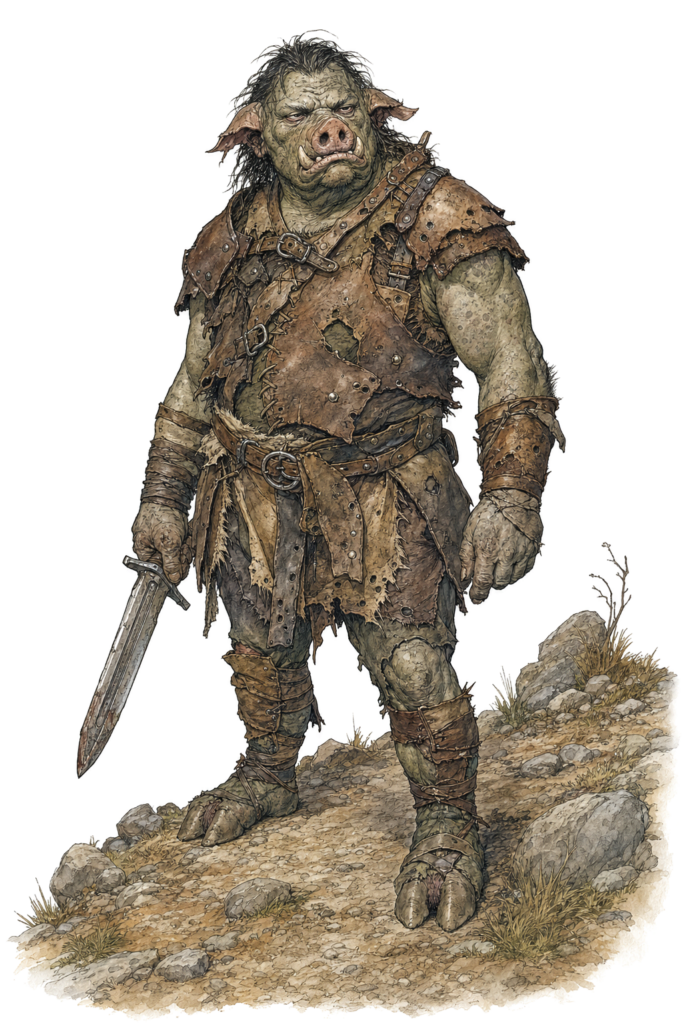
It looks like a human if a human were also partly something else — the features are wrong, the teeth are wrong, the temperament is definitely wrong. It is fighting in daylight, which it does not prefer. Its leader is behind it, making sure it fights anyway.
What an Orc Is #
An orc is an ugly humanlike creature that looks like a combination of animal and man — human-shaped but with bestial facial features and teeth. Orcs are nocturnal omnivores who prefer to live underground. They have bad tempers and do not like other living things. They are afraid of anything larger or stronger than themselves but may be forced to fight by their leaders.
Army fodder: Orcs are often used for armies by Chaotic leaders (both humans and monsters). The orc is the standard rank-and-file soldier of Chaotic military forces — not powerful individually but organized, numerous, and expendable from the perspective of whoever commands them.
Regional distinction. Of all the standard humanoids, orcs show the widest regional variation in appearance and temperament. They are found on nearly every continent and in nearly every climate, and the populations that developed in isolation have diverged considerably. What unites them is the species-wide daylight sensitivity, the nocturnal preference, the pack social structure, and the willingness to serve as soldiers under powerful Chaotic commanders. Everything else is regional variation.
Core Statistics — Common Orc #
| Stat | Value |
|---|---|
| Hit Dice | 1d8 (avg 5 HP) |
| AC | 14 |
| AV | 1 |
| HR | +1 (–1 in daylight = net +0) |
| FR | +1 |
| FD | 11 |
| Move | 120 ft (40 ft encounter) |
| Attacks | 1 weapon: by weapon |
| No. Appearing | 2d4 (1d6×10) |
| Save As | Fighter 1 |
| Morale | 8 (6 after group leader killed) |
| Treasure | (P) individual / D lair |
| Alignment | Chaotic |
| Intelligence | Low (INT 7) |
| XP | 10 |
| Terrain | Hill, Mountain, Wilderness |
AC/AV Reasoning #
RC original is AC 6 (descending) = Ascending AC 14. Orcs typically wear leather armor or scavenged chain fragments.
- AC 14 — Standard light armor. The orc is better protected than a goblin or kobold but relies on weapon skill more than armor quality
- AV 1 — Minimal armor absorption. The orc’s defense is primarily its AC
Skill Slots (1 total — 1 HD = 1 base; no asterisks; Low INT 7) #
| Slot | Skill | Notes |
|---|---|---|
| 1 | HR Investment (Basic) | HR +1; –1 in daylight |
Daylight Penalty #
In full daylight, orcs fight with a penalty of –1 on their attack rolls. HR +1 base –1 penalty = net HR +0 in daylight. Underground or at night: full HR +1.
Leadership Structure — Two Tiers #
Group Leader (1 per group) #
| Stat | Value |
|---|---|
| HP | Fixed 8 |
| Damage bonus | +1 to all weapon damage |
| Morale effect | Group Morale 8 while alive; drops to 6 when killed |
Tribal Chieftain (1 per tribe, lair only) #
| Stat | Value |
|---|---|
| HP | Fixed 15 |
| Attacks as | 4 HD monster (HR +4) |
| Damage bonus | +2 to all weapon damage |
Tribal Structure #
Many different tribes of orcs exist. Each tribe has as many female orcs as males, and at least two whelps for each two adults. The 1d6×10 lair number represents fighting-capable adults only. Whelps are non-combatants — what the party does about them is a character and alignment question.
Allied Creatures (Lair Only) #
For every 20 orcs in a tribe, there may be an ogre with them (1-in-6 chance). There is a 1-in-10 chance of an allied troll living in the lair as well.
The ogre(s) serve as heavy support — 4+1 HD, +2 damage, Morale 10. A troll ally is a wildcard — 6+3 HD, regeneration, fire-dependent.
Weapons and Military Use #
Orcs prefer swords, spears, axes, and clubs. They cannot use mechanical weapons (such as catapults), and only their leaders understand how to operate such devices.
Regional Variants — The Three Orc Sub-Races #
Orc populations across the Known World have diverged into three broadly recognized sub-races, each with distinct appearance and territorial distribution. The daylight penalty, leadership structure, allied creature rules, and tribal demographics apply to all three sub-races.
Sub-Race I — Common Orc #
The most numerous of all, found in most regions of the Known World.
Orcus Porcus — The Porcine Orc #
Territory: The most widely distributed orc population — hill country, mountain passes, borderland caves throughout the Known World.
Appearance: The standard orc, identifiable by obvious porcine features. Skin ranges from pink to brown to black to grey-greenish, sometimes with spots. Hair of any color and length in any style imaginable. Average height 6 ft + 1d6 inches. Tribal members identifiable primarily by their smell — they wear anything shabby and filthy.
Statistics: As Common Orc above, unmodified. This is the reference population.
Orcus Hyborianus — The Northern Orc #
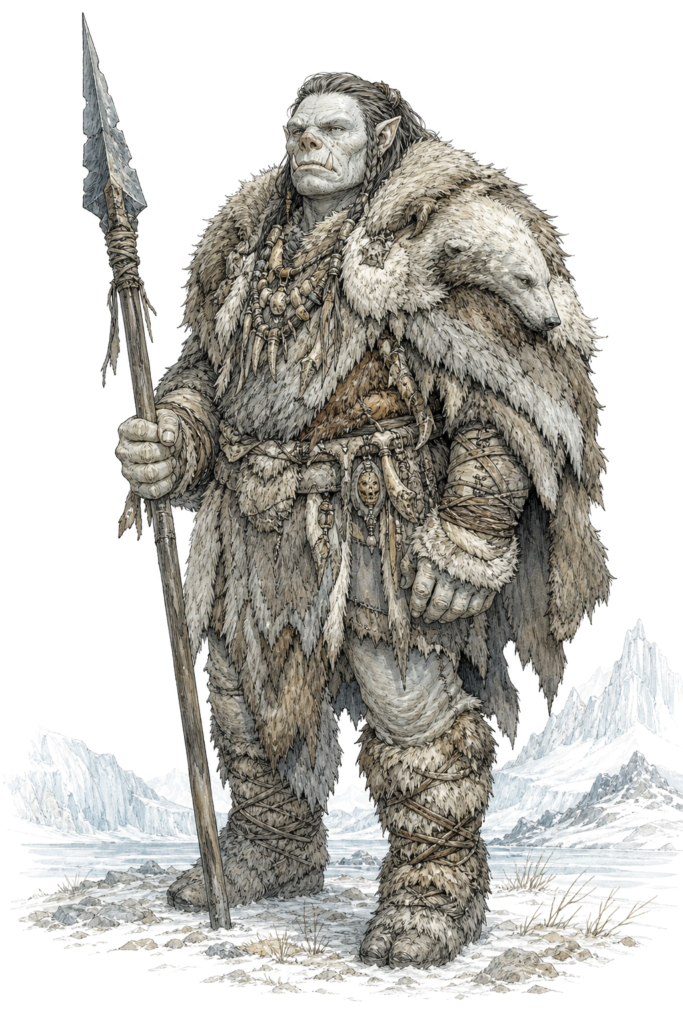
Territory: Northern reaches — glaciers, high mountains, sub-arctic wilderness.
Appearance: Sickly white to light grey skin, various heavy furs depending on available prey. Bulkier than the common Orcus Porcus — cold-adapted body plan accumulates fat and muscle differently.
Behavioral note: Northern Orcs operate in smaller, more self-sufficient bands. The harsh climate does not support large concentrations of orcs, and food scarcity means Northern Orc tribes raid over larger territories with less frequency but more persistence. A Northern Orc raiding band that identifies a target will follow it further and wait longer than a southern population would.
Statistics: As Common Orc, with the following changes:
| Stat | Value | Change from Common |
|---|---|---|
| Hit Dice | 1d8+1 (avg 6 HP) | +1 HP (cold-hardy constitution) |
| No. Appearing | 1d6 (2d4×5) | Smaller bands |
| Morale | 8 (7 after group leader killed) | +1 morale floor |
| XP | 13 | +3 |
Additional skill — Slot 1 modified: Cold Endurance (Basic) — immune to non-magical cold exhaustion; +2 to saves vs. cold-based magic. HR remains +1/net +0 in daylight.
Orcus Imperator Rex — The Underground Orc #
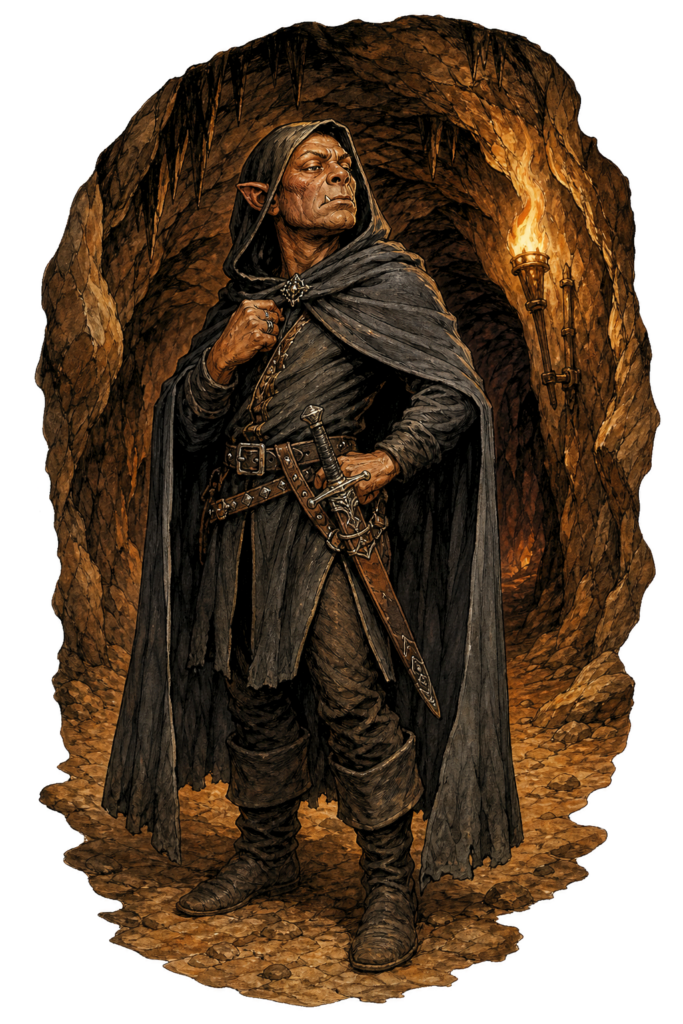
Territory: Deep cave systems and extensive underground complexes — primarily Broken Lands subterranean regions.
Appearance: Porcine features less obvious than standard Orcus Porcus — allows them to pass for really ugly humans at distance. Prefer black or dark grey hooded cloaks designed to blend with underground shadow. Copper-tinted skin, smaller snout.
Behavioral note: Long underground isolation has produced orcs with an inflated sense of their own importance relative to their actual capability. They are not simply aggressive — they believe themselves superior to other orcs and to most surface humanoids. This produces extreme arrogance combined with extreme violence when that arrogance is challenged. Imperator Rex orcs resist the Morale cascade after a group leader’s death more than other populations — their pride competes with their fear response.
Statistics: As Common Orc, with the following changes:
| Stat | Value | Change from Common |
|---|---|---|
| INT | 8 (Low+) | +1 INT (complex social politics selects for slightly higher intelligence) |
| Morale | 9 (7 after group leader killed) | +1 base (pride competes with fear) |
| XP | 12 | +2 |
Additional skill — Slot 1 modified: Underground Tactics (Basic) — +2 to surprise rolls in cave/dungeon environments; uses darkness and shadow positions instinctively; –2 to all actions in open sunlight (enhanced daylight sensitivity, on top of standard –1 HR penalty).
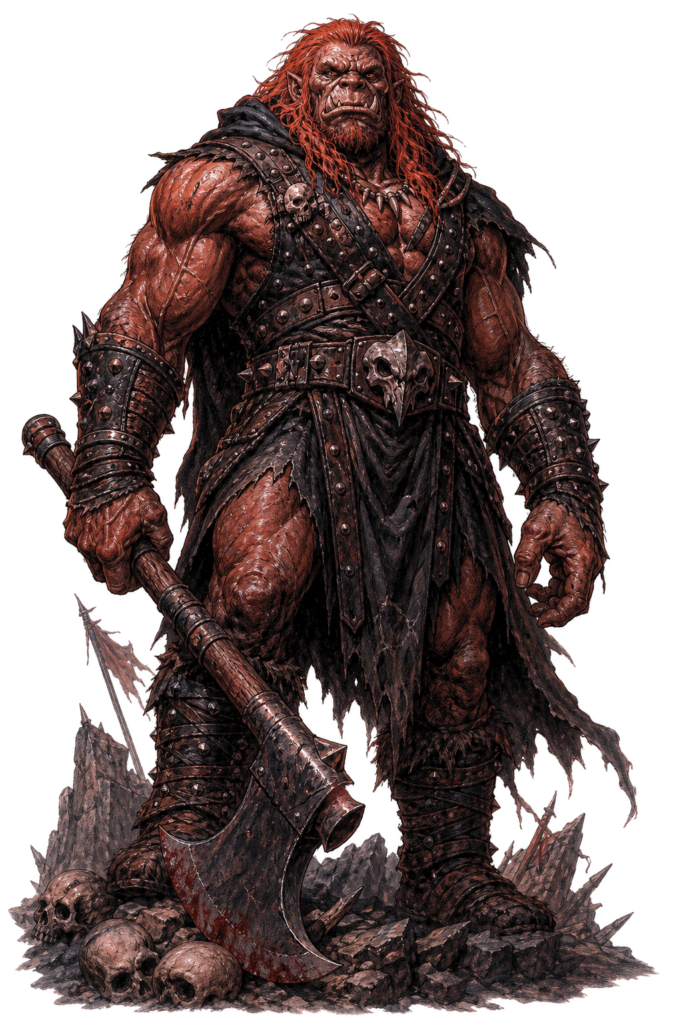
Sub-Race II — Red Orc #
Identifiable by their generally red hides and simian features. About the size of a tall human, with small round ears.
Average height 5’6″ + 1d12 inches. Found primarily in the Broken Lands, where two distinct populations occupy different ecological niches.
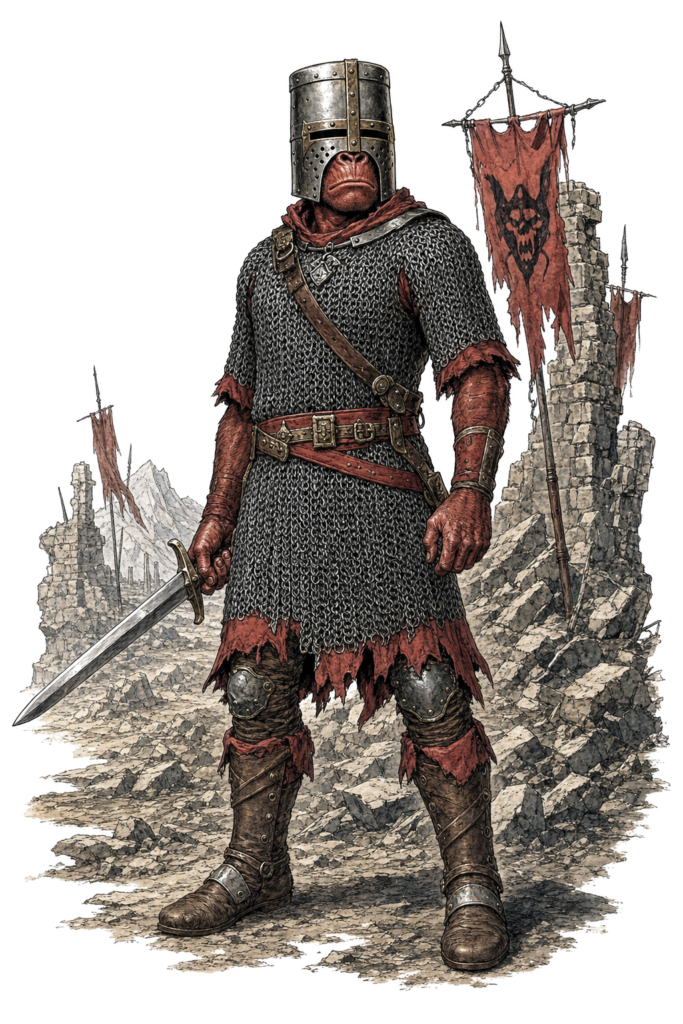
Orcus Rubeus Vulgaris — The Southern Red Orc #
Territory: Southern Red Orcland (Broken Lands).
Appearance: Very short hair if any, brick-red to reddish-brown. Simian features emulating various monkey faces found in nature. Usually wear mismatched armor pieces, preferring chain mail and great helms — the most consistently equipped of the Red Orc populations.
Behavioral note: The most militarily organized Red Orc population. Their preference for chain mail and great helms reflects consistent enough raiding success to accumulate and maintain proper armor. Southern Red Orcs in chain mail are a genuinely different tactical problem from common orcs in leather scraps.
Statistics: As Common Orc, with the following changes:
| Stat | Value | Change from Common |
|---|---|---|
| AC | 16 | +2 (chain mail + great helm) |
| AV | 3 | +2 (chain provides meaningful absorption) |
| Move | 90 ft (30 ft encounter) | –30 ft (heavy armor penalty) |
| XP | 15 | +5 |
Additional skill — Slot 1 modified: Military Discipline (Basic) — Morale drops from 8 to 7 (not 8 to 6) when the group leader falls. More militarily consistent than common orcs.
Orcus Simius Terribilis — The Northern Red Orc #
Territory: Northern Red Orcland (Broken Lands).
Appearance: Long shaggy hair ranging from bright orange to dull red. Much more muscular and physically imposing than the Vulgaris. Favor black studded leather armor and hoods. Noticeably larger and heavier than their southern cousins.
Behavioral note: The most physically dangerous individual orc in the Broken Lands — larger, stronger, and more aggressive than the Vulgaris, trading military organization for raw individual capability. Harder to route through leader-killing because cohesion is based on fear of each other rather than discipline or loyalty.
Statistics: As Common Orc, with the following changes:
| Stat | Value | Change from Common |
|---|---|---|
| Hit Dice | 1d8+2 (avg 7 HP) | +2 HP (larger, more muscular) |
| HR | +2 (–1 in daylight = net +1) | +1 HR (exceptional orc strength) |
| FR | +2 | +1 |
| Morale | 9 (7 after group leader killed) | +1 (fear-based cohesion) |
| XP | 18 | +8 |
Sub-Race III — Yellow Orc #
Identifiable by their yellow hides. Some come with ugly rat or pekingese faces. About human size with small pointed ears.
Average height 5′ + 1d20 inches. Found primarily in the hill and mountain country of Alfheim and the Ethengar steppes.
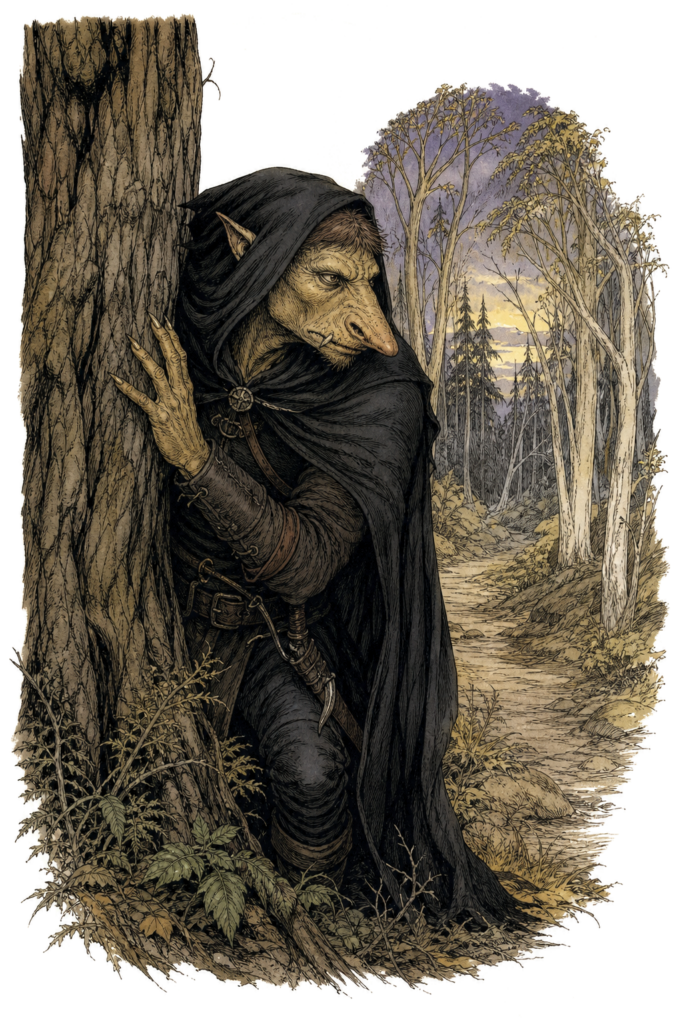
Orcus Facies Ratis — The Alfheim Yellow Orc #
Territory: Hills and mountains native to Alfheim’s borders.
Appearance: Very short hair ranging from tan to dull light brown. Longer pointed snout than other orc populations — the rat-faced appearance that gives this population its name. Favor black garb with hooded cloaks — an unusually consistent aesthetic for an orc population.
Behavioral note: Long experience raiding against elven opposition has made this population notably more cautious and tactically patient than common orcs. They assess, position, and prefer terrain advantage. The daylight penalty hits them badly against elves who prefer daylight operations, and they have adapted with deeper nocturnal schedules, better use of shadow and cover, and an ambush preference unusual for orcs.
Statistics: As Common Orc, with the following changes:
| Stat | Value | Change from Common |
|---|---|---|
| INT | 8 (Low+) | +1 INT (elf-border tactical pressure) |
| Morale | 7 (5 after group leader killed) | –1 (more cautious, quicker to disengage) |
| XP | 10 | Unchanged — caution offsets INT gain |
Additional skill — Slot 1 modified: Shadow Tactics (Basic) — in darkness or dim light: +1 to surprise rolls; in direct daylight: –2 to all actions (enhanced daylight sensitivity from nocturnal adaptation, on top of standard –1 HR).
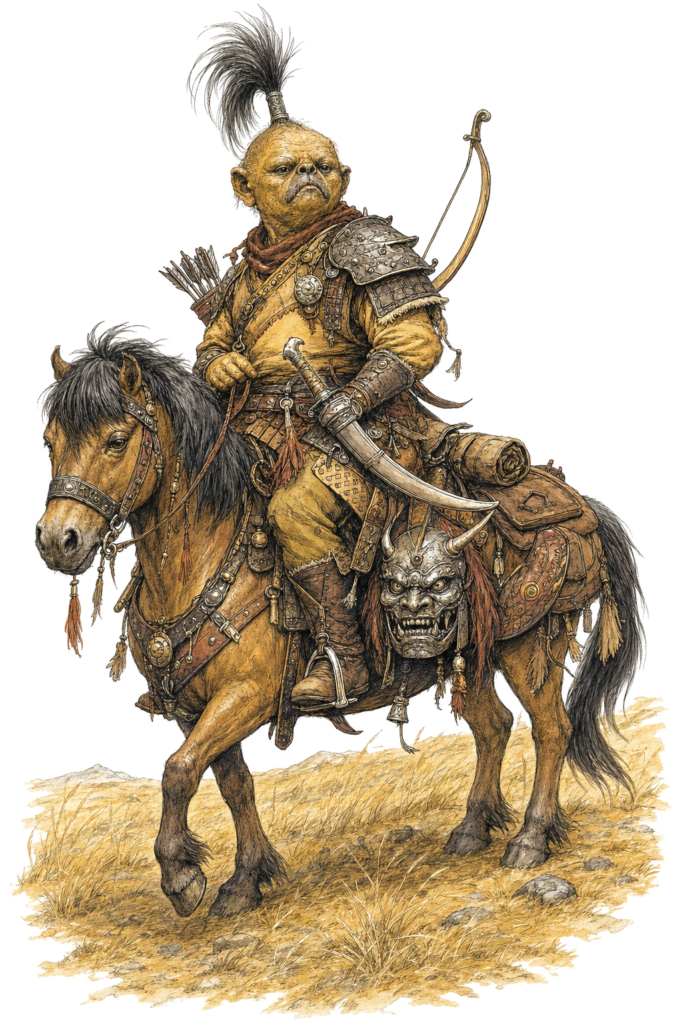
Orcus Canis Oriensis — The Ethengar Yellow Orc #
Territory: The vast Ethengar steppes and Yellow Orkia (Broken Lands).
Appearance: Long hair forming a plume on the head, dusty yellow to brown. Pekingese face — flat, round, with small compressed features. Favor mismatched oriental-styled armor and frightening helms designed to intimidate. Nomadic — no fixed lairs.
Behavioral note: The only nomadic orc population in the Known World. They range across the steppes in mobile bands, raiding and moving. They appear, raid, and are gone before pursuit can be organized. Their “lair” is a camp that moves — the standard lair encounter rules do not apply in the usual sense.
Statistics: As Common Orc, with the following changes:
| Stat | Value | Change from Common |
|---|---|---|
| Move | 150 ft (50 ft encounter) | +30 ft (steppe-adapted endurance) |
| Treasure | (P) individual only | No fixed lair treasure |
| XP | 12 | +2 (speed) |
Additional skill — Slot 1 modified: Mounted Combat (Basic) — 50% of Canis Oriensis encountered outdoors are mounted on steppe horses or dire wolves; mounted individuals use mount’s movement; +1 HR on first charge round.
Nomadic lair note: If the party tracks a band to their current camp, use standard lair demographics but treat the camp as established for 1d6 days and relocating in the next 1d4 days. Treasure is in portable form — sacks, saddlebags, light valuables. No permanent structures.
Full Regional Variant Summary Table #
Common Orc Sub-Race #
| Variant | HD | AC | AV | Move | INT | Morale | XP | Key Trait |
|---|---|---|---|---|---|---|---|---|
| Orcus Porcus (baseline) | 1d8 | 14 | 1 | 120 ft | 7 | 8 (6) | 10 | Most numerous; standard |
| Orcus Hyborianus | 1d8+1 | 14 | 1 | 120 ft | 7 | 8 (7) | 13 | Cold endurance; smaller bands |
| Orcus Imperator Rex | 1d8 | 14 | 1 | 120 ft | 8 | 9 (7) | 12 | Underground tactics; arrogant |
Red Orc Sub-Race #
| Variant | HD | AC | AV | Move | INT | Morale | XP | Key Trait |
|---|---|---|---|---|---|---|---|---|
| Orcus Rubeus Vulgaris | 1d8 | 16 | 3 | 90 ft | 7 | 8 (7) | 15 | Chain mail; military discipline |
| Orcus Simius Terribilis | 1d8+2 | 14 | 1 | 120 ft | 7 | 9 (7) | 18 | Strongest individual orc |
Yellow Orc Sub-Race #
| Variant | HD | AC | AV | Move | INT | Morale | XP | Key Trait |
|---|---|---|---|---|---|---|---|---|
| Orcus Facies Ratis | 1d8 | 14 | 1 | 120 ft | 8 | 7 (5) | 10 | Shadow tactics; elf-border caution |
| Orcus Canis Oriensis | 1d8 | 14 | 1 | 150 ft | 7 | 8 (6) | 12 | Nomadic; mounted; no fixed lair |
Encounter Notes #
The daytime ambush: 2d4 orcs in late morning sunlight. HR net +0. Kill the leader first — Morale collapses to 6 and half the group breaks within 1–2 rounds.
The night raid: Same orcs at night — HR +1 fully active. Smart orcs raid at night, not during the day.
The lair assault: 1d6×10 orcs in a cave complex. Chieftain (15 HP, attacks as 4 HD, +2 damage) in the deepest chamber. 1-in-10 chance of a troll. For every 20 orcs, 1-in-6 chance of an ogre. Against 60 orcs, the party needs corridor control, not open melee.
The Chaotic army: A Red Orc army using Orcus Rubeus Vulgaris troops in chain mail is significantly more resilient than a common orc force — the standard leader-kill-for-morale-cascade tactic is less effective against troops with Military Discipline.
CR justification:
| Rank | CR | Notes |
|---|---|---|
| Common orc (any) | 1 | Base from 1 HD |
| Orcus Rubeus Vulgaris | 2 | Chain mail survivability |
| Orcus Simius Terribilis | 2 | +2 HP, +1 HR, +1 FR |
| Orc group (2d4) | 2–3 | Numbers elevate CR |
| Orc lair (60) + chieftain + ogres | 7–9 | Army-scale encounter |


