
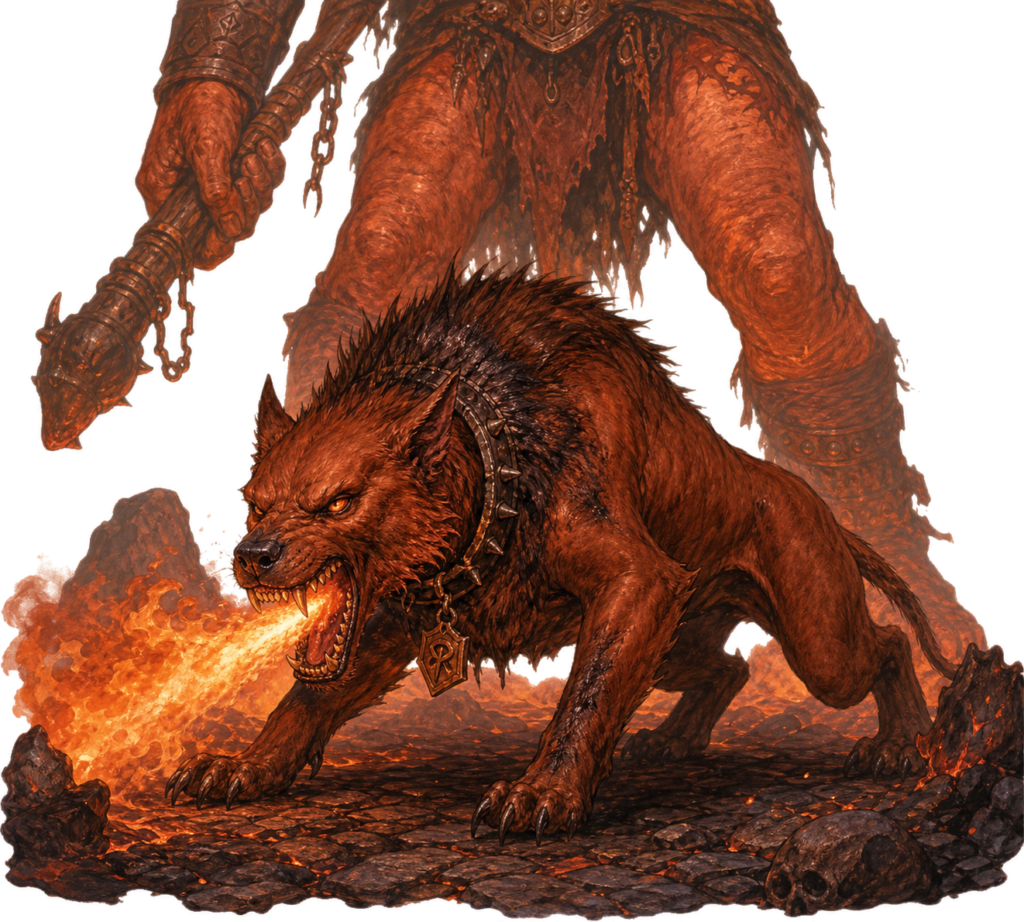
It looks like a large reddish-brown dog. Then it opens its mouth and fire comes out. Then you kill it and more fire comes out.
What a Hellhound Is #
A hellhound is a reddish-brown doglike monster the size of a small pony. It is found near volcanoes, deep in dungeons, and — most commonly in organized encounter contexts — as a guard for fire giants, who keep them in packs of 3d6. They are cunning and highly intelligent for an animal-category monster, capable of detecting invisible creatures and making tactical decisions about whether to breathe or bite each round.
The fire giant connection: Fire giants “always have either 1d3 hydras (20% chance) or 3d6 hellhounds (80%)” as guards. The hellhound is therefore one of the most common serious fire-aligned monster encounters in the RC — not as a random dungeon denizen but as an organized guardian force for one of the most powerful giant types.
Statistics by Hit Dice #
| HD | AC | AV | HR | FR | FD | Save As | XP | Breath Damage |
|---|---|---|---|---|---|---|---|---|
| 3** | 16 | 2 | +3 | +3 | 13 | F3 | 65 | 3d6 |
| 4** | 16 | 2 | +4 | +4 | 14 | F4 | 175 | 4d6 |
| 5** | 16 | 2 | +5 | +5 | 15 | F5 | 425 | 5d6 |
| 6** | 16 | 3 | +6 | +5 | 15 | F6 | 725 | 6d6 |
| 7** | 16 | 3 | +7 | +6 | 16 | F7 | 1,250 | 7d6 |
AC/AV Reasoning: RC original is AC 4 (descending) = Ascending AC 16. The hellhound’s reddish-brown hide is dense and fire-hardened — comparable to scale armor in protection.
Skill Slots (4 total — 3–7** HD = 4 base + 2 asterisks; High INT 12) #
Representative entry for 5 HD (mid-range). Scale HR, FR, FD, and damage by actual HD.
| Slot | Skill / Ability | Notes |
|---|---|---|
| 1 | HR Investment (Basic) | HR by HD |
| 2 | Fire Breath + Fire Immunity (innate, special) | 1d6/HD breath; Save vs. Dragon Breath for half; immune to normal fire. First asterisk |
| 3 | Detect Invisible (innate, special) | 75% chance per round, 60 ft range. Second asterisk |
| 4 | Alertness (Skilled) | Cannot be surprised in volcanic/dungeon terrain; detects intruders by heat signature at 90 ft |
Martial Style #
Style: Proactive (Basic rank) — Breath first, bite second Rank: Basic
The hellhound is an intelligent predator (INT 12) that follows a specific round-by-round decision process. Proactive style reflects the intentional breath/bite choice — the hellhound evaluates tactical advantage before committing to an attack form each round. Against clustered opponents, breath is correct. Against a single isolated target, bite may be more efficient. Against an invisible target just detected, breath covers the area.
The Bite vs. Breath Decision #
“A hellhound will attack one victim, either breathing fire (one chance in three: 1–2 on 1d6) or biting (two chances in three: 3–6 on 1d6) each round.”
Random for common hellhounds: Roll 1d6 at the start of each round. 1–2 = breath; 3–6 = bite.
Intelligent override (INT 12): A hellhound with INT 12 may override the random roll when tactical context is clear:
- Multiple opponents clustered together: Breath (catches all of them)
- Opponent is invisible and just detected: Breath (no need for precise targeting)
- Single opponent already engaged in melee: Bite (efficient, no risk to fire giant allies nearby)
- Opponent is fire-immune or fire-resistant: Bite (conserve breath for effective targets)
The DM may treat the 1–2 / 3–6 distribution as the hellhound’s behavioral default rather than a mandatory random roll for intelligent specimens.
Fire Breath — Complete Mechanics #
Damage: 1d6 per HD of the hellhound.
- 3 HD: 3d6 (avg 10.5)
- 4 HD: 4d6 (avg 14)
- 5 HD: 5d6 (avg 17.5)
- 6 HD: 6d6 (avg 21)
- 7 HD: 7d6 (avg 24.5)
Save: Save vs. Dragon Breath for half damage.
Target: One victim per breath — the hellhound targets a specific creature, not an area. The breath is a focused jet or cone toward one target, not the wide cone of a dragon. Adjacent creatures to the target may be at risk (DM determines splash zone — typically 5 ft radius around target).
No daily limit specified: The RC does not cap hellhound breath uses. Unlike dragons (3/day), a hellhound may breathe every round it rolls 1–2. In practice, this means approximately 1/3 of rounds involve breath. A pack of six 5 HD hellhounds breathing simultaneously is 6 × 5d6 = 30d6 potential damage per round to their targets — catastrophic against any party.
Detect Invisible — 75% Per Round #
“They can often detect invisible (as the magic-user spell; 75% chance per round, range 60 ft).”
Mechanics:
- Each round, roll d100. On 75 or less, the hellhound detects all invisible creatures within 60 ft
- On a failed roll (76–100), the hellhound does not detect invisible that round
- On a success, the hellhound knows the exact location of all invisible creatures within range — it may direct attacks, breath, or alerts to those positions
Combined with INT 12: A hellhound that detects an invisible creature will alert its pack (and any fire giant handlers) to the location. It will use breath against a detected invisible target rather than the less accurate “guess the square” approach.
The practical threat: Parties using Invisibility as a primary tactical approach are genuinely compromised by hellhounds. The 75% detection rate per round means that within 2 rounds, a detected party is very likely to have been spotted.
Final Retribution — Death Explosion #
House rule addition:
When a hellhound is killed, the killing blow causes it to explode in a final burst of fire equal to the last damage dealt to it.
Mechanics:
- Trigger: The blow that reduces the hellhound to 0 or fewer HP
- Damage: Equal to the damage dealt by the killing blow
- Area: 10 ft radius centered on the hellhound’s position
- Save: Save vs. Death Ray for half damage
- The killer is within the blast radius and must also save
Example: A fighter deals 14 damage to kill a 5 HD hellhound. The hellhound explodes for 14 damage to all creatures within 10 ft. The fighter who struck the killing blow is within 10 ft (they were in melee) and must save vs. Death Ray or take 14 fire damage.
Fire immunity: Fire-immune creatures take no damage from the retribution explosion.
Tactical implications:
- Killing a hellhound in melee is dangerous — the killer takes the explosion
- Ranged attacks or spells from beyond 10 ft avoid the explosion entirely
- A party fighting multiple hellhounds should use ranged attacks when possible
- Killing a hellhound inside a pack (adjacent other hellhounds) causes the explosion to hit the other hellhounds too — potentially triggering chain explosions if other hellhounds are killed by the blast
Chain explosion scenario: A 5d6 ranged Fireball kills two adjacent hellhounds simultaneously — both explode, each for the damage dealt to them. The fire-immune hellhounds in the pack take no damage from these secondary explosions; party members do.
Fire Immunity #
“They are immune to normal fire.”
Normal fire (torches, flaming oil, campfires, mundane flames) deals zero damage. This immunity does not extend to magical fire — Fireball, Burning Hands, and similar spells deal damage normally. The distinction is normal vs. magical fire, not fire vs. non-fire.
Practical note: Flaming oil flasks are useless against hellhounds. Fire arrows are useless. A torch used as a weapon is useless. Magical fire spells work normally and remain viable.
As Fire Giant Guards #
The most common hellhound encounter is as a fire giant’s guard pack. Fire giants “always have either 1d3 hydras (20%) or 3d6 hellhounds (80%).”
3d6 hellhounds: 3–18 hellhounds, average 10. A fire giant lair with 10 hellhounds at various HD levels represents:
- Combined breath damage potential per round: roughly 10 × 1/3 × 5d6 (average HD) ≈ 55d6 distributed damage if all breath simultaneously
- Combined Final Retribution on killing all 10: 10 separate explosions as they die
- Detect Invisible coverage: with 10 hellhounds each rolling 75% per round, an invisible party is detected with virtual certainty within 1–2 rounds
Coordination with the fire giant: The fire giant typically holds back while the hellhound pack engages the party. The hellhounds drive opponents into the giant’s range, reveal invisible intruders, and deal significant fire damage. The party must fight two threats simultaneously — the hellhound pack and the fire giant behind them.
Encounter Notes #
The volcanic lair: Six hellhounds of mixed HD (3–6) guard a volcanic cave entrance. The party approaches. Round 1: hellhounds detect the party at 90 ft (Alertness). Round 2: hellfhounds with detect invisible roll — 75% chance any invisible scout is spotted. Round 3: The pack charges. On each charge round, approximately 2 hellhounds (1/3) breathe while 4 bite. The party faces 2 breath attacks (avg 15 combined damage, saves for half) plus 4 bite attacks (avg 3.5 each) simultaneously. When the party begins killing hellhounds, the Final Retribution triggers on each kill — melee fighters take explosion damage equal to their killing blows.
The fire giant encounter: A fire giant lair with 3d6 hellhounds (result: 12). The party enters the lava-floored great hall. The hellhounds are positioned at the far end, between the party and the fire giant. With 12 hellhounds and 75% detection, the party’s invisible scout is almost certainly spotted on round 1. The fire giant lets the pack attack while it prepares its own assault. The correct party response: area fire magic (noting hellhounds are immune to normal fire but not magical fire), kill the pack quickly to trigger manageable-sized Final Retributions, then deal with the fire giant. Rushing the fire giant through the pack without clearing them first is a mistake — 12 hellhound Final Retributions over the course of the fight create unpredictable bursts of damage.
The chain retribution: A Fireball kills 3 adjacent hellhounds simultaneously. All three explode. Each explosion deals the hellhound’s portion of the Fireball damage (divided among them) to everyone within 10 ft. If the explosions overlap, party members caught in multiple blast radii take multiple saves. The fire-immune hellhounds in the pack are unaffected by each other’s retributions; the party members are not.
CR summary:
| HD | CR | Notes |
|---|---|---|
| 3** | 3 | Entry-level; 3d6 breath; retribution manageable |
| 4** | 4 | 4d6 breath; threat in packs |
| 5** | 6 | 5d6 breath; detect invisible problematic |
| 6** | 7 | 6d6 breath = avg 21 damage; serious |
| 7** | 8 | 7d6 breath = avg 24.5; fire giant tier |
| Pack of 10 mixed HD | 12 | Fire giant guard force |


