
One hit point. No, wait — four hit points. It has a crossbow. It is behind a rock. There are forty of them. They have been watching you for ten minutes and you still have not seen them.
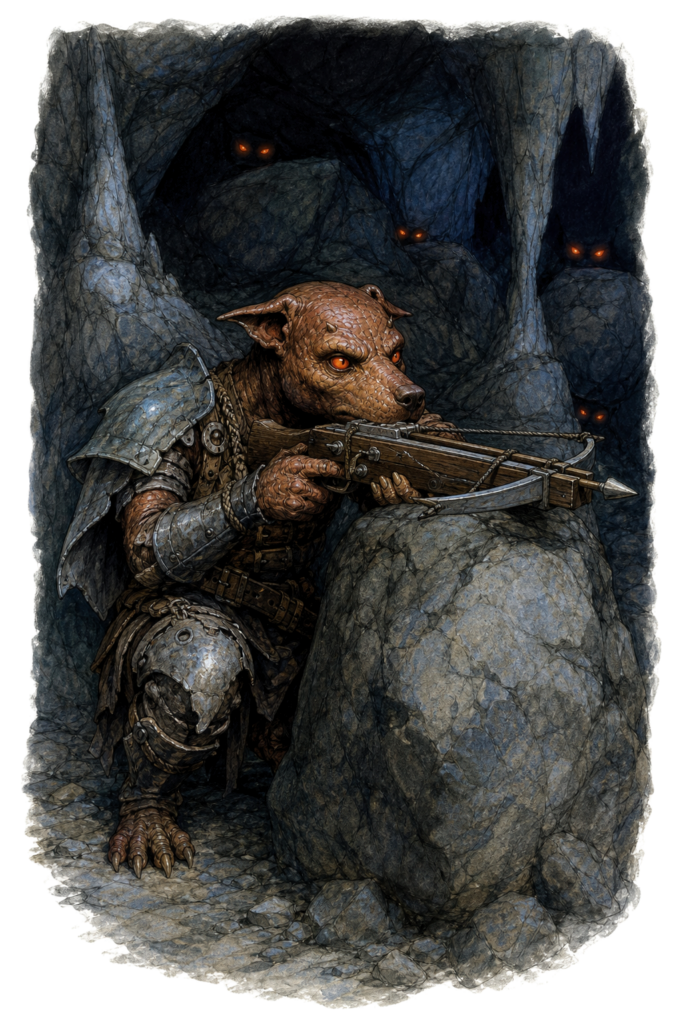
What a Kobold Is #
Kobolds are small, evil, doglike humanoids with scaly rust-brown skin and no hair. They live underground in clans of 10–60 members. They have 90 ft infravision and prefer to attack by ambush — almost always attacking by ambush if they have any choice. They are the weakest standard humanoid in the RC by individual stats, and they know it.
The –1 damage: Kobolds are too small and weak to wield weapons at full effectiveness. Every attack deals by weapon –1. A kobold with a short sword deals 1d6–1 (minimum 1). This is the kobold’s defining mechanical limitation — even with optimal weapons they underperform.
The gnome enmity: Kobolds hate gnomes and will attack them on sight. The gnomes say kobolds steal their gold; the kobolds presumably have their own version of events. The automatic attack applies regardless of other circumstances.
Regional distinction. Kobolds are found across the Known World’s cave systems, hills, and wilderness areas in sufficient variety that experienced dungeoneers learn to ask not just “are there kobolds?” but “what kind?” A clan that has been living in volcanic warrens for generations behaves differently from one occupying a conquered gnomish city. The common kobold described below is the baseline. The regional variants that follow are established populations with distinct territories, capabilities, and — in one case — a five-century history of learning from the most sophisticated small-humanoid engineering tradition in the Known World.
Core Statistics — Common Kobold #
| Stat | Value |
|---|---|
| Hit Dice | ½ d8 (1–4 HP) |
| AC | 13 |
| AV | 1 |
| HR | +0 (–1 damage on all attacks) |
| FR | +0 |
| FD | 8 |
| Move | 90 ft (30 ft encounter) |
| Attacks | 1 weapon: by weapon –1 |
| No. Appearing | 4d4 (1d6×10) |
| Save As | Normal Man (0 HD) |
| Morale | 6 (8 when chieftain is present and alive) |
| Treasure | (P) individual / J lair |
| Alignment | Chaotic |
| Intelligence | Average (INT 9) |
| XP | 5 |
| Terrain | Cavern, Hill, Mountain, Woods |
AC/AV Reasoning #
RC original is AC 7 (descending) = Ascending AC 13. Kobolds wear scavenged or crudely made armor.
- AC 13 — Small size (–4 to Large opponent’s HR), quick movement, and habitual use of cover and concealment. The kobold is not hard to kill if you can hit it; it works very hard to make sure you cannot hit it
- AV 1 — Light scavenged armor. The kobold’s real defense is not taking hits — it is staying behind cover and in ambush positions where it never gets hit at all
Skill Slots (1 total — ½ HD = 1 base; no asterisks; Average INT 9) #
| Slot | Skill | Notes |
|---|---|---|
| 1 | Ambush Preference (innate) | Kobolds prepare ambushes as a standard operating procedure. They do not fight in the open if they can avoid it. Their effective surprise rate in prepared ambush positions is 1–4 on d6 |
Martial Style #
Style: Reactive (Basic rank) — Ambush, ranged, retreat Rank: Basic
The kobold’s entire tactical philosophy flows from knowing it is individually weak. Reactive Basic with ambush preference means it waits for opponents to enter prepared kill zones, attacks from concealment, and retreats to another prepared position when the engagement becomes direct melee. A kobold that is fighting face-to-face with a Human Fighter has made a serious tactical error.
Preferred engagement: Crossbows or spears from cover at 30–60 ft range. The –1 damage penalty hurts less at range (spear still averages 2.5 per hit) and the Small size combined with cover makes the kobold genuinely hard to hit back.
The numbers game: 4d4 kobolds (up to 16) in an encounter means 16 simultaneous attacks each round. Against AC 14 (chain mail fighter), roughly 55% hit. Expected damage per round: 16 × 0.55 × 2.5 (avg spear –1) = approximately 22 HP/round from a full kobold attack wave. A party with AC protection survives the first round but individual kobolds die very quickly to almost any retaliation.
Leadership Hierarchy #
Common Kobold #
Standard statistics as above. 1–4 HP. Always in groups.
Bodyguard (1d6, in lair) #
| Stat | Value |
|---|---|
| Hit Points | Fixed 6 |
| Attacks as | 1+1 HD monster (HR +1) |
| Damage | By weapon –1 |
| Context | Kobold lair only |
Kobold Chieftain (1, in lair) #
| Stat | Value |
|---|---|
| Hit Points | Fixed 9 |
| Attacks as | 2 HD monster (HR +2) |
| Damage | By weapon –1 |
| Morale | 7 (own) |
| Presence | All kobolds within sight: Morale 8 |
The –1 damage penalty still applies even to the chieftain.
The Morale Aura #
The chieftain alive raises all kobolds within sight from Morale 6 to Morale 8.
- Morale 6 breaks on 2d6 roll of 7+ (58% per check) — kobolds without chieftain are essentially running from any serious combat
- Morale 8 breaks on 9+ (28% per check) — three times more reliable than without chieftain
The chieftain’s death triggers immediate checks across the entire force simultaneously. Killing it first is the correct tactical priority.
The Ambush Advantage #
Kobolds prepare ambushes as a standard operating procedure — this is not just preference, it is survival strategy.
Prepared ambush position:
- Kobolds pre-position in cover (behind boulders, in alcoves, in ceiling nooks)
- Crossbows loaded and aimed before the party enters the kill zone
- Surprise: 1–4 on d6 from a well-prepared ambush (kobolds’ Small size + silence + infravision in dark = excellent concealment)
- First round: full kobold force fires from concealment; party is surprised (no action)
The ambush counter: Alertness (detect preparation), infravision (party elf or dwarf sees heat signatures), prior knowledge (map shows kobold territory), or dimming light when entering known kobold territory.
Clan Structure #
10–60 members per clan — a community with non-combatant kobolds (young, elderly, craftsmen) mixed with fighters. Kobolds carve out cave systems appropriate to their Small size — passageways too narrow for Medium humanoids, 5–6 ft ceiling heights, extensive warren systems that give them terrain advantage in their own lair.
Traps: Kobolds set simple traps — deadfalls, covered pits, tripwires, and similar crude mechanical hazards — in approaches to their lair. Average INT (9) means they can design and execute basic trap systems effectively.
The Gnome Enmity #
Kobolds hate gnomes and will attack them on sight. Whatever started the gnome-kobold conflict — resource competition, historical territorial dispute, the specific events of 490 AC at Falun — the enmity is now instinctive and universal.
A party with a gnome member cannot diplomatically approach kobolds. Any negotiation attempt is impossible the moment the kobold identifies the gnome. The gnome must either stay behind, hide their identity, or accept that the encounter will be combat.
The Falun Caverns exception: Falun Caverns Kobolds (see below) have the most deeply embedded gnome enmity of any kobold population — they live in what was once the gnomish capital of their region and have spent five centuries fighting off gnome reclamation attempts. Their reaction to gnomes is not instinctive territorial aggression. It is institutional.
Regional Variants #
What follows are four established kobold populations beyond the common cave-dwelling baseline. The chieftain/bodyguard/morale-aura hierarchy is preserved across all variants. What differs is appearance, terrain specialization, trap sophistication, and in one remarkable case, an accumulated five centuries of gnomish engineering knowledge.
Stone Kobold (Canis Minor Petrus) #
Territory: Standard cave systems and hill-country warrens — the baseline population described above.
Appearance: Scaly rust-brown skin, no hair, small curved horns, eyes orange-red in the dark. Average height 3½–4 ft.
Statistics: As Common Kobold above, unmodified. This is the reference population.
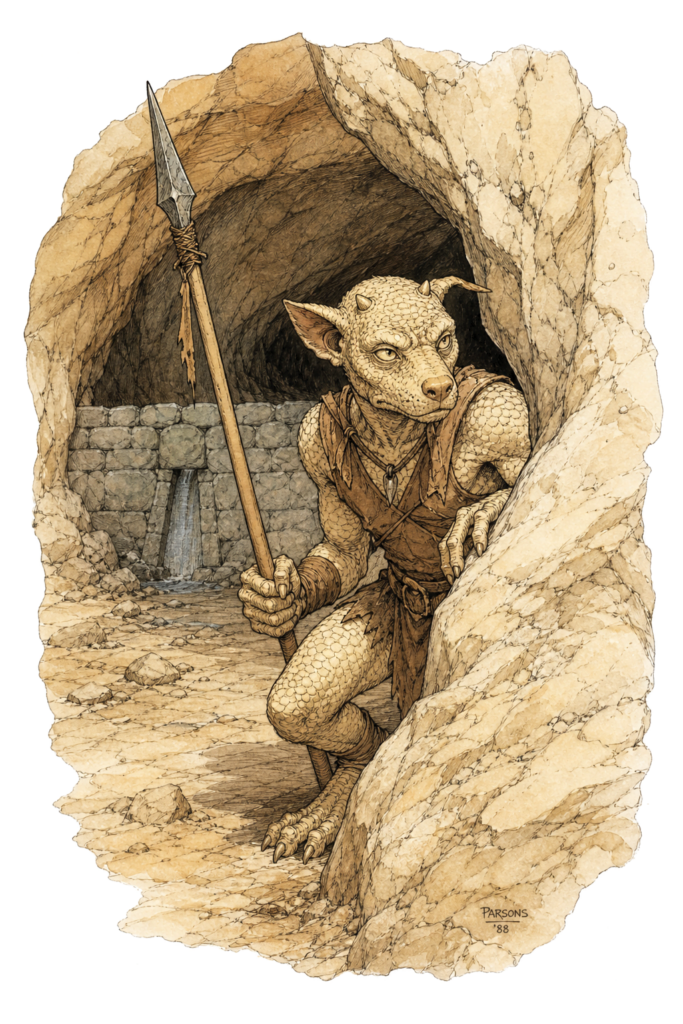
Sand Kobold (Canis Minor Aridus) #
Territory: Dry desert caves, sandstone canyon warrens, and the underground spaces beneath badland terrain.
Appearance: Pale sand-yellow to bleached ivory scales, eyes that are paler and more yellowish than the Stone Kobold’s orange-red. Thinner build, longer fingers. Average height 3½ ft, leaner than Stone Kobold.
Behavioral note: Sand Kobolds operate in environments where fresh water is as valuable as gold. Their trap vocabulary includes dehydration traps — blocked ventilation shafts, deadfall rocks that dam water channels, cached provisions that can be poisoned with desert-adapted toxins. They are ambush predators who have adapted their tradecraft to a terrain where survival itself requires planning.
Statistics: As Common Kobold, with the following changes:
| Stat | Value | Change from Common |
|---|---|---|
| AC | 14 | +1 (drier skin produces tighter scale-fit; less detectable profile against sandstone) |
| Move | 120 ft (40 ft encounter) | +30 ft (lean build, open terrain practice) |
| XP | 6 | +1 |
Additional skill — Slot 1 modified: Ambush Preference retains 1–4 surprise rate but also includes knowledge of terrain-based traps specifically adapted to desert/sandstone environments — blocking water sources, channeling prey into sun-exposed areas, deadfall in sandstone ceiling passages.
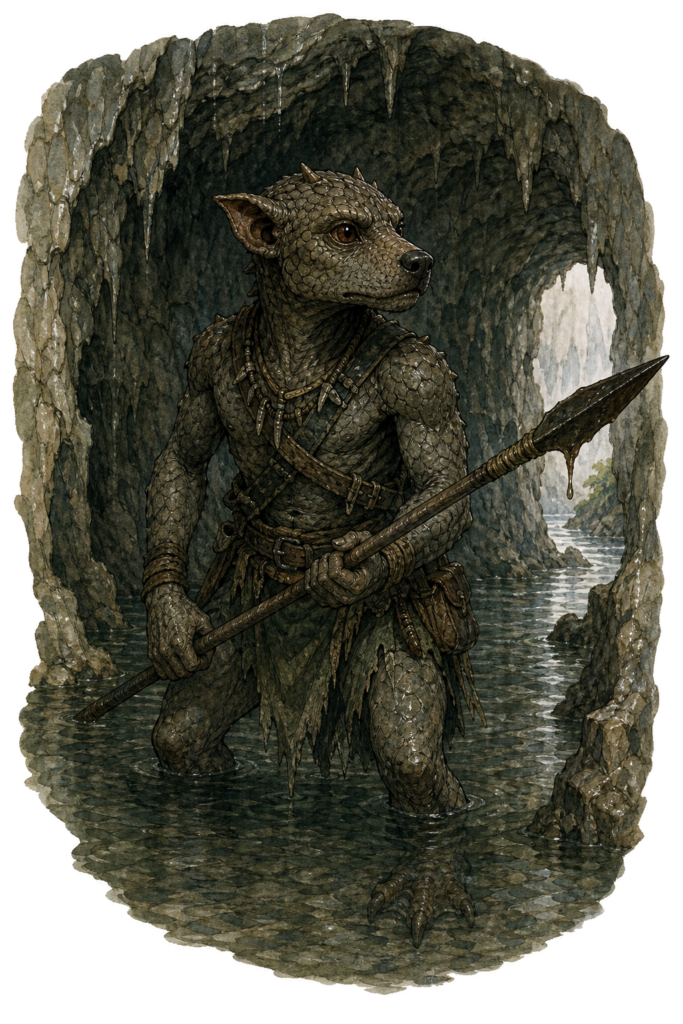
Swamp Kobold (Canis Minor Paludis) #
Territory: Underground spaces adjacent to swamp and marsh terrain — cave systems beneath wetland regions, flooded limestone cave networks.
Appearance: Dark grey-green scales with irregular mottling, partially webbed toes, eyes a deeper red-brown. Average height 3½ ft but stockier than the Stone Kobold baseline.
Behavioral note: Swamp Kobolds have developed the most extensive poison knowledge of any kobold population — wetland environments offer abundant toxic plant and animal resources, and five hundred years of accumulated herbalism has given Swamp Kobold clans a working pharmacopeia. Their traps incorporate natural toxins as standard operating procedure rather than as an occasional enhancement.
Statistics: As Common Kobold, with the following changes:
| Stat | Value | Change from Common |
|---|---|---|
| Move | 90 ft (30 ft) ground / 60 ft (20 ft) swimming | Added swim speed |
| Morale | 7 (9 with chieftain) | +1 (swamp territory confidence) |
| XP | 7 | +2 |
Additional skill — Slot 1 modified: Ambush Preference retains 1–4 surprise rate in swamp/cave terrain. Additionally: Poison Knowledge (Basic) — swamp kobold traps and weapons have a 1-in-6 chance of carrying a natural contact toxin (Save vs. Poison or –1 to all actions for 1d4 rounds; not lethal but compounds the ambush disadvantage for the party).
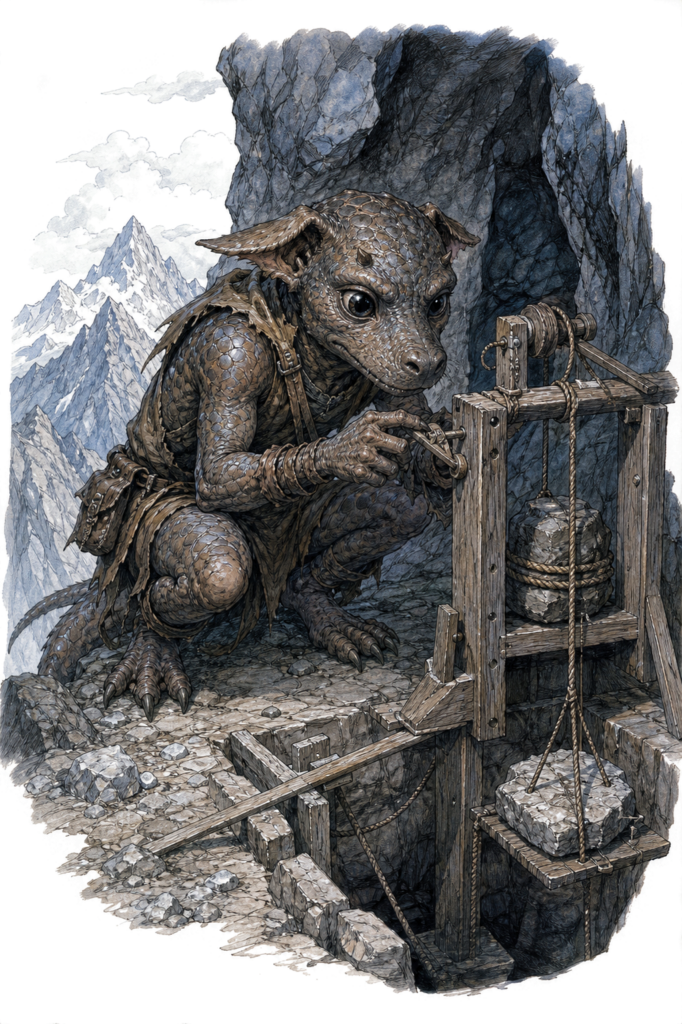
Highland Kobold (Canis Minor Montana) #
Territory: Mountain cave systems and high-altitude rock warrens, often in close proximity to (and active conflict with) gnome communities.
Appearance: Grey-brown scales with a slight blue-black tinge, heavier build than lowland kobolds adapted for cold and altitude, larger eyes for the dimmer high-altitude light. Average height 4 ft — the tallest of the common populations.
Behavioral note: Highland Kobolds occupy the same ecological niche as gnomes in mountainous regions, and the competition for cave resources with gnome communities keeps them in a state of active low-grade warfare. This proximity to gnome engineering — even as enemies — means Highland Kobolds have absorbed more gnomish problem-solving approach than the Stone or Sand populations. Their traps are meaningfully more sophisticated: multiple triggering mechanisms, false paths, reset traps that can be reused.
Statistics: As Common Kobold, with the following changes:
| Stat | Value | Change from Common |
|---|---|---|
| Hit Dice | ½ d8+1 (2–5 HP) | +1 HP (cold-hardy constitution) |
| INT | 10 (Average+) | +1 INT — proximity to gnome engineering has raised the baseline |
| XP | 6 | +1 |
Additional skill — Slot 1 modified: Ambush Preference retains 1–4 surprise rate. Additionally: Trap Sophistication (Basic) — Highland Kobold traps have two-stage triggering mechanisms; disarming requires two successful checks rather than one; reset mechanisms mean a triggered trap resets after 1d4 rounds unless the mechanism is destroyed.
Falun Caverns Kobold (Canis Minor Gnomifaber) #
Territory: The Falun Caverns — once the gnomish capital of the Northern Reaches region, conquered by kobold invaders in 490 AC. A kobold community of 200–300 individuals has occupied Falun ever since.
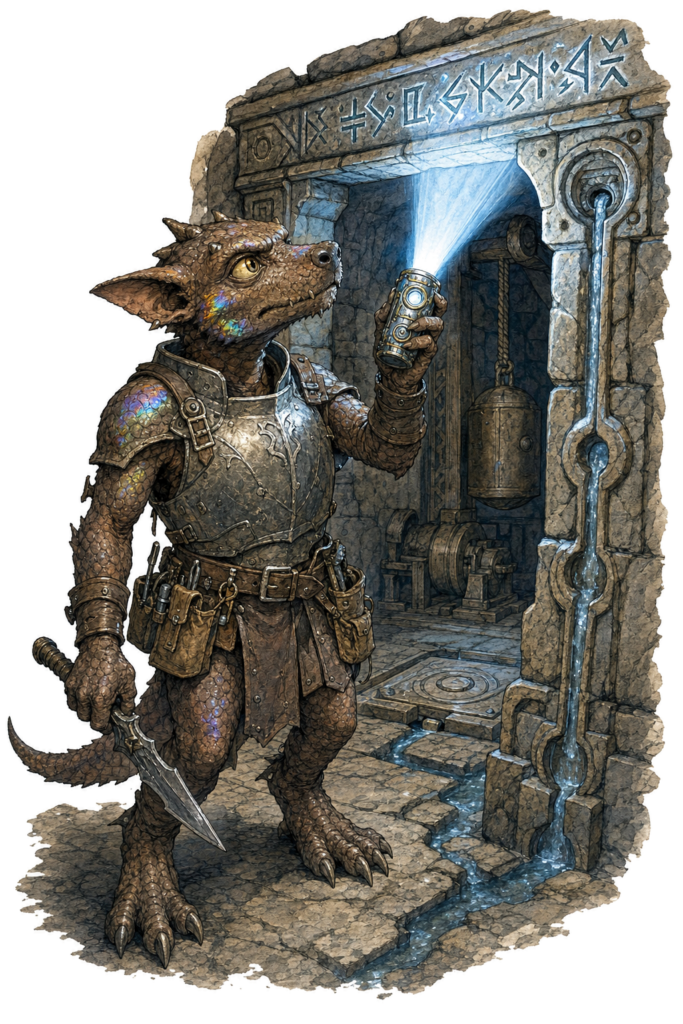
Appearance: Darker scales than Highland Kobolds — deep grey-brown with occasional iridescent patches where ancient gnomish bioluminescent residues have been absorbed into the skin over generations of contact. Their eyes are brighter and more alert than other kobold populations; something in five centuries of reading gnomish rune-script has selected for slightly larger pupils and better close-range focus. Average height 4 ft. Many wear scavenged gnomish equipment that they have partially repaired or adapted — not perfectly fitted, but functional. The most distinctive visual tell: Falun Caverns Kobolds almost always carry at least one piece of gnomish technology, even if they are not entirely sure how all of it works.
History: In 490 AC, a kobold force invaded and conquered the Falun Caverns, driving out the gnomish population. The original kobold invaders could not operate or extract gnomish artifacts — their technical knowledge was insufficient. The gnomish writing system (Auld Gnomish) remained unintelligible. The complex machines were dangerous puzzles. What they had were 200–300 gnomish-built structures, devices, tunnels, and accumulated knowledge systems that were slowly deciphering themselves to each successive generation of kobold inhabitants.
Five hundred years later, the Falun Caverns Kobolds have learned half of what the gnomes knew. Not all of it — some of the most sophisticated gnomish engineering remains genuinely beyond them, and certain areas of the caverns are taboo because the kobolds have determined (through fatal trial and error) that they do not know how to operate what is in those rooms. But they have learned enough to use the infrastructure, maintain the simpler devices, construct traps that incorporate gnomish principles, and recognize what gnomish artifacts are worth trading for.
They did not defeat a gnomish capital through brute force alone. They have been living in one long enough to become something no other kobold population is: a small, individually fragile creature that fights with its head.
Falun Caverns Kobold — Core Statistics #
| Stat | Value | Change from Common |
|---|---|---|
| Hit Dice | ½ d8+1 (2–5 HP) | +1 HP |
| AC | 14 | +1 (partially functional gnomish armor pieces; better-fitted equipment) |
| AV | 2 | +1 (gnomish-reinforced armor pieces provide actual absorption) |
| HR | +1 (–1 damage on attacks) | +1 HR / damage penalty unchanged |
| Move | 90 ft (30 ft) | Unchanged |
| INT | 12 (Average+) | +3 above Common — highest of any kobold population |
| Morale | 7 (9 with chieftain) | +1 base; +1 with chieftain |
| XP | 15 | +10 (significantly more capable) |
| Terrain | Falun Caverns specifically; any gnomish ruin |
Save As: Fighter 1 (rather than Normal Man — they fight better than common kobolds)
Falun Caverns Kobold — Skill Slots (3 total — ½ HD + INT 12 bonus slots) #
INT 12 provides additional skill development above the HD baseline — the Falun Caverns Kobold earns 3 slots where the Common Kobold earns 1.
| Slot | Skill | Notes |
|---|---|---|
| 1 | Gnomish Engineering (Basic — partial) | Can identify gnomish artifacts (70% accuracy); can operate simple gnomish devices (continual lights, basic mechanical locks, flowstone pumps, food processing equipment); cannot operate complex gnomish devices (alchemical processors, advanced automation, the most sophisticated mechanisms). This represents five centuries of accumulated practical knowledge, not formal training. |
| 2 | Trap Architecture (Skilled — gnomish principles applied) | Falun Caverns Kobold traps are qualitatively different from common kobold traps. They use gnomish mechanical principles: counterweights, flowstone channels as hydraulic triggers, false-floor mechanisms with gnomish load-sensing. Disarming requires: (a) recognizing the gnomish mechanism (INT check at –2 for anyone without gnomish engineering knowledge), then (b) two sequential successful Trap Disarm checks. False-path systems: 1-in-3 chance any apparent safe route is actually a false path designed to look like a party has bypassed a trap while actually entering a second one. Surprise element: 1-in-4 chance a disarmed trap contains a secondary mechanism the party did not identify. |
| 3 | Auld Gnomish (Partial literacy) | Can read approximately 40% of Auld Gnomish rune-script — enough to follow basic instructions, read map keys, and identify warning signs. Cannot read complex technical documentation or advanced engineering specifications. They can tell the party “DO NOT ENTER” from “SAFE PASSAGE” on gnomish signs, which is information other kobold populations definitively do not have. |
Falun Caverns Kobold — Leadership Hierarchy #
The leadership structure is preserved but enhanced:
Bodyguard (1d6, in lair):
| Stat | Value | Change from Common |
|---|---|---|
| Hit Points | Fixed 8 | +2 HP |
| Attacks as | 2 HD monster (HR +2) | +1 (gnomish weapons, better training) |
| Damage | By weapon (no –1 penalty) | Bodyguards have learned to use gnomish tools and weapons at proper effectiveness |
The Falun Caverns Chieftain:
| Stat | Value | Change from Common |
|---|---|---|
| Hit Points | Fixed 12 | +3 HP |
| Attacks as | 3 HD monster (HR +3) | +1 |
| Damage | By weapon (no –1 penalty) | Superior gnomish-origin weapon |
| INT | 14 | Can read 60% of Auld Gnomish; operates most simple gnomish devices |
| Morale | 8 (own) / 9 for those in sight | +1 above common chieftain |
| Special | Gnomish device operation (Expert) | Understands 60% of gnomish technology; can operate devices the common kobold cannot |
The Chieftain’s knowledge advantage: The chieftain has had access to accumulated clan records — generations of notes in crude kobold script describing what each gnomish device does, how to operate it, and what happens if you do it wrong. This oral and written tradition is the Falun Caverns Kobolds’ most valuable asset, more important than any individual device or weapon. The clan protects these records above all else.
Falun Caverns Kobold — What They Can Do #
With gnomish infrastructure:
- Operate continual lights (turning on/off, directing them as ambush lighting)
- Use flowstone channels as hydraulic trap mechanisms (pressure plates that open water channels, flooding specific corridors on a trigger)
- Maintain the beetle ranches (providing consistent food supply — superior nutrition to other kobold populations contributes marginally to the +1 HP)
- Navigate the Falun Caverns map with genuine understanding of the layout, including areas the party cannot easily map
Traps specific to Falun Caverns:
- Hydraulic pit: Gnomish flowstone channel redirected to fill a false floor section with water from below — the floor is solid, then 3 feet of water in 1 round
- Counterweight gate: Gnomish counterweight mechanism repurposed as a portcullis — drops on a pressure-plate trigger; weighs 400 lbs; requires STR 18 to lift manually
- Light trap: Continual lights positioned behind a concealment screen — triggered to blind the corridor when the party reaches a specific point; surprise for the kobolds positioned in the suddenly dark area behind the party
- False map: A convincingly gnomish-looking map left where the party will find it; 40% of it is accurate (the parts the kobolds understand); the rest leads the party into prepared kill zones
What they cannot do:
- Operate alchemical processors or advanced gnomish machinery
- Read complex technical gnomish documentation
- Reproduce gnomish engineering from scratch (they maintain and adapt what exists; they cannot build new gnomish systems)
- Access the taboo sections of the Falun Caverns — areas where the kobolds’ trial-and-error experimentation resulted in sufficient casualties that those areas were declared off-limits generations ago
The taboo sections: These are noted on the kobold clan’s internal maps with a specific marking that translates roughly as “kills us.” Some of these sections contain the most sophisticated gnomish engineering in the caverns. Some contain things that the gnomes themselves considered dangerous and contained deliberately. The kobolds do not know which is which, because both kinds kill kobolds who enter. The party may fare differently.
Falun Caverns Kobold — Encounter Notes Specific to This Population #
The first encounter: A party entering the Falun Caverns finds the gnomish infrastructure partially operational — some continual lights still function, some are dark, flowstone channels carry water in expected directions but not all of them. The kobold ambush positions are in gnomish alcoves designed for something else (equipment storage, meeting spaces) that have been repurposed into excellent firing positions. The ambush rate is still 1–4 on d6, but the sophistication of the position is immediately apparent to any character with Architecture or Gnomish Engineering knowledge.
The trap gauntlet: The approach to the chieftain’s chamber runs through three gnomish-derived trap mechanisms. Each requires both identifying the gnomish mechanism and disarming it. A party with gnomish technical knowledge moves through faster and with fewer casualties. A party without it is moving through traps they cannot fully understand.
The chieftain’s negotiation: A Falun Caverns chieftain with INT 14 can negotiate. It speaks enough Common to communicate basic terms, can read a written agreement, and is capable of evaluating whether a deal is worth making. It will not make a deal that involves gnomes, gnomish artifacts leaving the caverns, or any acknowledgment that the kobolds’ ownership of Falun is illegitimate. Within those constraints, it is the most diplomatically accessible kobold population in the Known World.
The gnome reclamation context: If the party includes or is allied with gnomes seeking to reclaim the Falun Caverns, the Falun Caverns Kobolds treat this as an existential threat and fight accordingly. The chieftain’s first action against a gnome-allied party is to activate every gnomish device it knows how to operate, flood the kobold-controlled corridors, and fall back to the taboo-zone border — using the kobold knowledge advantage of the terrain to its maximum before direct combat.
The gnomish records: The kobold clan records are in a specific chamber — crude kobold script on flowstone tablets, describing five centuries of interaction with gnomish devices. To a gnomish scholar or a party with research objectives, these records are potentially more valuable than any artifact in the caverns. They document what the gnomes built from the perspective of creatures who have been living with it, failing to operate it, accidentally triggering it, and occasionally figuring it out — for five hundred years.
Regional Variant Summary Table #
| Variant | HD | AC | AV | INT | Move | Morale | XP | Key Trait |
|---|---|---|---|---|---|---|---|---|
| Stone (common) | ½d8 | 13 | 1 | 9 | 90 ft | 6 (8) | 5 | Baseline |
| Sand | ½d8 | 14 | 1 | 9 | 120 ft | 6 (8) | 6 | Speed; desert traps |
| Swamp | ½d8 | 13 | 1 | 9 | 90/60 ft (swim) | 7 (9) | 7 | Poison traps; swimming |
| Highland | ½d8+1 | 13 | 1 | 10 | 90 ft | 6 (8) | 6 | Sophisticated traps; gnome-proximity INT bump |
| Falun Caverns | ½d8+1 | 14 | 2 | 12 | 90 ft | 7 (9) | 15 | Gnomish engineering; trap architecture; partial literacy |
Encounter Notes — Common to All Populations #
The numbered encounter: 4d4 kobolds (up to 16) on an encounter roll. A raiding or hunting party away from their lair — less organized than a lair defense, without the chieftain. Morale 6 means they disengage quickly if the party shows force. In the open, the party’s larger size and weapon reach matter; in a warren, the kobolds have the size and infravision advantage.
The lair: 1d6×10 kobolds (up to 60) in their cave complex, with chieftain and bodyguard. The warren has multiple ambush points, traps at the entrance, and passages too tight for humans to move at full speed.
The attrition fight: 60 kobolds represent 150 HP of potential damage at 2.5 avg each — more than enough to kill a mid-level party through attrition if the party cannot clear the lair efficiently. The ambush advantage + warren terrain + numbers is what makes kobold lairs genuinely dangerous despite individual fragility.
CR justification:
| Rank | CR | Notes |
|---|---|---|
| Common kobold (Stone, Sand, Highland) | 1 | Trivial alone; dangerous in large numbers |
| Swamp kobold | 1 | Poison trap adds meaningful complication |
| Falun Caverns kobold | 2 | Significantly more capable individually; trap sophistication elevates lair CR |
| Chieftain (any variant) | 2 | Fixed HP + HR + morale aura |
| Falun Caverns chieftain | 3 | INT 14 + gnomish device operation + no damage penalty |
| Falun Caverns lair (full) | 5–7 | Gnomish infrastructure as tactical environment elevates total encounter CR |


