Bigger than a goblin. Meaner than a goblin. No daylight penalty. They are not in their cave because they prefer it — they are in their cave because it is theirs.
What a Hobgoblin Is #
Hobgoblins are relatives of goblins but larger, stronger, and more aggressive. Unlike their goblin cousins, they suffer no penalty in daylight — they operate equally effectively underground and outdoors. They live in caves and dungeons but hunt in rough wilderness, making them more dangerous as surface encounters than goblins.
The comparison to goblins:
| Property | Goblin | Hobgoblin |
|---|---|---|
| HD | 1–1 | 1+1 |
| AC | 14 | 14 |
| AV | 1 | 2 |
| Daylight | –1 HR | No penalty |
| Intelligence | Average (9) | Average (10) |
| Morale base | 7 | 8 |
| Leader | King (15 HP, 3 HD attacks) | King (22 HP, 5 HD attacks) |
| Lair number | 6d10 | 4d6 |
Hobgoblins are the upgraded goblinoid — same basic chassis, better stats, no exploitable weakness.
Regional distinction. Hobgoblin populations have diverged across the Known World in the same fashion as orcs and goblins — diet, climate, and territorial pressure have produced distinct populations with visible differences in build, temperament, and capability. The common hobgoblin described below is the baseline. The regional variants that follow represent established populations with their own territories.
Core Statistics — Common Hobgoblin #
| Stat | Value |
|---|---|
| Hit Dice | 1d8+1 (avg 5 HP) |
| AC | 14 |
| AV | 2 (melee) / 1 (missile) |
| HR | +2 |
| FR | +2 |
| FD | 12 |
| Move | 90 ft (30 ft encounter) |
| Attacks | 1 weapon: by weapon |
| No. Appearing | 1d6 (4d6) |
| Save As | Fighter 1 |
| Morale | 8 (10 when king is present and alive) |
| Treasure | (Q) individual / D lair |
| Alignment | Chaotic |
| Intelligence | Average (INT 10) |
| XP | 15 |
| Terrain | Cavern, Hill, Mountain, Woods |
AC/AV Reasoning #
RC original is AC 6 (descending) = Ascending AC 14. Hobgoblins wear whatever armor they have — typically scavenged or crafted leather and chain pieces, better equipped than goblins on average.
- AC 14 — The goblin’s AC reflects Small size and quickness; the hobgoblin’s reflects actual armor worn and a larger, more combat-capable body
- AV 2 — Meaningfully better than the goblin’s AV 1. More consistent scavenged armor, better crafted equipment, or natural toughness from the larger body frame
Skill Slots (2 total — 1+1 HD = 2 base; no asterisks; Average INT 10) #
| Slot | Skill | Notes |
|---|---|---|
| 1 | HR Investment (Basic) | HR +2 |
| 2 | Wilderness Hunting (Basic) | No penalties in daylight or outdoor terrain. Hobgoblins range across rugged wilderness effectively — they know how to hunt on the surface as well as underground |
Martial Style #
Style: Hard (Basic rank) Rank: Basic
Hobgoblins fight straightforwardly — they hit things. No subtlety, no tactical sophistication at the common rank, but no exploitable weaknesses either. Hard Basic means they commit fully to attacks, do not hold back, and do not surrender easily.
The no-daylight-penalty distinction: A hobgoblin raiding party in daylight is at full effectiveness. They can mount coordinated daytime assaults on settlements and caravans without the defensive window that daylight provides against goblins or orcs.
Leadership Hierarchy #
Common Hobgoblin #
Standard statistics as above.
Bodyguard (1d4, in lair only) #
| Stat | Value |
|---|---|
| Hit Points | 3d6 each (avg 10.5; range 3–18) |
| Attacks as | 4 HD monster (HR +4) |
| Damage | By weapon |
Thoul bodyguard option: A hobgoblin king might have one or more thouls in his bodyguard — a magical crossbreed of hobgoblin, ghoul, and troll combining paralysis touch, regeneration, and full undead immunities. See Thoul for full statistics.
Hobgoblin King (1, in lair only) #
| Stat | Value |
|---|---|
| Hit Points | Fixed 22 |
| Attacks as | 5 HD monster (HR +5) |
| Damage | By weapon +2 |
| Morale | 9 (own) |
| Presence | All hobgoblins within sight: Morale 10 |
The Morale Aura #
As long as their king is alive and with them, hobgoblin morale is 10 rather than 8.
- Morale 8 breaks on 2d6 roll of 9+ (28% per check)
- Morale 10 breaks on 11+ (8% per check) — the king’s presence triples the difficulty of breaking the force
When the king falls: immediate reversion to Morale 8 and simultaneous checks across the entire force.
Surface and Dungeon Operations #
Hobgoblins live underground in caves and dungeons but often hunt outdoors in rough, rugged wasteland and wilderness, having no penalties in daylight.
Terrain capability: Hobgoblins operate effectively across underground caves, hill terrain, mountain wilderness, and forested hills. No-penalty outdoor operations combined with the wider terrain range makes hobgoblins more dangerous as wilderness encounters than goblins or orcs in varied terrain.
Regional Variants #
What follows are four established hobgoblin populations, each adapted to distinct territory and circumstance. The king/bodyguard/morale-aura hierarchy is preserved across all variants.
Common Hobgoblin (Goblinus Ferox Communis) #
Territory: The baseline population found throughout Known World cave systems and hill country.
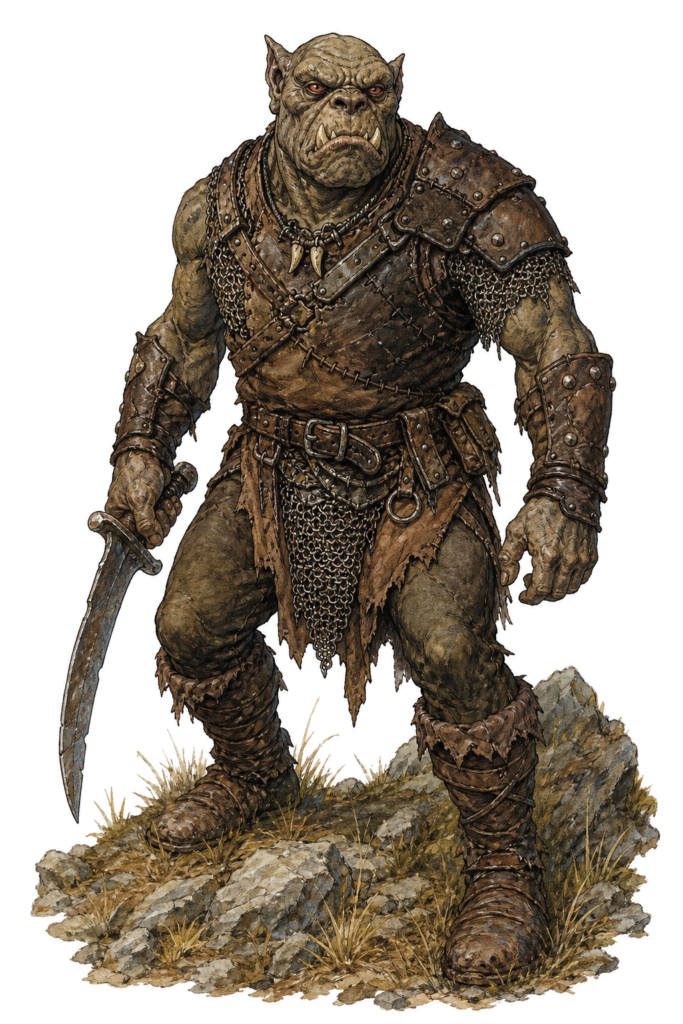
Appearance: The bulldog or toad-faced appearance that most people picture when they hear “hobgoblin” — squinted red eyes, heavy jaw, projecting lower teeth. Skin tones vary widely. Average height 6 ft + 1d12 inches.
Statistics: As Common Hobgoblin above, unmodified.
Steppe Hobgoblin (Goblinus Oriensis) #
Territory: The Ethengar steppes and the nomadic corridors of the eastern Known World.
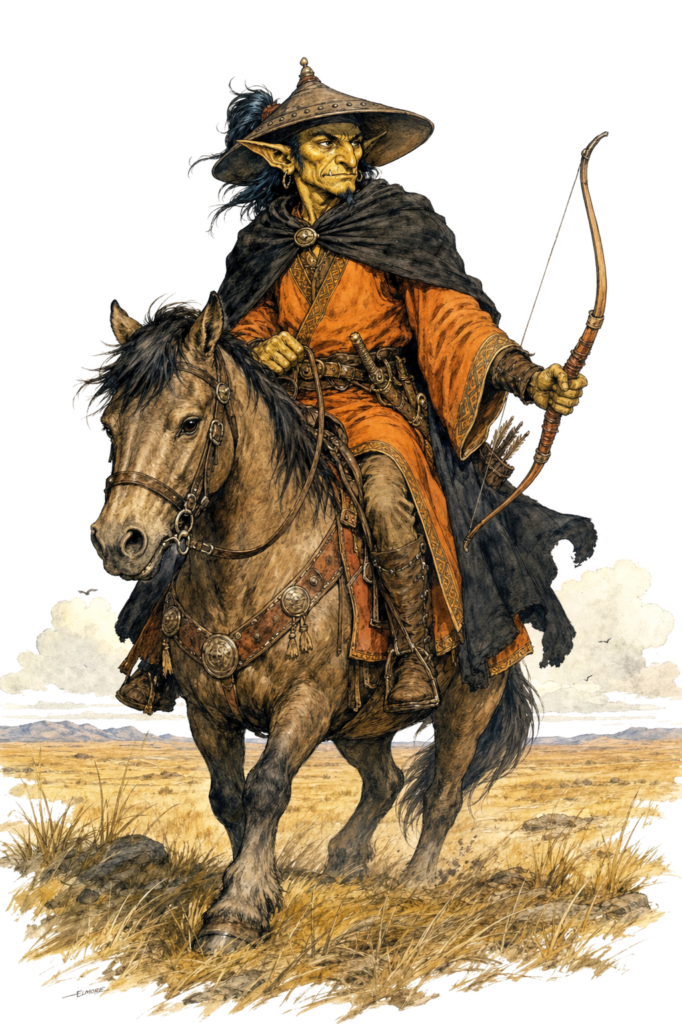
Appearance: Yellow skin. Hair usually bluish-black, tied in the back. Often wear rags dyed in bright orange, black cloaks, and large, round, slightly conical hats. Ethengar-nomad aesthetic throughout — they have adapted not just biologically but culturally to the steppe nomad way of life surrounding them.
Behavioral note: Steppe Hobgoblins are the only major hobgoblin population with a fully nomadic lifestyle — no fixed cave systems, no permanent lair in the conventional sense. They range with the same seasonal patterns as the Ethengar human nomads of the region, and the two populations have been in sufficient contact that Steppe Hobgoblins have adopted steppe horse culture to a degree unusual for hobgoblins. They are mounted fighters, not dungeon-dwellers.
Statistics: As Common Hobgoblin, with the following changes:
| Stat | Value | Change from Common |
|---|---|---|
| Move | 120 ft (40 ft encounter) | +30 ft (steppe-adapted physique) |
| Treasure | (Q) individual only | No fixed lair treasure — nomadic |
| XP | 18 | +3 (speed + mounted capability) |
Additional skill — Slot 2 modified: Mounted Combat (Basic) — 60% of Steppe Hobgoblins encountered outdoors are mounted on steppe horses; mounted individuals use mount’s movement; +1 HR on first charge round. No fixed lair — camp of 4d6 hobgoblins relocates every 1d6 days.
Desert Hobgoblin (Goblinus Fortis) #
Territory: Desert and warm arid regions — the Sind desert fringe and similar hot-climate territories.
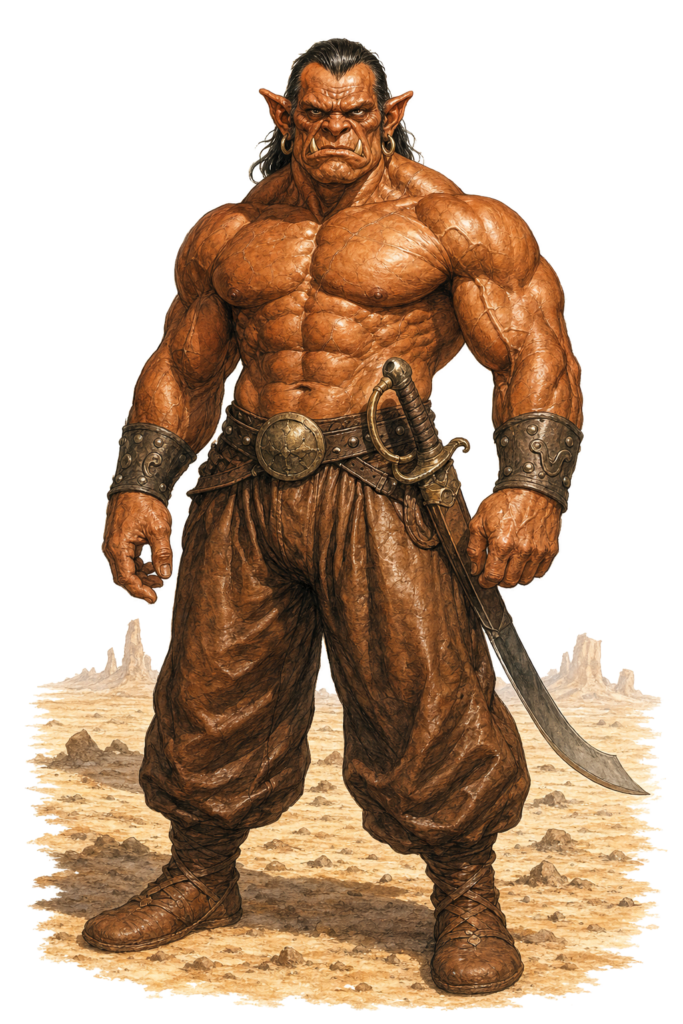
Appearance: Copper skin, very muscular, bulldog-faced. A distinctive behavioral marker: they regularly slick their hair back using goat or camel butter, which has a recognizable smell and keeps the fur matted and neat. Torso often remains bare or with minimal covering; wear puffy pants made of rags or leather, and a scimitar. Well-adapted to desert heat.
Behavioral note: Desert Hobgoblins are the physically strongest of the regional populations — the harsh desert environment has selected for exceptional constitution and raw strength. They are direct fighters rather than tactical ones, relying on physical dominance. Their desert adaptation includes heat resistance and the ability to operate during the hottest parts of the day when other creatures are avoiding activity — reversing the usual nocturnal advantage.
Statistics: As Common Hobgoblin, with the following changes:
| Stat | Value | Change from Common |
|---|---|---|
| Hit Dice | 1d8+2 (avg 7 HP) | +2 HP (exceptional constitution) |
| HR | +3 | +1 (greater raw strength) |
| FR | +3 | +1 |
| XP | 22 | +7 |
Additional skill — Slot 2 modified: Heat Endurance (Basic) — immune to non-magical heat exhaustion; +2 to saves vs. fire-based effects in their home territory; can operate in full midday desert heat without penalties that would affect other humanoids. Wilderness Hunting still applies but is desert-terrain specific.
Northern Hobgoblin (Goblinus Hyborianus) #
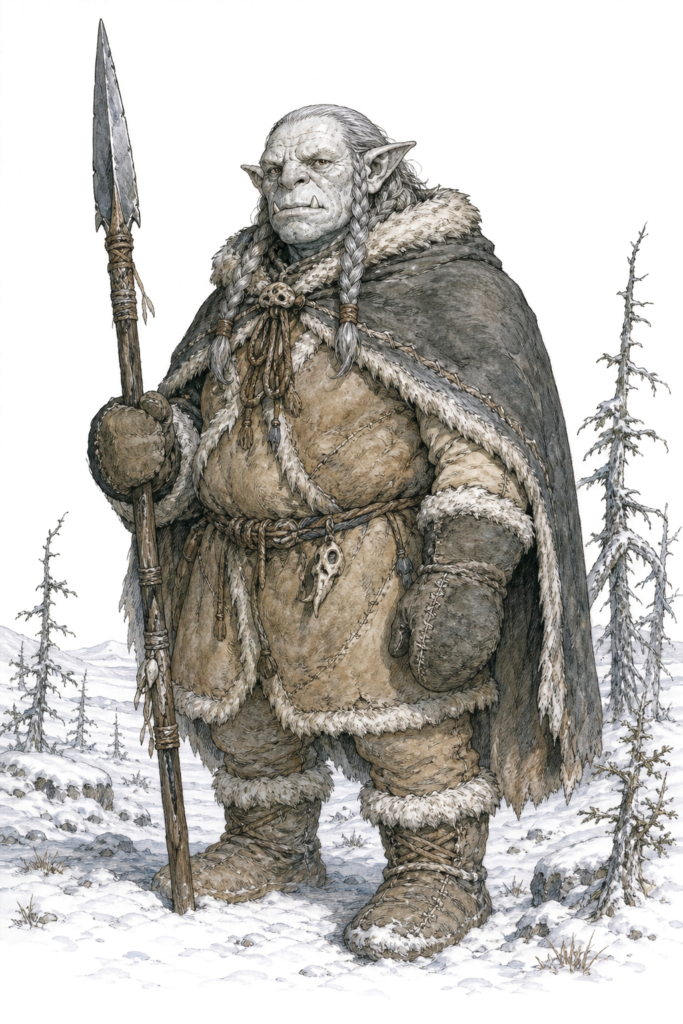
Territory: Hyboria and polar regions — the extreme northern territories.
Appearance: Dead white skin with flat-grey braided hair. Often wear reindeer skin coveralls with seal skin cloaks and mittens. Live in Hyboria and most polar regions. Built for cold survival — heavier and stockier than common hobgoblins.
Behavioral note: Northern Hobgoblins operate in a climate where survival itself requires planning and cooperation. They are less aggressive in the random-encounter sense than other hobgoblin populations — picking fights in sub-arctic conditions with creatures that might damage you before you can return to shelter is a poor survival strategy. They are deliberate, patient, and more willing to negotiate passage or temporary coexistence than other hobgoblins when the alternative is a fight they might not fully win before dark falls.
Statistics: As Common Hobgoblin, with the following changes:
| Stat | Value | Change from Common |
|---|---|---|
| Hit Dice | 1d8+1 (avg 6 HP) | +1 HP (cold-hardy build) |
| Morale | 7 (9 when king present) | –1 base (deliberate rather than aggressive) |
| XP | 17 | +2 |
Additional skill — Slot 2 modified: Cold Endurance (Basic) — immune to non-magical cold exhaustion; +2 to saves vs. cold-based effects; functions normally in sub-arctic conditions that impose penalties on unacclimatized creatures.
Dark Hobgoblin (Goblinus Grandis) #
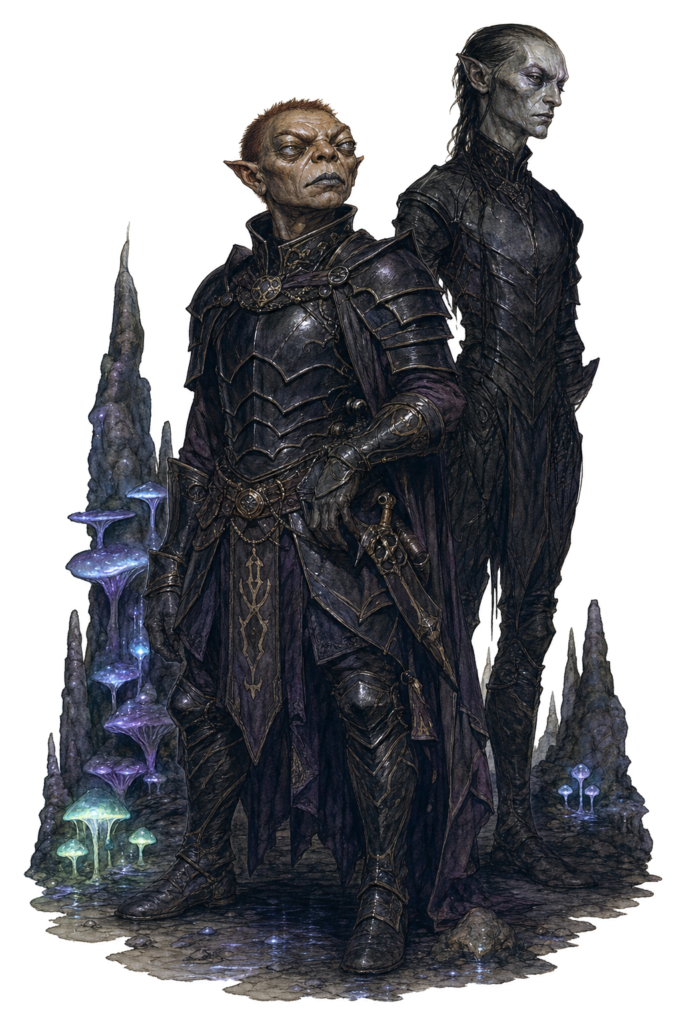
Territory: The deepest Known World cave systems and the Hobgobland region — the most underground-adapted population.
Appearance: Light tan skin, very short rusty-brown or black hair. Toad-faced, with lips often grey or black and protruding eyes. Often wear various pieces and styles of armor, favoring dark, gloomy colors. Found anywhere in the Known World and Hobgobland (Broken Lands).
Behavioral note: The Goblinus Grandis has been underground long enough and consistently enough that it has developed enhanced infravision and superior underground tactical awareness compared to other hobgoblin populations. It is the most dungeon-capable of the regional populations, functioning in complete darkness with a confidence that surface hobgoblins cannot match. It is also the most likely to have thouls in its king’s bodyguard — the underground environment that sustains thouls is their natural habitat as well.
Statistics: As Common Hobgoblin, with the following changes:
| Stat | Value | Change from Common |
|---|---|---|
| AC | 15 | +1 (more consistently armored from underground trade) |
| AV | 3 | +1 (heavier and better-fitted armor) |
| XP | 20 | +5 |
Additional skill — Slot 2 modified: Underground Dominance (Basic) — in cave/dungeon environments: +2 to surprise rolls; –1 to opponents’ surprise rolls (underground terrain advantage); infravision extends to 120 ft (rather than standard 60 ft). Thoul bodyguard probability: 1-in-4 chance (rather than optional) that at least one bodyguard is a thoul.
Regional Variant Summary Table #
| Variant | HD | AC | AV | Move | Morale | XP | Key Trait |
|---|---|---|---|---|---|---|---|
| Common (Ferox Communis) | 1d8+1 | 14 | 2/1 | 90 ft | 8 (10) | 15 | Baseline |
| Steppe (Oriensis) | 1d8+1 | 14 | 2/1 | 120 ft | 8 (10) | 18 | Nomadic; mounted; no fixed lair |
| Desert (Fortis) | 1d8+2 | 14 | 2/1 | 90 ft | 8 (10) | 22 | Strongest; heat endurance |
| Northern (Hyborianus) | 1d8+1 | 14 | 2/1 | 90 ft | 7 (9) | 17 | Cold endurance; deliberate |
| Dark (Grandis) | 1d8+1 | 15 | 3/1 | 90 ft | 8 (10) | 20 | Underground dominance; thoul affinity |
Encounter Notes #
The surface warband: 1d6 hobgoblins hunting in rough hill terrain. Daylight. Full effectiveness. Morale 8 means they are not suicidal — if the party looks too strong, they pull back. Average INT (10) means they can estimate odds reasonably.
The lair: 4d6 hobgoblins (up to 24) in a cave complex. The king (22 HP, attacks as 5 HD, +2 damage) has 1d4 bodyguards including possibly thouls. With the king alive, all 24 hobgoblins hold at Morale 10. Killing the king collapses Morale to 8 and triggers immediate checks — potentially breaking half the force on the same round.
The thoul bodyguard reveal: The party fights through to the king’s chamber. The bodyguard includes what appears to be two hobgoblins with slightly wrong proportions and an odd smell. When the party’s fighter hits one with a sword, it regenerates 3 HP the next round. The Cleric’s healing touch activates the thoul’s paralysis — Save vs. Paralysis. The party realizes the bodyguard is not entirely hobgoblin.
CR summary:
| Rank | CR | Notes |
|---|---|---|
| Common hobgoblin (any variant) | 2 | 1+1 HD base |
| Desert (Fortis) | 3 | +2 HP, +1 HR, +1 FR |
| Dark (Grandis) | 3 | Better armor + underground dominance + thoul affinity |
| Bodyguard | 3 | 4 HD attacks, variable HP |
| King (any variant) | 4 | 5 HD attacks; +2 damage; morale aura |


