You are afraid of what they are. They find this exhausting. Death is not the opposite of life. It is the other half of the same thing. They have known this since before your civilization learned to write it down. They are still waiting for you to catch up.
Who the Kha Are #
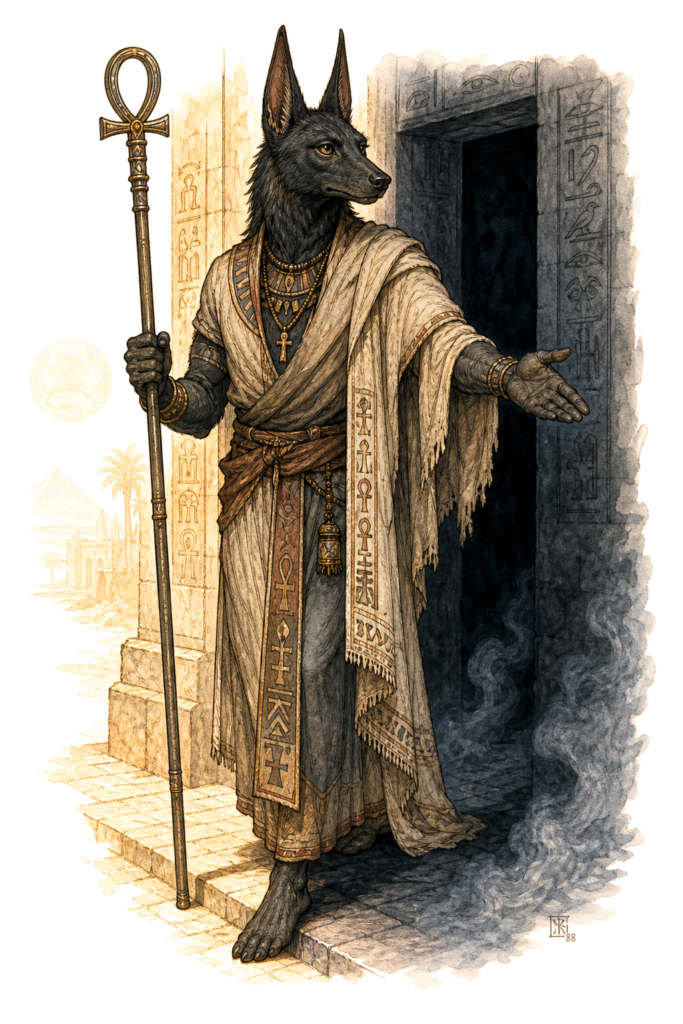
The Kha are a jackal-headed humanoid race native to Thothia, serving as psychopomps, guides between the living and dead, interpreters of the spirit paths, and practitioners of a magical tradition that encompasses healing, transformation, death, and undeath as four expressions of a single continuous process.
They were not always a true-breeding race. The earliest Kha were magical constructs — purpose-built psychopomps created by Nithian binders alongside the ushabti, designed to serve a different function in the afterlife bureaucracy. Where the ushabti answered for the dead, the Kha guided them. Where the ushabti maintained the physical tomb, the Kha maintained the threshold between what the tomb contained and where it was going.
Somewhere in the Nithian period, the Kha construct-line crossed a threshold the ushabti have not — they began reproducing. Not through binding magic, not through Cleric-scribe inscription, but biologically, with all the genetic variation and inherited differences that biological reproduction produces. By the time the Nithian Empire fell, the Kha were no longer constructs with an operational mandate. They were a people.
The Hutaaka connection: The Hutaaka of the western territories — Karameikos, the Lost Valley — are the Kha’s distant cousins. Both descend from the same Nithian construct-line, shaped by the same divine influence of the Immortal Pflarr. But the lineages diverged thousands of years ago under entirely different conditions. The Hutaaka went west, became secretive, insular, and proud, and maintained their original character as magical scholars and priests of hidden knowledge. The Kha stayed in Thothia, integrated into an active death-culture, and became something the Hutaaka would find both familiar and deeply strange.
The Kha know about the Hutaaka. They think of them the way one thinks of a sibling who moved away young and developed entirely differently: recognizable, genetically connected, not quite the same species in any way that matters.
Physical Description #
Kha stand between 5 and 6 feet tall, lean-framed, with the narrow build of something designed for endurance over strength. Their heads are fully jackal — elongated muzzle, tall pointed ears with excellent directional range, amber or gold eyes with slit pupils that adjust across a wider light range than human eyes. Their hands are four-fingered with blunt nails, functional for tool use and gesture-based magical practice.
Fur coloration: Ranges from pale desert sand to deep black, often with lighter undersides and darker facial markings. The darker Kha tend toward roles in active death-work (the association between black jackal coloration and Anubis-equivalent functions is not an accident — it was shaped by Nithian binders who had opinions about livery). The sandier Kha tend toward healing and life-work roles. This correlation is cultural, not deterministic — there are black-furred healers and sand-colored death-guides, and the Kha find the mortal tendency to sort by coat color both amusing and slightly insulting.
The death-scent: Kha carry a faint chemical signature that mortal creatures detect unconsciously — something between incense and cold stone. It is not unpleasant, but it produces a subliminal awareness of mortality in humans and demihumans who spend extended time near Kha. The Kha are aware of this effect. They consider it not their problem.
Spirit-sight markings: Kha who have achieved the rank of Walker (see Castes below) develop faint luminescent markings along their muzzle and brow — visible only in darkness, pale blue-white, the color of moonlight on water. These are not applied cosmetically. They develop naturally as a consequence of extensive spirit-path work, like the calluses of a craft.
Origins — The Divergence from Hutaaka #
The Nithian construct-line that produced both the Kha and the Hutaaka was shaped by Pflarr — an Immortal whose portfolio encompasses magic, knowledge, and the careful management of power. The original constructs were servants and agents of a divine plan that the Immortal has never fully explained to either descendant species.
What the Hutaaka kept: The Hutaaka retained strong arcane and divine magical aptitude, the instinct for secrecy and institutional preservation, and Pflarr’s blessing in the form of exceptional magical talent and extended lifespan.
What the Kha developed: The eastern Nithian construct-line was stationed at the thresholds — the places where the living world met the mortuary infrastructure of the Nithian Empire. Constant exposure to the mechanics of death, the passage of souls, and the binding magic that managed the transition from life to afterlife shaped the construct-line differently. When this line began breeding true, the biological inheritance included the death-sense, the spirit-path navigation, and the life/death manipulation magic that are now the Kha’s defining characteristics.
Pflarr’s position on the Kha: Ambiguous and characteristic. Pflarr does not overtly claim the Kha as his creations — they diverged too far from the original intent. But he has not abandoned them either. Kha clerics receive divine power from Pflarr. Whether Pflarr views this as obligation, investment, or simple acknowledgment of what they have become, only Pflarr knows, and Pflarr does not explain himself to either branch of his descendant peoples.
The Life-Death Continuum — Kha Philosophy #
The Kha do not have separate concepts for healing magic and death magic. They have one concept: Sahu — the movement of vital force through its proper cycle. Healing is Sahu moving toward life. Death is Sahu completing a circuit. Undead are Sahu interrupted — not evil by nature, simply stuck at a point in the cycle they should have moved through.
This philosophy produces a magical tradition that other cultures find deeply unsettling.
A Kha healer applies the same theoretical framework to healing as to death — they are manipulating the same force in the same way. The distinction between Cure Light Wounds and Cause Light Wounds is directional, not categorical. A Kha healer is not more specialized in one than the other; they understand both as the same competency applied in different directions.
A Kha psychopomp does not fear or avoid the newly dead. They approach death the way a ferryman approaches the river — it is their professional environment. The newly dead are clients who need guidance, not horror to be driven away.
A Kha necromancer (in the Kha tradition, the term is Sahu-wer, the Great Mover) is not primarily interested in creating armies of undead. They are interested in the mechanics of interrupted Sahu — why did the vital force not complete its circuit? What is holding it? Can it be unstuck? The Sahu-wer practitioners approach undead the same way a physician approaches disease — not with horror, but with professional curiosity about what went wrong and whether it can be corrected.
What the Kha think of other races’ attitudes toward death: They find it exhausting. Every generation, in every culture that interacts with the Kha, the same conversations: the flinching from the death-scent, the discomfort when the Kha speak of recent deaths with clinical calm, the horror when a Kha healer mentions that they could just as easily have gone the other direction. The Kha are polite about this, mostly. They have learned to manage their natural candor around mortals who have not made peace with what is, in the end, the most universal experience available.
Castes and Roles #
The Kha have three primary social roles, broadly correspondent to their magical specialization. These are not rigid castes — Kha move between roles across their lives — but they provide the social structure of Kha communities.
The Rekhet — Healers #
“The force moves toward life. We guide it.”
The Rekhet are the Kha’s most visible face to the outside world. They practice life-oriented Sahu manipulation — healing, restoration, cure of disease and poison, and the management of biological processes. They are skilled physicians in both the magical and mundane sense; the Kha understanding of anatomy, particularly the anatomy of dying, is precise and detailed.
What makes Rekhet healers distinctive: They understand the physiology of death as well as the physiology of life. A Rekhet who cures a disease understands exactly what that disease was doing and what interrupted it. A Rekhet who heals a wound understands the process that would have killed the patient. This knowledge makes them exceptionally effective healers — and it means they can, if circumstances require, apply the same knowledge in reverse.
The Rekhet’s reputation: Outside Thothia, Rekhet healers are valued and slightly feared. Their healing is excellent. Their bedside manner is occasionally disturbing — they will tell patients the exact biological process that was occurring in clinical detail, because the Kha see no reason to soften information about a patient’s own body. Patients who want optimistic vagueness find Kha healers unsatisfying.
The Shemsu — Psychopomps and Spirit Guides #
“The force moves to completion. We walk with it.”
The Shemsu are the core of Kha professional identity — the death-guides, the psychopomps, the walkers of spirit paths. They attend the dying, receive the newly dead, navigate the spirit roads between the material world and whatever lies beyond it, and ensure that the cycle of Sahu completes properly.
The death-sense: All Kha have some degree of death-sense, but the Shemsu develop it most fully. At full development, a Shemsu can:
- Sense any death within a variable radius (see mechanics below)
- Distinguish between deaths by cause (violence, disease, age, magical intervention) from the quality of the Sahu cessation
- Communicate with the newly dead within 1 hour of death — not raise them or compel them, but speak with them as they are in the transition
- Navigate the spirit paths — the invisible channels through which Sahu moves at death — as a physical geography
Spirit path navigation: The spirit paths are not another plane. They are channels through this one — overlaid on material geography, accessible to Shemsu and certain magical effects, invisible to most mortal perception. A Shemsu moving on the spirit paths is not quite in the material world but is not fully removed from it — they can observe the material world, can hear and be heard by those with spirit-sight, but cannot interact physically with material objects or be physically affected by material events.
The Walkers: Shemsu who have achieved the rank of Walker — marked by the luminescent facial markings that develop through spirit-path work — can bring others onto the spirit paths for limited periods. They use this for guidance work (escorting the newly dead to their proper destination), for investigation (observing locations or events without material presence), and occasionally for tactical purposes that the Shemsu leadership does not officially endorse.
The Sahu-Wer — The Great Movers #
“The force has stopped where it should not have stopped. We ask why.”
The Sahu-wer are the Kha’s most misunderstood practitioners — what other cultures would call necromancers, but what the Kha understand as specialists in interrupted vital force. They work with undead not to create armies but to diagnose, manage, and where possible resolve the conditions that produce undeath.
The Sahu-wer’s actual practice:
- Diagnosis of undead: what created this condition? What is the interrupted cycle? Is it voluntary (the undead chose to remain) or coerced (something is holding the Sahu in place)?
- Interaction with intelligent undead: the Sahu-wer approach vampires, liches, and similar high-intelligence undead as case studies in interrupted Sahu. They are the only practitioners who will negotiate with such creatures from a position of philosophical rather than adversarial footing
- Resolution work: the Sahu-wer do not primarily destroy undead — they attempt to understand and resolve the underlying condition. Sometimes resolution looks like the undead choosing to complete their cycle. Sometimes it looks like destruction
- Creation, selectively: the Sahu-wer will create undead in specific controlled circumstances — for study, for assistance in resolving difficult spirit-path situations, and in genuine emergencies. They are not indiscriminate about this and are severe with practitioners who are
The Sahu-wer’s relationship with Thothian authority: Complex. The Pharaoh’s court wants to use Sahu-wer for military purposes; the Sahu-wer object to this on principled grounds and have been managing the court’s expectations on this front for several dynasties. The current compromise: the Sahu-wer provide consultation on undead threats, train the royal guards in identifying and responding to uncontrolled undead, and do not create military undead forces in exchange for autonomy in their professional practice.
What the Sahu-wer think of Aketheti: They know what she is. They know what the energy drain is doing. They have submitted three formal assessments to the Pharaoh’s court over two centuries, each carefully worded to convey concern without triggering the political crisis that explicit accusation would create. The assessments have been filed. The Pharaoh has not acted. The Sahu-wer have noted this in their own records and are making long-term plans.
Core Statistics — Kha by Role #
Common Kha #
| Stat | Value |
|---|---|
| Hit Dice | 2d8 (avg 9 HP) |
| AC | 13 |
| AV | 1 |
| HR | +2 |
| FR | +2 |
| FD | 12 |
| Move | 120 ft (40 ft encounter) |
| Attacks | 1 bite (1d4) or 1 weapon (by type) |
| Save As | Cleric 2 |
| Morale | 8 |
| Treasure | Nil (individual) |
| Intelligence | High (INT 12) |
| Alignment | Neutral |
| XP | 25 |
Save As Cleric 2: All Kha save as Clerics, not Fighters. Their connection to Sahu and the divine tradition of Pflarr gives them superior saves against death effects, energy drain, and necromantic magic specifically.
Rekhet (Healer) — Cleric 3–6 #
| Stat | Value |
|---|---|
| Hit Dice | 3–6 HD (by level) |
| AC | 14 (ritual garments + natural) |
| AV | 2 |
| HR | +2 to +3 |
| Save As | Cleric by level (+1 to all saves vs. death/disease) |
| Spells | Cleric spell progression; bidirectional (see below) |
| Special | Life-sense 30 ft; diagnose disease/poison by touch |
| Intelligence | High (INT 13) |
| XP | by level |
Bidirectional Spellcasting: Rekhet Clerics have access to both the standard and reversed forms of all reversible Cleric spells without choosing one version. They may cast Cure Light Wounds or Cause Light Wounds from the same spell slot, deciding at casting which direction the Sahu flows. This applies to: all Cure/Cause variants, Restore/Remove Life, Purify/Putrefy Food and Water, and all other reversible Cleric spells. They may not cast both versions of the same spell from the same slot — one slot, one direction.
Shemsu (Psychopomp) — Cleric 3–8 with Spirit-Path Training #
| Stat | Value |
|---|---|
| Hit Dice | 3–8 HD (by level) |
| AC | 13 |
| AV | 1 |
| HR | +2 to +4 |
| Save As | Cleric by level (+2 to all saves vs. fear/charm) |
| Spells | Cleric spell progression; spirit-path focus |
| Special | Death-sense (variable radius); speak with newly dead; spirit-path navigation; Walker marking at 6th level |
| Intelligence | High-to-Exceptional (INT 13–15) |
| XP | by level |
Death-Sense Range by Level:
| Level | Sense Range | Distinguishes Cause |
|---|---|---|
| 1–2 | 300 ft | No |
| 3–4 | ½ mile | Yes (violence/disease/age) |
| 5–6 | 2 miles | Yes + magical intervention |
| 7–8 | 5 miles | Yes + identifies magical type |
| 9+ | 10 miles | Full forensic detail |
Speak with Newly Dead: Within 1 hour of death, a Shemsu may communicate with the deceased — not compel, not raise, but speak with them in transition. The newly dead are not bound to answer but typically do, because the Shemsu are the ones they expect to see and the conversation is natural from their perspective. After 1 hour, the dead have moved too far along the spirit path for this contact.
Spirit Path Navigation (Walker rank, 6th level): The Shemsu can enter the spirit paths as an action, becoming semi-incorporeal (can be affected by force effects and magic but not physical weapons or normal damage). While on the spirit paths: Move 240 ft, observe material world, cannot physically interact. Can bring one additional willing creature per 3 Cleric levels (2 at 6th, 3 at 9th). Duration: up to 1 turn per level per day.
Sahu-Wer (Great Mover) — Cleric 5–12 #
| Stat | Value |
|---|---|
| Hit Dice | 5–12 HD (by level) |
| AC | 15 |
| AV | 2 |
| HR | +3 to +6 |
| Save As | Cleric by level (+2 all saves; +4 vs. energy drain specifically) |
| Spells | Full Cleric progression + Sahu-wer exclusive spells |
| Special | Undead diagnosis; controlled undead creation; Sahu interruption analysis; turning as control (not just drive away) |
| Intelligence | Exceptional (INT 15–17) |
| XP | by level |
Turning as Control: Sahu-wer Clerics do not Turn undead — they Command them. The same mechanics apply (2d6 HD affected by level) but the effect is Command rather than Drive Away. Commanded undead follow the Sahu-wer’s instructions for 1 turn. The Sahu-wer may alternatively Turn normally if they choose, but Command is their default application of divine turning power.
Undead Diagnosis: By spending 1 turn in close examination of an undead creature (willing or restrained), the Sahu-wer can determine: what created the undead condition, how long it has persisted, whether it is voluntary or coerced, and what would be required to resolve it. This is not magical detection — it is professional assessment. It requires the Sahu-wer to get close to the undead and examine it without being attacked, which requires the Command ability or a cooperative subject.
Sahu-Wer Exclusive Spells #
These spells exist only within the Kha tradition and cannot be learned by non-Kha practitioners without extensive study under a Sahu-wer teacher (minimum 6 months, DM determines feasibility).
Sahu Reading (1st level, Cleric) Casting time: 1 round. Range: Touch. Duration: Instant.
The Sahu-wer reads the vital force status of a touched creature or recently dead body. Determines: current HP to within 20%, active diseases or poisons and their progression stage, presence of magical effects affecting the subject’s life force, time since death (for the dead), and whether any necromantic magic has been applied to the subject in the past week.
Redirect Sahu (2nd level, Cleric) Casting time: 1 round. Range: 30 ft. Duration: Instant.
The Sahu-wer redirects vital force from one creature to another within range. Transfers 1d6+level HP from the source to the target — the source takes this as damage, the target heals this amount. The source may Save vs. Spells to resist. Cannot reduce source below 1 HP. May be used on undead as source (draining their animating force to heal a living creature) or on a healthy creature to restore a damaged one.
This is the spell other cultures find most disturbing. The Kha consider it a standard medical tool.
Sahu Suspension (3rd level, Cleric) Casting time: 2 rounds. Range: Touch. Duration: Up to 1 day per level.
Suspends a creature’s vital processes — they do not heal, worsen, age, or die during the suspension. Used primarily for: stabilizing a critically injured creature that cannot yet be fully treated, preserving the recently dead for examination, suspending the progress of a disease or poison until treatment is available. The creature is in suspended animation — not dead, not alive in the active sense, simply… paused. Save vs. Spells for unwilling subjects.
The Kha use this on themselves for extended spirit-path journeys where the physical body would otherwise require food and water.
Interrupt Sahu (4th level, Cleric) Casting time: 1 round. Range: 60 ft. Duration: Special.
The Sahu-wer interrupts the vital force of a living target, causing immediate cessation of one biological process — heartbeat, respiration, blood circulation, or neural function. Save vs. Death Ray or the targeted process stops for 1d4 rounds. A creature whose heart stops for 1d4 rounds takes 2d8 damage per round and must Save vs. Death Ray at the end of the duration or die. Creatures without the targeted process (undead, constructs) are unaffected.
This is the Kha’s primary offensive spell. They do not use it casually. The Sahu-wer council maintains strict guidelines about its use.
Resolve Sahu (5th level, Cleric) Casting time: 1 turn. Range: Touch. Duration: Permanent.
Attempts to complete the interrupted vital force cycle of an undead creature — in effect, returning it to the cycle of death and life. The undead creature must be willing or restrained. Save vs. Spells at –2 for intelligent undead (they rarely want to complete the cycle). Failure: no effect. Success: the undead creature’s animating force resolves — the body becomes truly dead and the spirit is released to continue its natural path. This is not destruction in the violent sense; it is completion. It cannot be reversed.
The Sahu-wer consider this their most important spell and use it with corresponding gravity.
Raise Servitor (5th level, Cleric — restricted) Casting time: 1 turn. Range: Touch. Duration: Up to 1 week.
Creates a controlled undead servitor from a fresh corpse (within 24 hours of death). The servitor obeys the Sahu-wer’s commands within its physical capabilities and cannot act independently. Unlike standard undead creation, the servitor retains none of the deceased’s personality, memory, or Ka — the Sahu-wer specifically separates these before animating the body, releasing the spirit to its proper path while retaining only the physical shell as a tool.
This spell requires the Sahu-wer council’s authorization for each use. Unauthorized use is a serious cultural transgression.
The Kha in Thothian Society #
The Kha occupy a specific, recognized, and carefully circumscribed position in the Thothian social order. They are:
- Officially: Sacred functionaries under the authority of the Pharaoh’s death-administration, holding authority over funerary practices, necropolis maintenance, and the management of undead threats
- Practically: An independent professional class with institutional memory longer than the current dynasty, deep knowledge of what the Pharaoh’s government does not want generally known, and a divine mandate from Pflarr that gives them standing even the Pharaoh cannot simply override
- Informally: The people you call when something dead is causing a problem, the people who will tell you exactly what killed your relative and how, and the people whose temples have better records of the past two thousand years than the royal archives
The necropolis districts: Major Thothian cities have Kha-administered necropolis districts — the quarters containing the official tombs, the death-temples, the facilities for body preparation, and the wayhouses where the Shemsu receive the newly dead. These districts are clean, orderly, and slightly unsettling to non-Kha visitors. The Kha find it restful.
The spirit road wayhouses: Along the major routes between Thothian cities, the Kha maintain small wayhouses at traditional spirit path junctions. These serve both material purposes (emergency medical care for travelers) and spiritual ones (the wayhouses mark points where the spirit paths cross the physical roads, and Shemsu use them to receive those who die on the road between cities).
Relations with Other Thothian Factions #
| Faction | Kha Relationship |
|---|---|
| Pharaoh’s Court | Formal deference; practical independence; ongoing negotiation about limits of authority |
| Ushabti | Deep mutual respect; shared Nithian origins; the Sahu-wer are the ushabti’s primary repair specialists; the ushabti are the Kha’s primary historical records |
| Aketheti | Professional awareness; the Sahu-wer know what she is; formal assessments submitted; Aketheti finds the Kha useful and somewhat concerning |
| Thothian Clerics | Collegial tension; the mainstream Thothian divine tradition views the Kha’s bidirectional magic as theologically uncomfortable; the Kha view the mainstream tradition as incomplete |
| Visiting outsiders | Patient, slightly exhausted courtesy; the Kha have explained death to non-Thothians many times and will explain it again |
| Hutaaka (west) | Distant recognition; they are aware of each other; direct contact is rare; when it occurs, both sides find it simultaneously familiar and profoundly strange |
Playing a Kha Character #
Kha player characters use the following framework:
Available classes: Cleric (primary — all three specializations available as advancement paths), Fighter (rare but not unknown — Kha warriors, usually Shemsu who needed combat training for spirit-path work), Magic-User (the intersection with Nithian binding magic; Kha MUs focus on life/death manipulation and spirit-path magic)
Racial abilities:
- Save As Cleric of equivalent level (or actual class level, whichever is better)
- Death-sense at 300 ft (base; improves with Shemsu training)
- Bidirectional reversible Cleric spells (Cleric class only)
- +2 to saves vs. death effects, energy drain, fear
- Death-scent (passive; non-Kha in extended proximity develop subliminal mortality awareness — social effect at DM discretion)
- Infravision 60 ft
Racial limitations:
- Other races are frequently unsettled by them; –1 to initial reaction rolls with non-Thothians who have not encountered Kha before
- Cannot use Protection from Evil as a spell or item effect — the Kha’s fundamental philosophy does not recognize evil as a category separate from improperly managed Sahu, and the spell does not function for them
- Subject to the same turning mechanics as non-undead Clerics; the Kha are not undead regardless of their professional proximity to death
Cultural roleplay note: A Kha character does not fear death and does not expect others to pretend to. They will tell injured party members their exact prognosis. They will identify cause of death on a fresh corpse the way other characters identify terrain. They will express genuine puzzlement at the emotional responses of their companions to entirely natural biological processes. They are not cruel. They are calibrated differently, and the recalibration took their people several thousand years. The party may not have that long.


