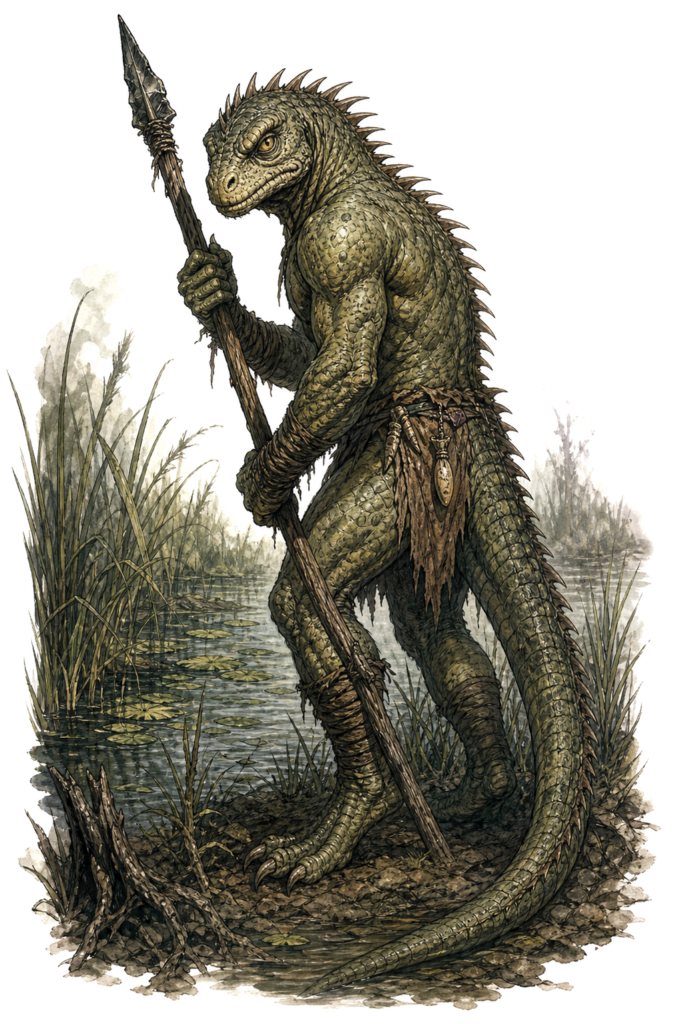
It looks like a man with a lizard’s head, claws, scales, and tail. It is looking at you the way you look at a meal. One in ten of them will try to negotiate first. The others are already calculating how many you are.
What a Lizard Man Is #
Lizard men are humanoid reptilians — men with lizard heads, claws, scaly hides, and tails — who live in tribes in swamps, rivers, seacoasts, and dungeons. They are semi-intelligent, physically strong (weapon +1 damage from strength), and pragmatic to the point of brutality: other races are primarily interesting as food sources.
Morale 12: Lizard men never check Morale. They fight until dead or satisfied. This reflects both their reptilian persistence and their tribal culture — retreating from prey is not something lizard men do.
One in ten speaks Common: Roughly 10% of lizard men have enough exposure to human settlements to learn basic Common. Only these individuals can be negotiated with. The other 90% have one interest: eating.
The negotiation caveat: “If they are hungry enough, though, and the PCs can’t deliver them a lot of food, the lizard men will still prefer to eat the characters.” Negotiation with lizard men is a food problem. They will deal if the party can provide more food than the party themselves would provide. A party with packhorses, cattle, or significant food supplies has negotiating leverage. A party with only their own bodies does not.
Core Statistics #
| Stat | Value |
|---|---|
| Hit Dice | 2d8+1 (avg 10 HP) |
| AC | 15 |
| AV | 2 (melee) / 1 (missile) |
| HR | +3 |
| FR | +3 |
| FD | 13 |
| Move | 60 ft (20 ft encounter) ground / 120 ft (40 ft encounter) swimming |
| Attacks | 1 weapon: by weapon +1 |
| No. Appearing | 2d4 (6d6) |
| Save As | Fighter 2 |
| Morale | 12 |
| Treasure | Type D |
| Alignment | Neutral |
| Intelligence | Low (INT 6) |
| XP | 25 |
AC/AV Reasoning #
RC original is AC 5 (descending) = Ascending AC 15. Thick scaly hide provides natural armor equivalent to leather.
- AC 15 — The scaly hide is the lizard man’s primary protection; it is wearing no manufactured armor in most cases. The scales absorb modest weapon impact and deflect glancing strikes
- AV 2 — The scale coverage provides meaningful absorption. A lizard man equivalent to a lightly armored warrior but with the scales doing the work
- Swimming speed is double ground speed — lizard men are genuinely faster in water than on land, making swamp and river ambushes their preferred fighting terrain
Skill Slots (2 total — 2+1 HD = 2 base; no asterisks; Low INT 6) #
| Slot | Skill | Notes |
|---|---|---|
| 1 | HR Investment (Basic) | HR +3; the +1 damage is incorporated into the weapon damage notation |
| 2 | Aquatic Combat (Basic) | No penalties in water or swamp; full swim speed in combat; can hold breath for 15 minutes |
Martial Style #
Style: Hard (Basic rank) Rank: Basic
Lizard men fight straightforwardly with spears and clubs. Hard Basic reflects their powerful builds and Morale 12 commitment — they do not hold back, do not retreat, and do not accept defeat. The only reason they stop fighting is because they or their prey are dead.
Weapons: Spears and large clubs (treat as maces). The +1 damage applies to both. A lizard man with a club deals 1d6+1 (mace damage +1); a lizard man with a spear deals 1d6+1.
Lizard Man Varieties #
The RC explicitly invites variety: “Some varieties of lizard men are just drab green or brown in color, while others may be dramatically colorful: bright reds, blues, yellows, or greens, like some other reptiles.”
Six varieties are presented below, each based on a distinct real-lizard analog. All share the core statistics above. Variety modifies appearance, one signature ability, and sometimes CR.
Variety 1 — Common (Iguana Type) #
Coloration: Drab green to brown, blending with swamp vegetation Crest/dewlap: Small dorsal crest of low spines; no dewlap Habitat emphasis: Swamp and river; the baseline encounter
Signature: None beyond core statistics. The common lizard man is the benchmark — what all others are compared against.
Tribal role: The most numerous variety; forms the bulk of any tribe. All standard statistics apply.
Variety 2 — Frilled (Frilled Lizard Type) #
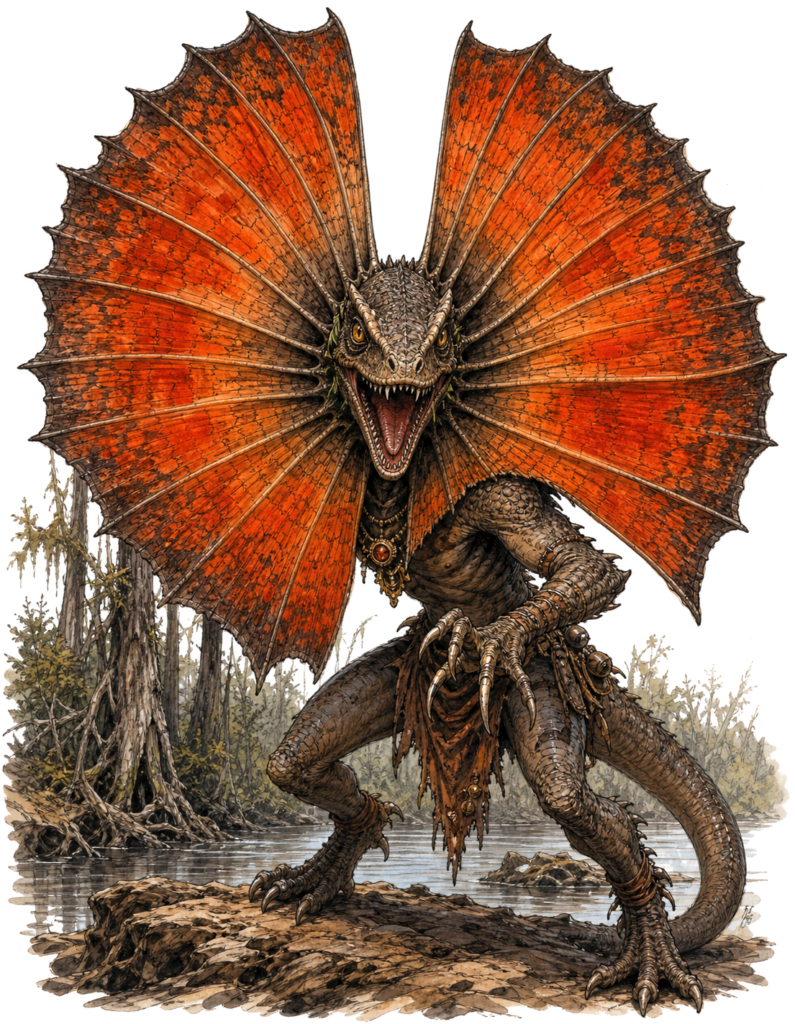
Coloration: Brown-gray with orange-red frill; the frill fans out dramatically when threatened Crest/dewlap: Large neck frill (8–12 inches, fans open in threat display) Habitat emphasis: River banks and wooded swamp margins
Signature — Threat Display: When the frilled lizard man opens its frill and hisses, all creatures of 1 HD or fewer must Save vs. Spells or flee for 1d4 rounds. Creatures of 2–3 HD must Save vs. Spells or suffer –1 HR for 1 round from startlement. No effect on creatures of 4+ HD who have seen it before.
Use: Frilled lizard men typically open the engagement with the threat display before closing to melee — the few seconds of confusion allow their kin to surround prey.
CR: 3 (+1 for the fear display’s tactical value at low HD encounters)
Variety 3 — Chameleon-Kin (Color Change Type) #
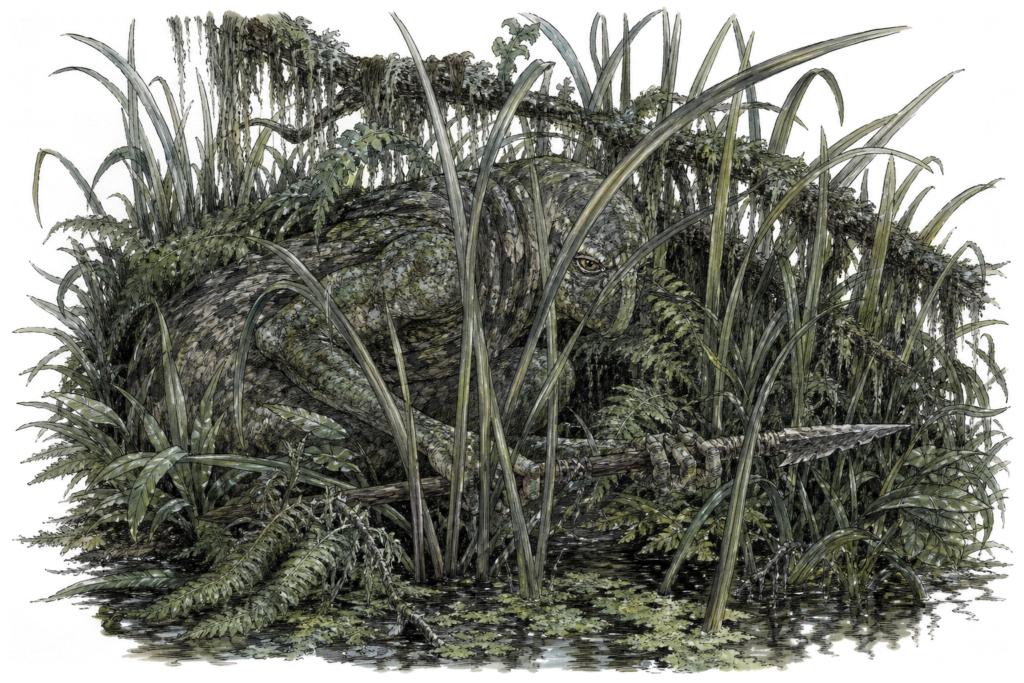
Coloration: Variable — shifts between green, brown, and grey over 1d4 rounds Crest/dewlap: No crest; slightly flattened body profile Habitat emphasis: Dense swamp vegetation; ambush specialists
Signature — Partial Color Change: Unlike the true horned chameleon, the lizard man’s color change is slow (1d4 rounds to shift) and imperfect. When stationary for at least 2 rounds, the chameleon-kin lizard man blends with surroundings:
- Surprise on 1–4 on d6 (instead of standard 1–2) from ambush positions
- –2 HR for attackers who have not yet identified the specific lizard man’s position
This variety is used as scouts and ambush point-men.
CR: 3 (+1 for the ambush surprise advantage)
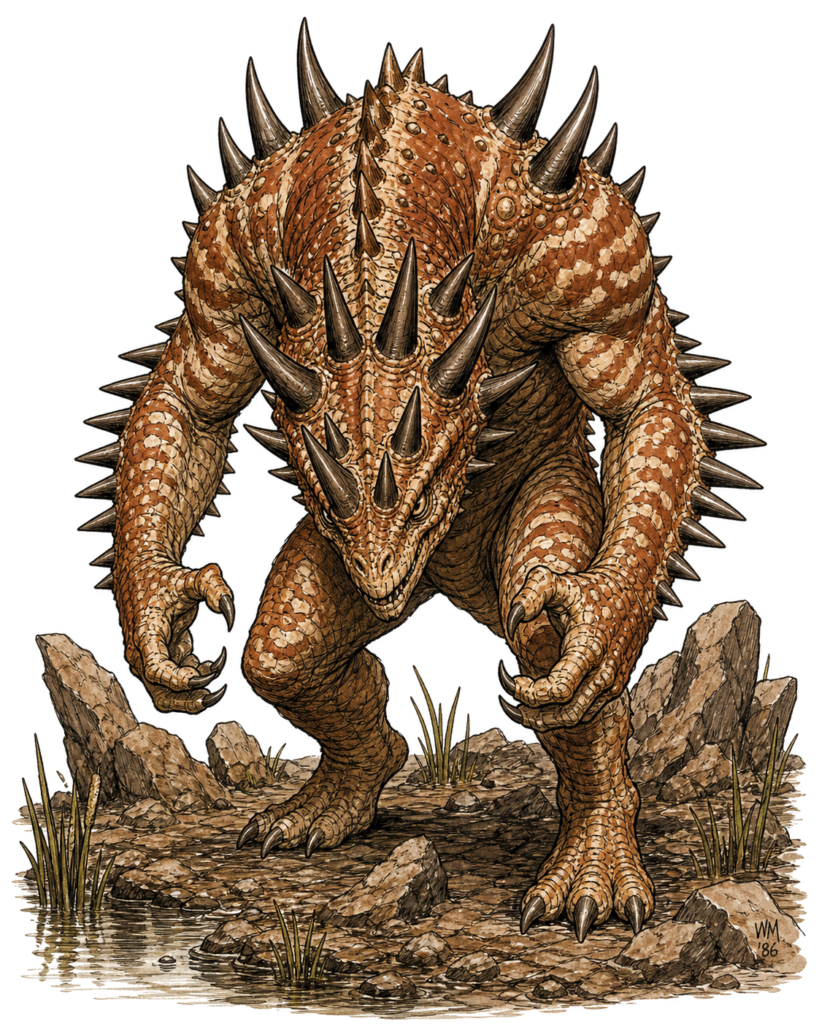
Variety 4 — Spiny (Thorny Devil / Horned Lizard Type) #
Coloration: Rust-brown with cream patterning; darker spines Crest/dewlap: Multiple prominent horn clusters on head and shoulders; spiny lateral ridges Habitat emphasis: Rocky swamp margins and coastal areas
Signature — Spine Defense: Any creature that successfully grapples a spiny lizard man or strikes it barehanded takes 1d4 automatic damage from the spines. A creature that fails a Wrestling FR roll against a spiny lizard man takes 1d4 spine damage on the failed attempt.
Additionally, the spiny lizard man’s bite deals 1d4 damage in addition to its weapon attack (the horn clusters make its head a weapon). The bite is a free attack if the lizard man successfully grapples an opponent.
CR: 3 (+1 for spine defense making it dangerous to grapple)
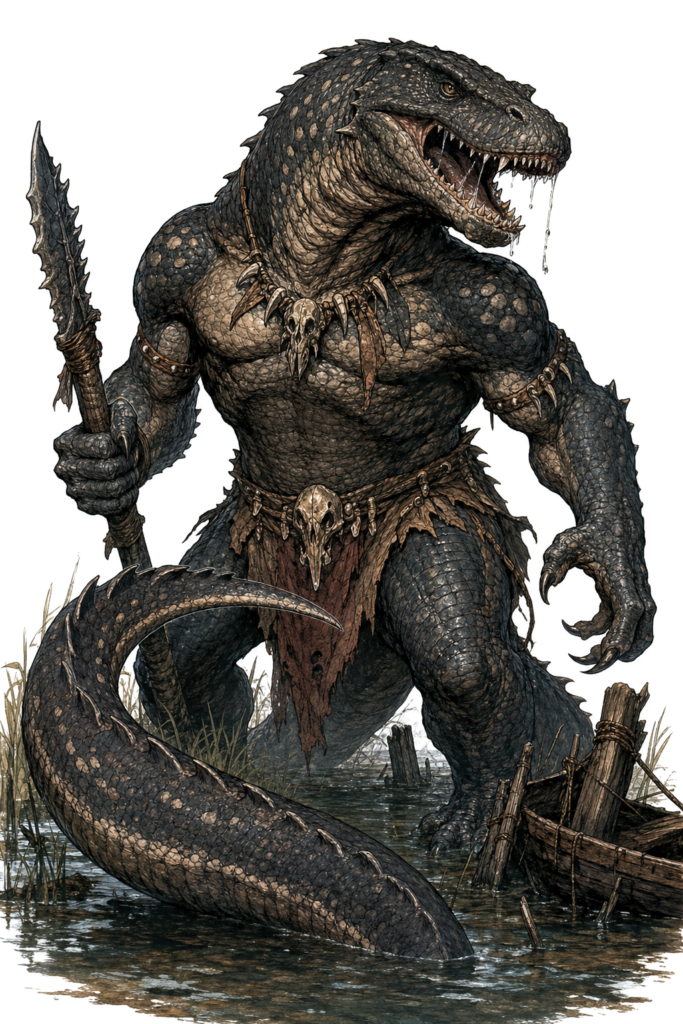
Variety 5 — Monitor (Komodo Type) #
Coloration: Dark grey-brown with lighter spotting; heavy-scaled Crest/dewlap: No crest; massive head and powerful neck Habitat emphasis: Coastal and deep swamp; the largest variety
Signature — Infectious Bite + Powerful Tail: The monitor-type lizard man has a mouth full of bacteria from its carrion diet. Any creature bitten (not struck with a weapon — the lizard man must use its natural bite attack as its action) must Save vs. Poison or develop a festering wound: the wound deals 1 HP per day until Cure Disease is applied.
The monitor tail sweep: once per encounter, the monitor lizard man may swing its heavy tail as a bonus action (separate from its weapon attack): HR +3 vs. AC; hit = 1d6 damage + target must Save vs. Paralysis or be knocked prone (loses next action).
Statistics modifier: Monitor lizard men have +1 HD (3+1 HD, avg 14 HP), +1 to all combat statistics. XP 50.
CR: 4 (+2 for the infectious bite’s long-term consequence and the tail sweep)
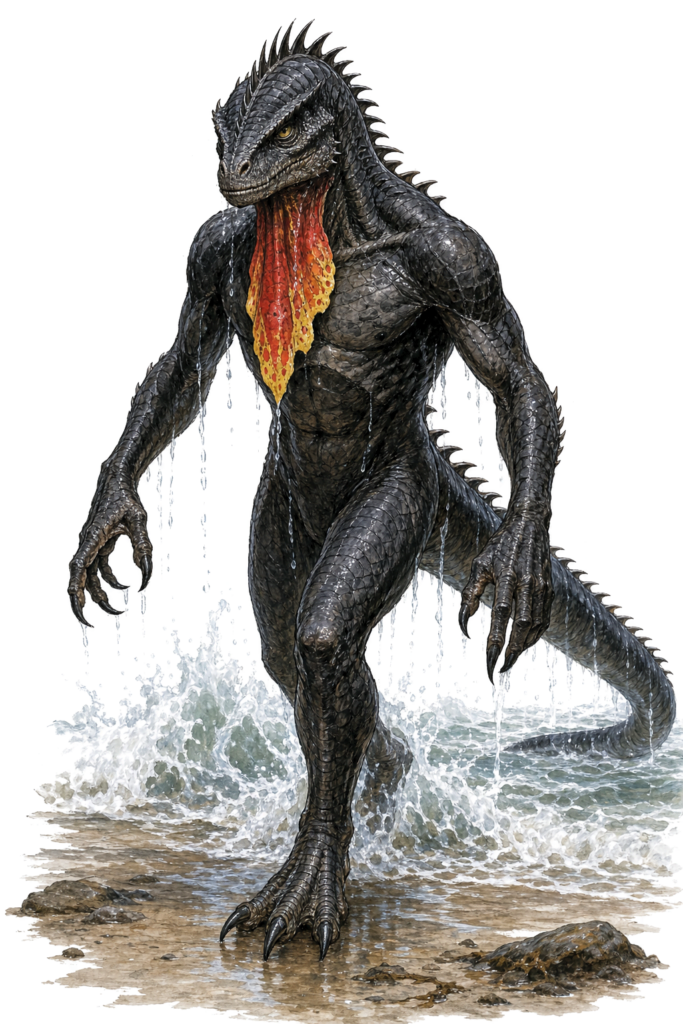
Variety 6 — Crested Sea (Marine Iguana Type) #
Coloration: Black and dark grey; some with red and yellow seasonal patches (males) Crest/dewlap: Prominent dorsal crest from head to tail; males display red-yellow dewlap patches in breeding season Habitat emphasis: Seacoast exclusively; powerful salt-water swimmers
Signature — Marine Mastery: Crested sea lizard men have adapted to salt water. They can hold their breath for 30 minutes (vs. standard 15), swim at 180 ft (60 ft encounter, vs. standard 120 ft), and can dive to significant depths (up to 100 ft) without ill effect.
In water combat, crested sea lizard men gain +2 HR and +2 to all FR rolls — they fight at full capability in conditions where most opponents are at –2 HR.
Display behavior: During breeding season (DM’s discretion — spring/summer), males display their red-yellow dewlap patches. This counts as a territorial display — any non-lizard man who enters sea lizard man coastal territory during breeding season faces immediate Morale 12 aggression without any negotiation possibility.
CR: 4 (+2 for the marine superiority in their primary combat environment)
Variety Summary Table #
| Variety | Coloration | Signature | CR |
|---|---|---|---|
| Common (Iguana) | Drab green/brown | Standard; most numerous | 2 |
| Frilled | Brown-gray with orange frill | Fear display; sub-3 HD creatures affected | 3 |
| Chameleon-Kin | Shifting green/brown/grey | Surprise 1–4; –2 HR to attackers while stationary | 3 |
| Spiny (Horned) | Rust-brown with cream | 1d4 spine damage on grapple/barehanded; bonus bite in grapple | 3 |
| Monitor (Komodo) | Dark grey-brown | Infectious bite (1 HP/day, disease); tail sweep 1d6 + prone | 4 |
| Crested Sea (Marine) | Black/dark grey | 180 ft swim; 30-min breath; +2 HR/FR in water | 4 |
Tribal Structure #
“They live in tribes and often try to capture humans and demihumans and take the victims back to the tribal lair as the main course of a feast.”
6d6 in lair — up to 36 lizard men in a tribal lair. A typical tribe includes:
- A tribal chief (3+3 HD, fixed 22 HP, attacks as 4 HD, +2 damage — DM construction)
- 1d6 tribal warriors of mixed varieties (selected by DM from the variety table)
- 2d4 common lizard men
- Non-combatant young (not encountered unless the party attacks the lair directly)
Mercenary role: “Sometimes they hire themselves out to other races as warriors or scouts.” A tribe that is approached by a race offering consistent food supply may enter into a mercenary arrangement — particularly Monitor or Sea varieties in their specialized environments.
Mixed-variety tribes: A tribe may contain multiple varieties. A coastal tribe might be primarily crested sea type with some common and frilled. A deep swamp tribe might mix common, chameleon-kin, and spiny. The varieties reflect regional adaptation rather than separate species.
Encounter Notes #
The swamp ambush: The party is crossing a swamp. Chameleon-kin lizard men have been motionless in the reeds for 3 rounds. Surprise on 1–4. The frilled lizard man unit-leader fans its frill and hisses as they close — sub-3 HD party members or NPCs must save or flee. The common lizard men encircle during the confusion. This is the standard combined-variety tribal attack.
The capture attempt: The lizard men want live prey, not corpses. When they reduce a character to 0 HP, they stabilize rather than kill (Morale 12 means they will take losses to secure live prey). A captured character wakes up in the tribal lair — alive, because a live feast is better than a dead one. Escape from a 6d6-member tribal lair requires social interaction (the 1-in-10 Common speaker), physical solutions, or the party’s rescue.
The negotiation: The tribe is hungry. The party has packhorses loaded with trade goods. One lizard man (1-in-10) speaks broken Common. It is explaining, clearly, that the tribe will eat the party if the party cannot provide equivalent food value. The math: 36 lizard men, 4 party members. The party needs to offer significantly more than their own caloric value to make the negotiation work.
The monitor bite aftermath: A party member was bitten by a monitor variety in the fight. They saved against the poison during the encounter. Three days later, the wound is festering — 1 HP/day. They need Cure Disease. The Cleric has it. This is the monitor bite’s actual gameplay impact: a post-encounter consequence that creates urgency for magical healing.


