It is eight to ten feet tall, wearing animal skins, carrying a large club, and looking at your food. It is not planning anything complicated. It wants your food and your money, and it is bigger than you.
What an Ogre Is #
Ogres are huge, fearsome humanoids — 8 to 10 ft tall, wearing animal skins, typically living in caves. They are primitive and greedy: they hunt animals when necessary but prefer to ambush travelers or bully them into surrendering food and money. They have no special combat tactics. When they decide to fight, they hit things with clubs until the things stop moving or the ogres fail a morale check.
The explicit no-tactics note: The RC specifically states “Ogres have no special combat tactics.” This is rare — most entries leave tactics implicit. The ogre is a direct, uncomplicated threat: close, hit, repeat.
Regional distinction. Ogre populations have diverged across the Known World’s geography to a degree that produces genuinely distinct variants — not just in coloring but in build, temperament, and the specific nature of their threat. An ogre encountered in the northern wilderness looks and behaves differently from one found in the forest interior. Three broadly recognized populations are documented below.
Core Statistics — Common Ogre #
| Stat | Value |
|---|---|
| Hit Dice | 4d8+1 (avg 19 HP) |
| AC | 15 |
| AV | 3 (melee) / 2 (missile) |
| HR | +5 |
| FR | +5 |
| FD | 15 |
| Move | 90 ft (30 ft encounter) |
| Attacks | 1 club: by weapon +2 |
| No. Appearing | 1d6 (2d6) |
| Save As | Fighter 4 |
| Morale | 10 |
| Treasure | (S×10) individual outside lair / S×100+C lair |
| Alignment | Chaotic |
| Intelligence | Low (INT 6) |
| XP | 125 |
AC/AV Reasoning #
RC original is AC 5 (descending) = Ascending AC 15. Animal skins over a Large, muscular frame.
- AC 15 — Thick animal hide functioning as rough leather armor, combined with large body mass
- AV 3 — Heavy musculature and hide absorb moderate impact
Weapon +2 damage: Every ogre attack deals 2 additional points of damage reflecting exceptional strength.
Skill Slots (2 total — 4+1 HD = 2 base; no asterisks; Low INT 6) #
| Slot | Skill | Notes |
|---|---|---|
| 1 | HR Investment (Basic) | HR +5 |
| 2 | FR Investment (Basic) | FR +5; the ogre’s mass and strength make it nearly impossible to Shove |
Martial Style #
Style: Hard (Basic rank) — Club, hit, repeat Rank: Basic
The RC is explicit: no tactics. Hard Basic is the correct style — maximum committed force with no variation. Morale 10 means it holds fairly well but will eventually flee when enough companions are down.
The Bully Encounter #
Ogres are just as content to ambush travelers or bully them into surrendering food and money instead of fighting.
The approach: The ogre(s) step into the road, blocking passage. The demand is non-verbal but clear: goods, or pain. Morale 10 ogres mean it: this is not a bluff.
What they want: Food (first priority), coin (second), both (preferred), the encounter to end quickly (Low INT means they do not overthink it).
Negotiation outcomes:
- Give them what they want: The ogres take it and let the party pass
- Refuse and fight: Standard combat
- Offer something better: An ogre with INT 6 can be redirected with a sufficiently attractive alternative — “there is a rich merchant camp two miles east” may work
Treasure on the Road #
When encountered outside their lair, a group of ogres will be carrying 1d6×100 gp in large sacks. The sacks are visually obvious. They are abandoned when ogres flee or fall.
The Neanderthal Enmity #
Ogres hate neanderthals and will attack them on sight. The mutual enmity is instinctive — territorial predators competing for the same caves and hunting grounds.
Regional Variants #
Three established ogre populations are recognized across the Known World, each adapted to distinct terrain. The no-tactics note applies to all three — ogres of every regional population fight the same way: directly, with their primary weapon, until the problem stops. What differs is appearance, terrain preference, and the specific nature of their physical capability.
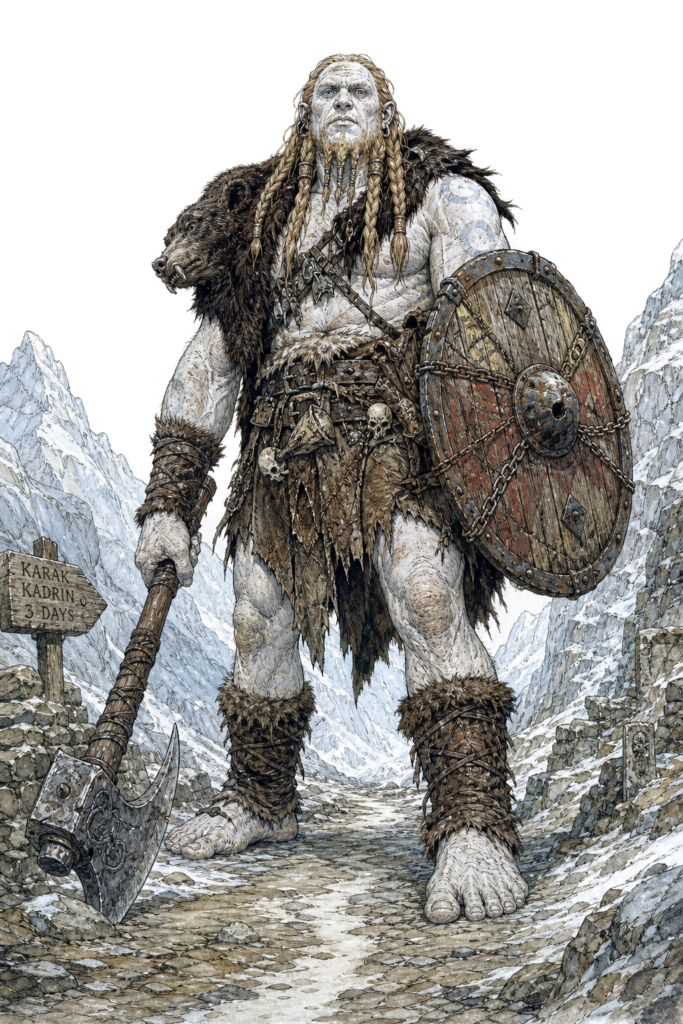
Northern Ogre (Homo Monstrum Bellicosus) #
Territory: Northern regions — the dominant ogre population of northern wilderness, most common in mountain areas and broken terrain such as Ogremoot in the Broken Lands.
Appearance: Chalky white skin with braided blond or red hair; dull grey eyes. Usually wearing bearskins and old battered shields fastened by chains and leather straps. Usually fight with cutting or slashing weapons rather than pure clubs — the northern tradition favors large axes and swords taken from fallen opponents. Common in most northern regions.
Behavioral note: The most frequently encountered ogre population and the baseline most dungeoneers picture. The Homo Monstrum Bellicosus is what the RC entry describes — the bully-or-fight model, food-and-coin motivated, living in caves in rough terrain. The bearskin armor and shield use make this population slightly better protected than the common statistics suggest.
Statistics: As Common Ogre above, with one addition:
| Stat | Value | Change from Common |
|---|---|---|
| AC | 16 | +1 (shield carried in addition to hide) |
| AV | 4 | +1 (shield adds meaningful absorption) |
| XP | 135 | +10 |
This is the reference population for most purposes. The +1 AC/AV from the shield use is the only mechanical distinction.
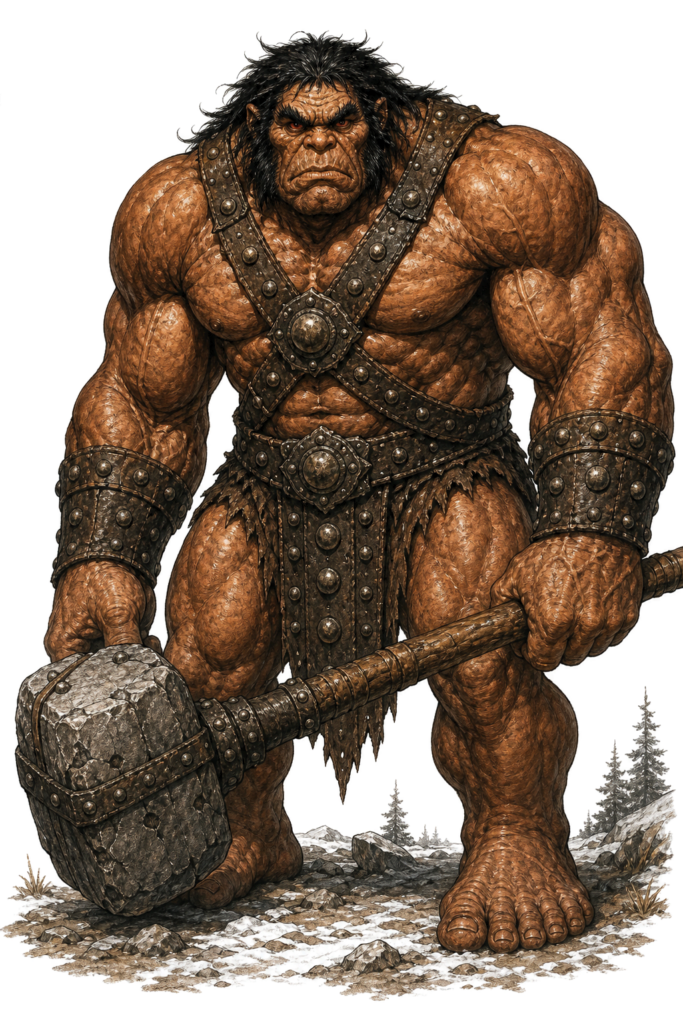
Copper Ogre (Homo Monstrum Brutalis) #
Territory: Found in most northern regions, slightly south of the Bellicosus range — overlapping territory but different ecological niche.
Appearance: Copper skin, with black bushy hair and eyebrows; red eyes. Very muscular and slightly hunched, often wearing studded leather and blunt weapons. The Brutalis is visually distinctive from the Bellicosus — the copper skin and red eyes make identification at distance possible in good light.
Behavioral note: The Homo Monstrum Brutalis is the most physically powerful of the three ogre populations — more muscular than the Bellicosus, with a hunched posture that concentrates its mass in the shoulders and upper body. The preference for studded leather over bearskins means it has better armor on average. The “blunt weapons” preference means it consistently uses the heaviest clubs and mauls rather than the cutting weapons favored by the Bellicosus — dealing crushing damage rather than slashing, which matters against some armors and materials.
Statistics: As Common Ogre, with the following changes:
| Stat | Value | Change from Common |
|---|---|---|
| Hit Dice | 4d8+3 (avg 21 HP) | +2 HP (exceptional musculature) |
| AC | 15 | Unchanged — studded leather equivalent to hide |
| AV | 4 | +1 (studded leather provides better absorption than plain hide) |
| HR | +6 | +1 (exceptional strength even for an ogre) |
| FR | +6 | +1 |
| XP | 175 | +50 (significantly more dangerous) |
Weapon note: The Brutalis uses the largest available blunt weapon — great club (1d10+2), maul (1d12+2), or similar. The +2 damage bonus still applies from exceptional strength. Against targets in chain mail or plate, blunt weapons are often more effective than slashing — the DM may apply a –1 AV reduction for targets in metal armor hit by the Brutalis’s crushing attacks.
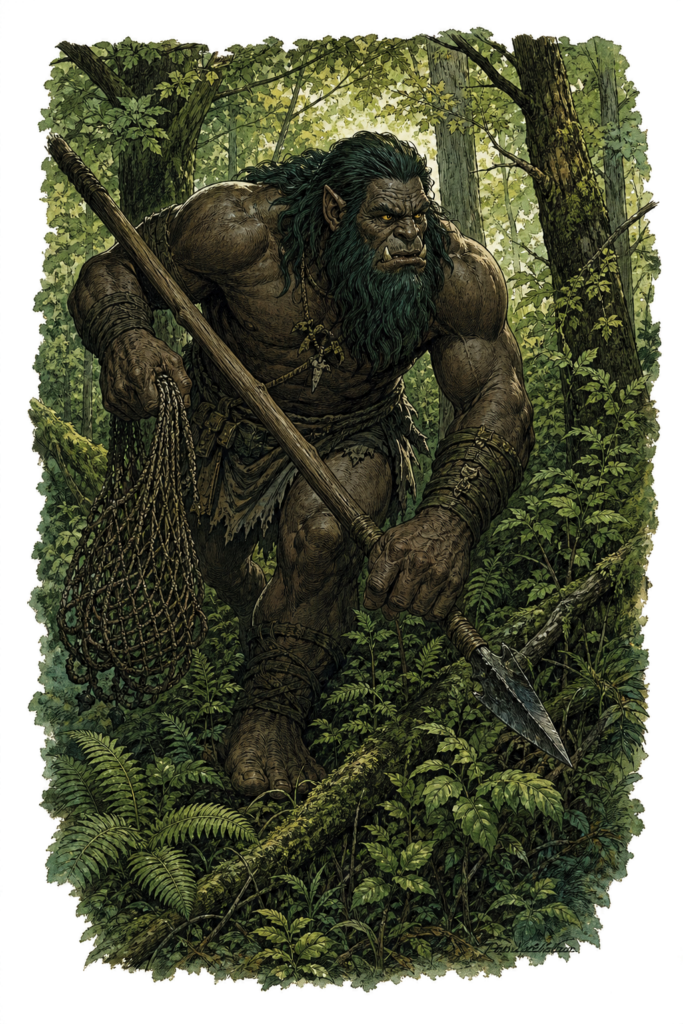
Forest Ogre (Homo Monstrum Grossus) #
Territory: Forest interiors — the forest-dwelling ogre population, common in forested regions throughout the Known World.
Appearance: Usually large fat ogres. Brown or black skin, very dark green hair and beard, yellow eyes. Good hunters with nets and spears. Common forest-dwellers.
Behavioral note: The Homo Monstrum Grossus is the most ecologically sophisticated of the three populations — “good hunters” is significant praise for a creature the RC characterizes with “no special combat tactics.” The forest ogre has developed hunting capability beyond the simple ambush-and-bully model of its northern cousins. It uses nets and spears — ranged capability and restraint tools — which implies a more patient hunting approach. It does not just wait for prey to come to it on a road. It goes into the forest and hunts.
Statistics: As Common Ogre, with the following changes:
| Stat | Value | Change from Common |
|---|---|---|
| Move | 120 ft (40 ft encounter) | +30 ft (forest-adapted, more mobile in woodland) |
| XP | 150 | +25 (hunting capability and net use) |
Additional skill — Slot 2 modified: Hunting (Basic) rather than FR Investment — the Forest Ogre hunts actively and effectively. Net use: as a ranged weapon (20 ft range; target Save vs. FD 15 or entangled; entangled targets lose DEX bonus to AC, move at half speed, –2 to all attack rolls). Spear: 1d6+2 (melee or thrown 20 ft). The net is typically used to restrain prey before the spear closes — the Forest Ogre’s preferred sequence is net → close → club or spear. FR remains +5 from base HD but is not the defining skill.
Forest encounter note: The Homo Monstrum Grossus encountered in forest terrain cannot simply be navigated around by the road-avoidance tactic that works against northern ogres. It is in the forest because it hunts there. Encounter numbers (1d6 wilderness, 2d6 lair) apply normally, but the forest ogre is typically in active hunting posture rather than road-blocking posture when encountered. The bully encounter model is less common — the Forest Ogre is more likely to have been stalking the party before they know it is there.
Regional Variant Summary Table #
| Variant | HD | AC | AV | Move | HR | FR | XP | Key Trait |
|---|---|---|---|---|---|---|---|---|
| Northern Bellicosus | 4d8+1 | 16 | 4 | 90 ft | +5 | +5 | 135 | Shield use; baseline threat |
| Copper Brutalis | 4d8+3 | 15 | 4 | 90 ft | +6 | +6 | 175 | Strongest; blunt weapons; crushing |
| Forest Grossus | 4d8+1 | 15 | 3 | 120 ft | +5 | +5 | 150 | Net/spear hunter; forest mobile |
Encounter Notes #
The road ambush: 1d6 ogres step out from behind boulders or trees on a road. They want food and coin. Morale 10 means they will fight seriously once negotiations break down. With 4+1 HD each and +2 damage, three ogres dealing 1d6+2 per round each total about 16.5 HP per round at 50% hit rate — significant pressure on low-to-mid level parties.
The cave lair: 2d6 ogres in a cave complex. No tactics: they fill the corridor and swing. Treasure: S×100 + C in a back chamber.
The forest hunt: A party traveling through dense woodland becomes aware they are being followed. The Homo Monstrum Grossus has been tracking them for 20 minutes. The first sign is a net from a direction the party was not watching. Then the spear. Then the club. In its forest terrain with a hunting approach it has practiced for years, the Forest Ogre is a genuinely dangerous encounter for the party it has selected.
The Brutalis in chain-armored opposition: A party in plate armor facing a Copper Ogre finds the armor less reassuring than usual — the DM may apply the crushing-weapon AV reduction, and the Brutalis’s +6 HR means it hits consistently. Morale 10 and 21 avg HP make it a sustained combat problem.
The outpost for something larger: A group of 1d6 ogres operates on behalf of a hill giant clan — demanding tribute from travelers to report back. Among the coin sacks, a crudely written note lists which parties have paid and which have refused. The party is on the list of people who refused. The giant clan knows their description.
The negotiated passage: The party has iron rations to spare. They offer 1 week’s iron rations and 50 gp to the lead ogre. The lead ogre looks at the food, then the coin, then the party, then the food again. INT 6: it makes a simple calculation. The food and coin are worth more than the beating. It grunts, holds out its hand, takes the goods, and moves aside. This is a legitimate encounter resolution — it is the same calculation that leads humans to pay tolls.
CR justification:
| Rank | CR | Notes |
|---|---|---|
| Northern Bellicosus | 4 | Shield use elevates slightly above base |
| Forest Grossus | 4 | Net/spear hunting approach adds tactical texture |
| Copper Brutalis | 5 | +2 HP, +1 HR, +1 FR, crushing damage |
| Ogre group (1d6) | 5–7 | Numbers compound individual threat dramatically |
| Ogre lair (2d6) | 7–9 | Full group + terrain |


