Do not touch the goods without asking. Do not question the price. Do not offer less than what they named. They have crossed three hundred miles of desert to bring you this. They know exactly what it cost them. They know exactly what it is worth. They are not guessing and they are not playing. This is the last time they will say the number.
Who the Aqrab Are #
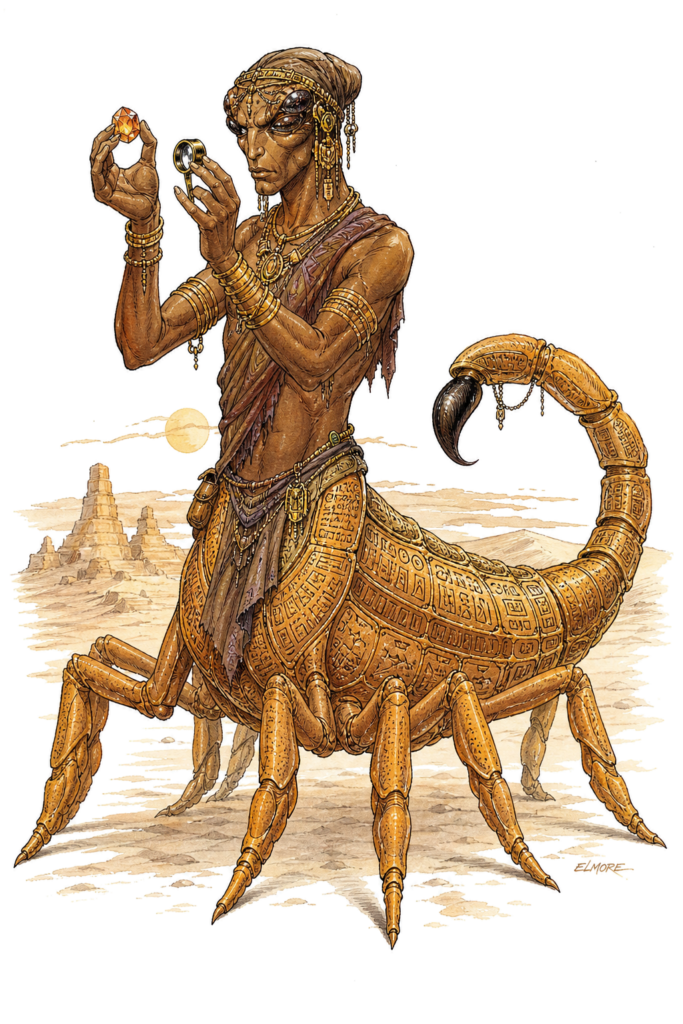
The Aqrab (singular and plural; the word is Nithian for “scorpion” and functions as both their self-designation and their name for the trade tradition they carry) are a distinct cultural and physical variant of the manscorpion lineage — smaller, leaner, more refined in form than the warlike standard manscorpion, with a social structure built entirely around commerce, caravan management, and the preservation of Nithian mercantile tradition.
They are not a separate species from the standard manscorpion. They are what happens when a manscorpion population spends three thousand years selecting for different traits under different pressures. The warlike manscorpion selects for size, aggression, and combat capability. The Aqrab selected for intelligence, endurance, navigation, and the social intelligence required to conduct trade across hostile desert terrain with customers who are nervous about doing business with scorpion-people. Both approaches are successful in their respective contexts.
The size distinction: Standard manscorpions are 8 HD and move at 240 ft. The Aqrab average 5 HD and move at 180 ft. They are shorter in the humanoid torso section, with a lighter arachnid body optimized for endurance travel rather than combat speed. The tail sting is present and functional — it is not a display structure — but it is proportionally smaller than the standard manscorpion’s. This difference is visible and immediately legible to anyone familiar with both types.
What they are not: The Aqrab are not pacifists, not soft, and not easy targets. Three thousand years of crossing desert terrain with valuable trade goods has selected for people who can defend themselves effectively when required. They simply do not start fights, because starting fights is bad for business, and business is everything.
Physical Description #
The Aqrab humanoid torso stands approximately 4 to 5 feet above the scorpion body junction — shorter than the standard manscorpion’s 6-foot upper body. The human features are clean-planed, with dark eyes set wide, and the characteristic manscorpion compound eye structure that grants exceptional range of peripheral vision. Skin tones in the humanoid section range from deep brown to near-black, sun-darkened by generations of desert travel.
The scorpion body is proportionally elegant — narrower than the standard manscorpion’s combat-optimized frame, built for the sustained ground-covering movement of long desert crossings rather than the explosive acceleration of combat. The chitin coloration is typically amber, gold, or dark red — the colors of desert sand at different times of day. The red hourglass marking that characterizes their giant scorpion kin is absent; instead, the Aqrab typically display geometric Nithian-script patterns along the carapace, marking trade alliances, family lineage, and notable transactions. These patterns are applied over a lifetime and read by other Aqrab as a partial biography.
The stinger is elegant rather than massive — 8 inches of dark chitin curving to a sharp point. Functional. Not the first option, but not the last.
The hands are four-fingered with very precise finger joints — the Aqrab have exceptional fine motor control, necessary for handling delicate trade goods, evaluating gemstones, and the intricate weight-and-measure systems they use for commodity assessment. An Aqrab evaluating a gem moves with the focused precision of a jeweler who has been doing this for forty years. Many of them have.
The Sled Caravans #
The defining feature of Aqrab life is the sled caravan — a train of flat-bottomed cargo sleds pulled across desert terrain by teams of Giant Scorpions. This is not a metaphor or a convenience. It is the center of Aqrab civilization.
The home sled: The lead sled in any caravan is the family residence — a flat-decked platform with low walls of treated hide, a collapsible shade structure, and precisely organized storage below deck. An Aqrab family lives on their home sled for their entire lives. Children are born on it. Elders die on it. The sled is the household, the family archive, and the primary asset of the caravan all at once.
The cargo sleds: 2d6 cargo sleds follow the home sled in a typical Aqrab caravan, each loaded to precisely calculated capacity. The Aqrab know their cargo weights to the nearest pound — exceeding draft animal capacity in desert conditions is how caravans die, and the Aqrab have been calculating loads since before the Nithian Empire fell.
Giant Scorpion draft teams: Each sled is pulled by a team of 2d4 Giant Scorpions, trained from hatching and bonded to the caravan family. Aqrab Giant Scorpions are not the hostile, attack-everything creatures of the RC encounter table. They are working animals — responsive to specific command signals (a combination of vocal calls, physical touch on specific carapace points, and rein pressure), capable of maintaining pace across extremely difficult terrain, and loyal in the way working animals are loyal to handlers they have known since birth.
Training Giant Scorpions: The Aqrab training tradition for Giant Scorpions is the most developed such expertise in the Known World. The process begins at hatching — the scorpion receives its first handling within hours of emerging from the egg. Key training stages: desensitization to the sled harness (months 1–3), draft work on flat terrain (months 4–8), command response refinement (months 9–18), and caravan integration with other trained scorpions (year 2+). A fully trained Giant Scorpion draft animal is worth considerably more than an untrained one to an Aqrab caravan; to a non-Aqrab buyer, they are essentially worthless because the training is command-specific to the training family.
What the scorpions will do in combat: Trained Aqrab draft scorpions will defend the caravan if attacked. They do not attack proactively. If the caravan is raided, the scorpions respond to specific release commands from their handlers and fight as standard Giant Scorpions (see BECMI_Scorpion_Giant.md). The Aqrab handlers do not release the scorpions against merchant disputes — only against actual physical threats.
Core Statistics #
| Stat | Value |
|---|---|
| Hit Dice | 5d8** (avg 22 HP) |
| AC | 17 |
| AV | 3 |
| HR | +4 |
| FR | +5 |
| FD | 15 |
| Move | 180 ft (60 ft encounter) |
| Attacks | 1 weapon (by type) + 1 tail sting (1d6 + venom) |
| No. Appearing | 1d4 (caravan: 2d6 + family) |
| Save As | Fighter 5 |
| Morale | 9 |
| Treasure | Type A (trade goods) + Type E (personal wealth) |
| Intelligence | High (INT 13) |
| Alignment | Neutral |
| XP | 300 |
Two asterisks: Tail venom (first) and Trade Expertise (second).
AC 17 / AV 3: Lighter than the standard manscorpion’s combat-optimized chitin. The Aqrab’s carapace is excellent natural armor but not the battle-hardened plate of their warlike kin.
FR +5 / FD 15: The scorpion body’s eight-leg stability and low center of gravity. An Aqrab is very difficult to knock down, topple, or move against its will — physically useful in desert terrain with unpredictable ground, and professionally useful when someone tries to physically intimidate them in a market context.
Type A treasure: The Aqrab’s trade goods are their primary wealth — the richest standard treasure type reflects a functioning merchant caravan with months of accumulated stock. This is not coin hoarded in a lair. It is inventory, professionally assessed and priced.
Skill Slots (7 total — 5** HD = 4 base + 1 at 5 HD + 2 asterisks; High INT 13) #
| Slot | Skill / Ability | Notes |
|---|---|---|
| 1 | HR Investment (Basic) | HR +4 |
| 2 | FR Investment (Basic) | FR +5 |
| 3 | Tail Venom — Trade Sting (innate, special) | 1d6 + venom: Save vs. Poison or incapacitated (see below). First asterisk |
| 4 | Trade Expertise — Absolute Valuation (innate, special) | Knows exact market value of any traded good; cannot be deceived by false appraisal. Second asterisk |
| 5 | Giant Scorpion Husbandry (Expert) | Train, command, and maintain Giant Scorpions; draft teams respond to complex commands; can assess Giant Scorpion health and age by examination |
| 6 | Desert Navigation (Expert) | Cannot be lost in desert terrain; knows oasis locations across their trade routes; reads sand, wind, and star navigation at Expert level |
| 7 | Nithian Mercantile Tradition (Skilled) | Reads and writes ancient Nithian commercial script; knows pre-dynastic trade law and contract formats; recognizes Nithian artifacts and their approximate provenance |
The Tail Venom — Trade Sting #
The Aqrab tail venom is not the instant-kill mechanism of the standard Giant Scorpion or the paralytic sting of their warlike manscorpion kin. It has been selected — whether deliberately or through generations of use in non-lethal conflict resolution — for incapacitation rather than death.
Mechanics: 1d6 damage. Save vs. Poison or incapacitated as follows:
| d6 | Incapacitation Effect | Duration |
|---|---|---|
| 1–2 | Muscle weakness: –4 HR, –4 FR, half movement | 1d6 turns |
| 3–4 | Nausea and disorientation: cannot take offensive actions; may move and defend only | 1d4 turns |
| 5–6 | Sedation: Save vs. Poison again at –2 or fall unconscious | 1d4+1 turns |
The save and success: Even on a successful save, the venom deals 1d6 damage and causes 1 round of the muscle weakness effect (–2 HR and –2 FR only, not the full penalty).
How it is used: The Aqrab tail sting is a last resort, used when a situation has escalated past the point where negotiation or threat-display resolves it. They do not sting over haggling. They sting over theft, physical assault on caravan members, or threats to the scorpion teams. The incapacitation rather than kill outcome reflects their preference for resolution — an incapacitated thief can be robbed of what they took and sent away; a dead one causes complications with regional authorities.
The warning: Before stinging, an Aqrab will raise the tail to a visible position and hold it — three seconds, approximately. This is not threat display. It is courtesy notice. They are telling you what is about to happen if you continue. Most experienced desert travelers recognize this and stop immediately.
Trade Expertise — Absolute Valuation #
“They know what they got and what it’s worth.”
The Aqrab’s second asterisk ability is not a combat power. It is the most important ability they have professionally.
What it does: An Aqrab examining any trade good — gem, spice, textile, weapon, magical item, animal, information — knows its current fair market value in the nearest major trade hub, within 5%. This is not magical detection. It is the accumulated expertise of a people who have been doing nothing but trade for three thousand years, combined with the intelligence to synthesize market information from every caravan they have crossed in the past year.
What it means practically:
- An Aqrab cannot be deceived about what something is worth. A gem salted with paste to look larger is identified on examination. A spice cut with inferior product is detected by smell. A “magical” item that is mundane is assessed correctly within 1 round of examination
- The price an Aqrab names is not an opening position. It is the price. They have already calculated fair value, their overhead, their risk margin, and their profit. The number they say is the number
- They extend this expertise to assessing what the party is worth as customers — an Aqrab who sees the party’s equipment, observes their physical condition, and listens to their questions for five minutes has a reasonable estimate of their financial position and buying power
The exception: Magical items outside their trade experience. The Aqrab can identify that an item is magical (the Nithian tradition gives them sensitivity to binding magic specifically) but cannot price items whose magical function they cannot assess. For these, they price on material value plus a standard magical-item premium, and they will say so explicitly.
The Price Is The Price — Haggling Rules #
The Aqrab do not haggle. This is not stubbornness or posturing. It is a foundational cultural principle rooted in three thousand years of Nithian mercantile tradition, and it has a specific logic:
The Nithian commercial principle (Ma’at-nefer): Fair trade is an expression of cosmic order. The Nithian tradition holds that the correct price for a thing is a fact about the world — it exists independent of desire, need, or negotiation, the same way a stone’s weight is a fact. To argue about the price is to argue about a fact. It is not merely rude. It implies the Aqrab has stated the price incorrectly, which implies dishonesty, which implies a violation of Ma’at-nefer. This is the insult. Not the attempt to pay less — the implication that the Aqrab named a wrong number.
What happens when someone haggles:
First offense (the party member offers less): The Aqrab repeats the price. Same tone. Same volume. No elaboration. They are giving the hagglers the opportunity to recognize the error and correct it.
Second offense (the party member persists): The Aqrab states clearly, once, that the price is correct and the implied accusation is noted. The tone shifts. The tail does not move. Nothing happens yet. But the interaction has been marked.
Third offense (the party member continues): The Aqrab closes the transaction. No goods are sold. The party is welcome to leave. If they return later — same day, next week, next year — the Aqrab remembers. The price for that party is now 20% higher, permanently, as a fee for having wasted the Aqrab’s time and impugned their professional accuracy. This increase is stated flatly when they return, with no further explanation.
Physical response: If haggling escalates to physical threats or attempts to take goods without payment, the tail warning position is assumed. Three seconds. The response after that is the full incapacitation sting, followed by the release of draft scorpion teams if the situation continues to escalate.
What the party can do instead of haggling: Ask questions. An Aqrab will explain why something is priced as it is — the sourcing difficulty, the transport cost, the current market conditions in the nearest city. This is not negotiation and does not invite counter-offers. It is information, provided professionally. A party that understands why the price is the price is a party the Aqrab enjoys doing business with. They may not buy at that price, but they are not insulting anyone by declining.
Bulk and repeat business: The Aqrab do give better pricing for large purchases and for established customers. This is not haggling. This is the standard Nithian commercial tier system — bulk discount is a fact of trade economics the same way any other price is a fact. The Aqrab will state the bulk pricing structure unprompted when a purchase reaches the relevant threshold. A party that has traded with the same Aqrab caravan three times is recognized as a repeat customer and the tier pricing applies automatically. They do not need to ask.
Nithian Superstition — The Omens of Trade #
The Aqrab follow the old Nithian ways, which in practice means an elaborate system of trade superstitions descended from actual Nithian commercial religion. These are not casual beliefs. They structure the caravan’s daily operations.
The morning assessment: Before any commerce, the senior Aqrab of the caravan examines the current omens: the direction of the wind, the behavior of the draft scorpions (scorpions that will not eat in the morning predict bad trade conditions; scorpions fighting their harness predict hostile customers), the orientation of specific stars (for pre-dawn departures), and the quality of the previous night’s dreams (the Aqrab have a complex dream taxonomy for trade-relevant symbolism).
Favorable omens: Wind from the north, scorpions eating readily, gold light at dawn, no unusual sounds from the cargo. Standard commerce proceeds normally.
Unfavorable omens: Specific configurations trigger trade restrictions for the day. On a day with serious unfavorable omens, the Aqrab will trade only in specific categories (the omens specify which), will refuse to sell certain classes of goods regardless of offer, and will not enter new long-term trade relationships. They will explain this plainly to prospective customers: “The omens today do not favor this transaction. Come back tomorrow.” This is not negotiable and is not personal.
The haggling omen: Haggling from a customer who is clearly in distress (visibly injured, clearly desperate, near starvation in the desert) triggers a specific Nithian exception — the tradition holds that Ma’at-nefer requires a merchant to assess whether the fair price is the moral price in conditions of genuine need. An Aqrab who encounters genuinely desperate customers will provide emergency necessities (water, basic food, emergency medical supplies) at cost price without the Ma’at-nefer commercial framework applying. This is not charity — it is a separate category called Aa-khet (great necessity) that the Nithian tradition treats differently from commerce. When the emergency is over, commerce resumes at standard pricing.
Nithian artifact recognition: The Aqrab have the most practical knowledge of Nithian material culture of any currently living group. They have been crossing the same desert routes for millennia, camping at the same oases, and picking up Nithian debris for three thousand years. An Aqrab who examines a Nithian artifact can identify its period, probable function, and approximate provenance. They will not help locate Nithian tombs for looting — this violates the Nithian mortuary tradition they follow — but they will accurately assess, buy, and sell Nithian objects that have already come to the surface. Their pricing of such objects is aggressive; they know exactly what they are.
Caravan Structure — Full Party #
A standard Aqrab caravan encountered in the desert:
| Component | Count | Notes |
|---|---|---|
| Senior trader (caravan head) | 1 | 5 HD, full stat block; the voice of the caravan in all transactions |
| Family traders | 1d4+1 | 3–4 HD; conduct secondary transactions; manage specific cargo categories |
| Caravan guards | 2d4 | Standard Aqrab stat block; positioned at caravan perimeter |
| Young adults (1–2 HD) | 1d6 | Learning the trade; assist with handling and logistics |
| Home sled | 1 | Family residence; private; visitors are not invited aboard without specific invitation |
| Cargo sleds | 2d6 | Each with specific inventory category; the sled organization is a filing system |
| Giant Scorpion draft teams | 2d4 per sled | Trained; bonded; will defend caravan if released |
The senior trader’s authority: Within the caravan, the senior trader’s commercial decisions are absolute. Within the broader Aqrab culture, disputes between caravans are resolved by the Oasis Council — a meeting of senior traders from all caravans that convenes at major desert oases three times per year.
The Oasis Council #
The Oasis Council is the closest thing the Aqrab have to a governing body. It convenes at traditional oases whose locations are known to all Aqrab but not widely publicized to outsiders. Business conducted at Council meetings:
- Resolution of trade disputes between caravans (the Ma’at-nefer framework provides a standard methodology)
- Information sharing: caravan routes, hazard reports, price data from across the trade network
- Collective assessment of major trade opportunities or threats
- Maintenance of the Nithian commercial calendar (certain trade categories are forbidden in certain months based on the old Nithian agricultural and ritual cycles)
- Management of Giant Scorpion bloodlines (the breeding program that maintains quality draft animals is a collective Aqrab project coordinated through the Council)
Council decisions are binding. An Aqrab caravan that violates a Council ruling loses its standing — other caravans will not trade with it, will not share route information, and will not provide emergency assistance. For a desert nomad people, loss of Aqrab community standing is potentially fatal.
Relations with Other Thothian Factions #
| Faction | Aqrab Relationship |
|---|---|
| Thothian Court | Formal commercial relationship; the Aqrab supply the palace with desert goods; pay tariffs without complaint; expect protection of the trade roads in return |
| Kha | Professional respect; the Kha handle death, which means they handle the aftermath of desert casualties, which means they are often at the same oases; the Aqrab find the Kha’s calm relationship with death professionally comprehensible — they too deal with things plainly |
| Ushabti | Useful contacts for Nithian artifact authentication; the ushabti’s historical memory and the Aqrab’s field knowledge complement each other in ways both parties have quietly exploited for centuries |
| Aketheti | Aware of her; have traded with the palace across her tenure; have noted the pattern; have said nothing; the Aqrab are very good at noting things and saying nothing until the commercial moment is right |
| Standard Manscorpion (RC warlike) | Acknowledged kin; not allies; the warlike manscorpion’s approach to other species creates severe problems for the Aqrab’s trade relationships and the Aqrab have spent considerable diplomatic effort making clear to customers that they are not the same thing |
| Travelers and adventurers | Potential customers; treated professionally; the Aqrab do not judge what people are buying or why; they assess the commercial transaction on its merits |
Encounter Modes #
The Desert Caravan (Standard) #
The party encounters an Aqrab caravan crossing the desert — a line of sleds pulled by Giant Scorpion teams, moving at a steady pace. The lead sled carries the senior trader. The caravan slows when it sees the party; the senior trader raises a hand in the traditional Nithian greeting (open palm, slightly bowed).
What the Aqrab want: To complete their journey, possibly to sell the party something useful, and to be left alone to do their work.
What the party can do: Buy provisions (the Aqrab carry water, preserved food, and trade goods appropriate to the desert route). Get information (the Aqrab know the terrain, know the hazards, and will share this information at standard consultation pricing). Hire as guides (the Aqrab will not divert from their established route, but they will sell directions and landmark descriptions with the same precision as physical goods).
What the party should not do: Attempt to rob the caravan. The draft scorpion teams will be released. The Aqrab guards will respond. The senior trader will raise the tail warning. The party will be the ones waking up in the sand two hours later with significant venom consequences and an assessment bill.
The Oasis Market #
A major desert oasis hosting an Aqrab Council meeting becomes a temporary market — six to twelve caravans, all trading simultaneously, with the organized efficiency of a professional fair. The oasis market is neutral ground (Council rule) — no violence, no theft, no political disputes that involve weapons. The Kha typically have a wayhouse at major oases. The Thothian court occasionally sends an assessor to collect tariffs.
For the party: The best opportunity to purchase desert-specific goods, acquire information about routes and hazards, and potentially meet multiple Aqrab senior traders. A party that behaves correctly at the oasis market — buys appropriately, does not haggle, treats the transactions professionally — builds a reputation across the Aqrab trade network. That reputation travels faster than the party does.
The Artifact Assessment #
An Aqrab trader has acquired something from a desert ruin that they have identified as Nithian, priced, and are prepared to sell — but they want authentication before the sale proceeds. They need someone with access to the Kha or ushabti historical knowledge to confirm their assessment. The party is useful for this, and useful parties get introduced to the Aqrab commercial network.
The twist: The item is genuine Nithian, correctly priced, and also something that shouldn’t have surfaced — something the Sahu-wer have been looking for, or something that Aketheti sent agents to find, or something the ushabti’s Named Ones recognize from four thousand years ago. The Aqrab don’t care about any of that. It’s worth what it’s worth. The party’s problem is that now they know what it is.


