
Nothing is there. Then something laughs. Then you are inside a fog that was not there a moment ago. The fog condenses. Something is watching you from inside the drizzle and you cannot see it and it can see you perfectly.
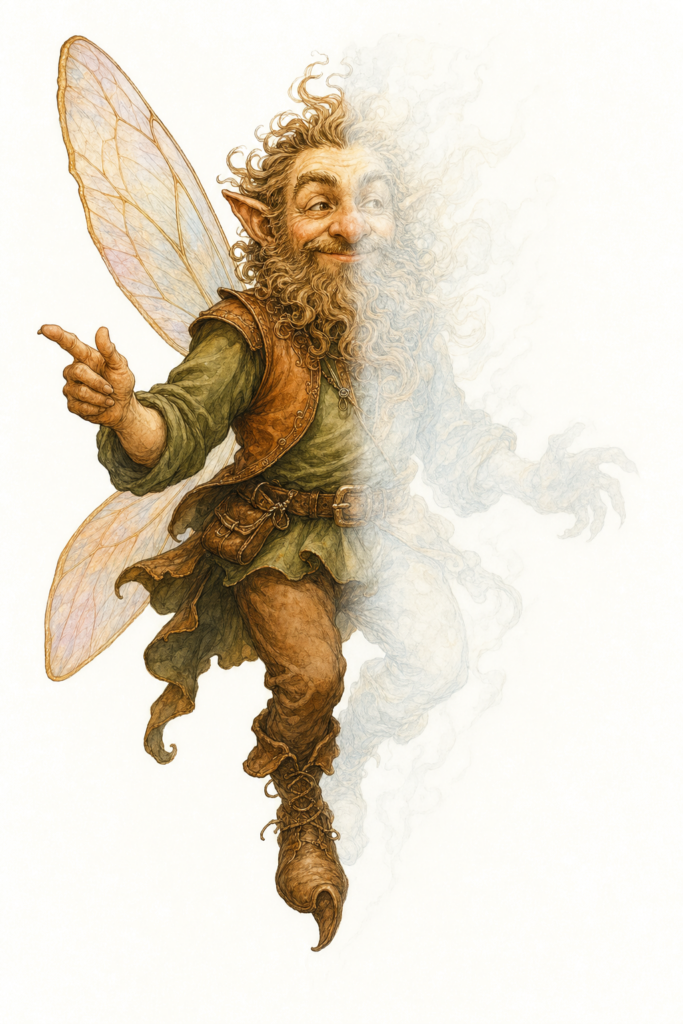
What a Faerie Is #
Faeries are aerial humanoids — halfling-sized beings with gossamer wings, dwarvish noses and beards, and elvish ears and eyes. They are close relatives of demihumans, combining physical features from all three races into a distinct form.
Natural permanent invisibility: The defining feature. Faeries are naturally invisible at all times — not a spell, not a power they activate, not an effect that can be suppressed. They simply do not appear to normal sight. Ever. This is their baseline state of existence.
The cloud empire: Far above the earth, faeries have built their own empire — homes made of clouds, a civilization only they and a few air creatures know about. Their society is above the storm layer, unknown to virtually all surface-dwelling races. They visit the lower world out of curiosity, mischief, or purpose.
Core Statistics #
| Stat | Value |
|---|---|
| Hit Dice | 1d8+1 to 9 (avg varies by rank) |
| AC | 15 |
| AV | 0 |
| HR | +1 (common) to +7 (9 HD leader) |
| FR | +1 (common) to +7 |
| FD | 10 (common) to 16 (leader) |
| Move | 120 ft (40 ft encounter) ground / 240 ft (80 ft encounter) flying |
| Attacks | 1 weapon or spell |
| Damage | By weapon or spell |
| No. Appearing | 1d6 (5d8+20 lair) |
| Save As | Elf 1 (common) or better |
| Morale | 9 |
| Treasure | (Nil) individual / Special lair |
| Alignment | Any |
| Intelligence | High (INT 13) |
| XP | 19 (common) or more |
AC/AV Reasoning #
RC original is AC 5 (descending) = Ascending AC 15. The faerie is a Small, fast-flying creature with no natural armor.
- AC 15 — A Small flying creature in constant motion, permanently invisible. AC 15 represents the inherent difficulty of striking something you cannot see at all — the attacker must strike at a location where the faerie might be, not where they can see it is. In mechanical terms, see Attacking Invisible Faeries below
- AV 0 — No physical protection. A faerie that is hit takes full damage. With 1d8+1 HP at common rank, a single solid hit from most weapons kills it
- The invisibility and AC: When the faerie is successfully located and attacked, AC 15 applies normally. But finding it is the primary challenge — before that, the attacker strikes blind
Faerie Ranks #
| Rank | HD | Save As | XP | Notes |
|---|---|---|---|---|
| Common | 1+1* | Elf 1 | 19 | Standard encounter |
| Sublieutenant | 2* | Elf 2 | 25 | Minor leader |
| Lieutenant | 3* | Elf 3 | 50 | Squad leader |
| Captain | 4* | Elf 4 | 125 | Significant combat threat |
| Major | 5* | Elf 5 | 300 | Serious leader |
| Commander | 6* | Elf 6 | 500 | Substantial power |
| Colonel | 7* | Elf 7 | 850 | Near-peak leadership |
| General | 8* | Elf 8 | 1,200 | Major encounter |
| Sovereign | 9* | Elf 9 | 1,750 | Maximum leader rank |
All asterisks reflect the special ability status. Each faerie has at least 1 asterisk for the permanent invisibility + five at-will abilities package.
Alignment (Any): The faerie’s alignment varies by individual. A group of 1d6 may include faeries of different alignments — the cloud empire is not monolithic in its values. A Lawful faerie captain may lead a mixed group including Neutral and Chaotic common faeries. Determine alignment individually or by group purpose.
Skill Slots (3 total for common; scales up) #
Common Faerie (3 slots — 1+1* HD = 2 base + 1 asterisk) #
| Slot | Skill / Ability | Notes |
|---|---|---|
| 1 | HR Investment (Basic) | HR +1; the faerie fights with tiny weapons appropriate to its halfling-sized body |
| 2 | Permanent Invisibility + Five At-Will Powers (innate, special) | The entire power package as a single asterisk. Full mechanics below |
| 3 | See Invisible (innate) | “Faeries can see invisible things easily.” Always active — the faerie sees all invisible creatures, objects, and effects without effort or action |
Leader faeries add slots at each HD increment. A 9 HD Sovereign has 9 + 5 (at 9 HD bonus) + 1 (asterisk) = 15 total slots, reflecting extensive accumulated combat and social abilities, possible spellcasting, and enhanced at-will power variants.
Permanent Invisibility — The Primary Property #
“Faeries are naturally invisible at all times, and never appear to normal sight.”
What This Means #
Not a spell: The invisibility is not magical in the spell-effect sense — it cannot be dispelled by Dispel Magic. It is the faerie’s natural biological state, as fundamental as a human being visible. See Invisible and True Seeing can perceive it; Dispel Magic cannot remove it.
Always active: When the faerie attacks, casts a spell, creates fog, or does anything — it remains invisible. The invisibility does not end when the faerie acts. This is the crucial difference from the Invisibility spell (which ends on attack) — faerie natural invisibility persists through all actions.
“Never appear to normal sight”: Humans, demi-humans, humanoids, and most creatures with normal vision cannot see faeries at all under any circumstances. Period.
What Can Perceive Faeries #
- See Invisible spell or effect
- True Seeing spell or effect
- Other faeries (they see each other normally)
- Creatures with natural Detect Invisible ability (some specific creatures)
- Hearing — faeries make sound; a faerie that speaks, laughs, or moves noisily can be tracked by ear
- Touch — a faerie that bumps into something has revealed its position for that instant
- Indirect effects — a faerie creating fog around itself reveals its approximate position (10 ft cube centered on the faerie); the condensed drizzle reveals its general location
Attacking Invisible Faeries #
Standard BECMI invisible creature rules apply:
- Attacker does not know exact position: –4 HR against the perceived location (may be wrong)
- If the attacker correctly identifies the faerie’s position (by sound, fog shape, etc.) and attacks that location: –4 HR still applies (location is approximate, not precise)
- Area effects (Fireball, Sleep) that cover the faerie’s actual location affect it normally — no HR roll required for the area effect itself
The practical problem: In combat, a faerie that has not revealed its position is effectively unhittable by conventional means. Even a faerie that has spoken (giving a general direction) or is inside its own fog cube (revealing a 10 ft zone) is only approximately locatable. The –4 HR means most characters will miss most of the time.
The Five At-Will Powers #
All five usable at will, up to once per round each. The faerie may use one per round.
1 — Assume Gaseous Form #
Effect: As the Potion of Gaseous Form — the faerie becomes gaseous (cannot be physically harmed, passes through openings, moves at 10 ft per round, cannot attack or use most abilities)
Use: Escape from physical containment, pass through barriers, travel through small spaces
Duration: Until the faerie uses Return to Normal Form (Power 4)
Invisible + gaseous: The faerie in gaseous form is both invisible AND gaseous — it is undetectable by physical means and unharmable by most attacks. The only way to affect a gaseous-invisible faerie is magical effects that specifically work on gaseous beings or on invisible beings.
2 — Create Fog #
Effect: Creates a 10 ft cube of fog centered on the faerie
Use: Concealment of approximate position (the fog itself is visible even if the faerie isn’t — the fog’s position reveals roughly where the faerie is); reducing visibility for opponents; creating conditions for Power 3
The fog reveal paradox: The fog makes the faerie’s position approximately known — it is somewhere in a 10 ft cube of fog. But the fog also reduces the attacker’s effective accuracy, and the faerie is still invisible within the fog. Net tactical effect: slightly easier to locate, harder to hit effectively.
3 — Condense Fog #
Effect: Causes drizzle within fog (must be inside fog created by Power 2 or natural fog)
Use: Reducing visibility further; creating an uncomfortable environment that discourages pursuit; soaking paper and parchment in the fog area (documents, spellbooks, maps get wet if the party lingers)
The drizzle zone: Any character inside the fog when drizzle begins gets wet — wet clothing, wet equipment, potentially wet spell components. A Magic-User inside a condensing fog zone may find their component pouch contents degraded if they stay long enough.
4 — Return to Normal Form #
Effect: Returns the faerie from gaseous form to its normal (still invisible) solid state
Use: Paired with Power 1 — resume normal capability after passing through a barrier or escaping containment
5 — Summon Breeze #
Effect: Creates a light breeze in the faerie’s immediate area. Effects:
- Open flames flicker
- Candles are extinguished
- The faerie can move at 360 ft (120 ft encounter) rate when riding the breeze
Use: Travel at triple normal fly speed (360 ft vs. 120 ft standard); extinguishing light sources the party needs; creating wind effects that interact with fog (slowly dispersing the condensed fog, or carrying it in a direction)
The candle-extinguishing use: In a dungeon where the party relies on torches and candles, a faerie that keeps summoning breezes is not merely a nuisance — it is a genuine tactical threat. Torches are harder to extinguish (they require a much stronger wind) but candles and oil flames in lanterns are vulnerable. A party suddenly plunged into darkness in a dungeon by an invisible faerie extinguishing their lights is in serious trouble.
360 ft movement on breeze: When riding a summoned breeze, the faerie moves at three times its standard fly speed. This makes it effectively impossible to catch in open terrain — any party member trying to pursue a retreating faerie on a breeze cannot keep up.
See Invisible — Always Active #
“Faeries can see invisible things easily.”
The faerie perceives all invisible creatures, objects, and effects within its visual range at all times. This is not a limited power — it is the faerie’s normal vision. For faeries, invisible things are simply visible. This makes sense biologically — in a species where everyone is naturally invisible, the ability to see invisible things is necessary for basic social interaction.
Tactical implication: A party that uses Invisibility spells to approach a faerie undetected is wasting the spell. The faerie sees them clearly. The faerie’s response to an invisible party approaching is simply to react normally — they are not more threatening because they are invisible.
Weapons and Equipment #
The faerie is halfling-sized and uses weapons appropriate to its stature. By RC weapon categories:
- Short sword, dagger, hand crossbow, sling, light bow — all usable
- Two-handed swords, polearms, full bows — not usable (too large for Small body)
Faerie weapons deal standard damage for the weapon type. A faerie short sword deals 1d6 — the same as a human short sword. The magical quality of faerie craftsmanship means these weapons are often +1 or better for leaders.
The Cloud Empire #
“They have their own great empire of the wind far above the earth, commonly known only to themselves and a few air creatures.”
Structure #
The lair number — 5d8+20 = 25–60 faeries — represents a settlement, not a random gathering. These settlements are built of clouds and exist above the storm layer. The faerie empire is a functioning civilization with:
- A political hierarchy (common → through nine leader ranks)
- Territory (sections of sky claimed by specific communities)
- Relations with other aerial beings (air elementals, cloud giants, djinn occasionally)
- Their own history, art, and culture that surface-dwellers know essentially nothing about
Reaching the Cloud Empire #
Standard adventuring characters cannot reach the cloud empire without:
- High-altitude flying capability sustained for hours
- Protection from cold and low oxygen at extreme altitude
- A way to navigate among clouds without landmarks
- Either faerie assistance to find them, or extraordinary luck
A party that has befriended faeries and been invited to the cloud empire is entering a campaign location no one else has visited — the knowledge of its existence is itself a secret.
What Faeries Know #
Their position above the storm layer gives faeries a unique observational advantage — they see everything happening below them from above the clouds. A faerie with a reason to share information knows:
- The movement of large armies (visible from above the clouds)
- The location of significant fires, explosions, or magical events
- Weather patterns days in advance
- The presence of other aerial beings (giants, dragons, djinn, etc.)
Encounter Notes #
The invisible observer: The party notices nothing. Then a candle goes out. Then another. Then someone hears quiet laughter from above and to the left. A small fog cube forms near the party’s campfire. This is the standard first-contact faerie encounter — the faerie is curious, mischievous, and completely safe from any normal response the party might make.
Detecting faeries in the field:
- Listen: Faeries that speak (rare but possible if curious enough) give a direction
- Fog watch: If a small fog cube forms spontaneously, there is a faerie inside it
- Flame watch: Simultaneous candle extinguishments in calm air with no apparent wind source suggest faerie presence
- Sound of wings: Gossamer wings at full speed produce a faint humming — Alertness check (difficulty –3) may detect the sound
- See Invisible: The cleanest solution. A party Cleric with True Seeing or a Magic-User with See Invisible simply sees the faeries and can interact normally
The friendly encounter: A Lawful faerie is curious about the party and wants to communicate. It becomes audible (speaks in Common — faeries with INT 13 speak multiple languages). It can hear the party’s responses. A faerie that decides the party is interesting and trustworthy may share information from above the clouds or offer to guide the party through difficult terrain that it has observed from altitude.
The hostile encounter: A Chaotic faerie has decided the party is amusing to torment. Candles out. Fog on the trail. Drizzle soaking spell components. The breeze extinguishing torches at critical moments. None of this triggers Morale — the faerie is invisible, untouchable by normal weapons, and having fun. The correct response is See Invisible + Area Effect spells, or simply moving on — the faerie’s territory is limited and it will eventually lose interest.
The leader encounter: A 7–9 HD faerie colonel or sovereign is a genuine combat threat — the same invisibility plus 7–9 HD of fighter capability, potentially spellcasting, and full at-will powers. Against an alert party with See Invisible active, this is a CR 6–8 fight. Against a party without See Invisible, it is essentially impossible to win — the faerie has all the advantages.
CR summary:
| Rank | HD | CR | Notes |
|---|---|---|---|
| Common | 1+1 | 2 | Invisible harassment; near-unkillable without See Invisible |
| Captain | 4 | 4 | Real combat threat with full powers |
| General | 8 | 7 | Major encounter |
| Sovereign | 9 | 8 | Near-peak with possible spellcasting |
| Settlement (25–60) | — | 12+ | Faerie community with full rank distribution |


